
7 Best AI Tools for SaaS Agreements in 2026
Quick answer: SaaS agreements are the most standardised commercial contract there is, which changes what a tool needs to do. Most of the document is boilerplate that nobody will move, and the value is in identifying the four or five terms worth arguing: liability cap, auto-renewal and uplift, data and security terms, and the service level remedy. GenieAI rates clauses in plain language for whoever is buying the software, at a published free tier rising to $75 a month. LegalOn has the deepest positions if legal reviews every one. If the problem is that nobody knows how many SaaS contracts you have, that is Evisort and a different purchase.
Comparison
| Tool | Score | Best for | Price | Key strength |
|---|---|---|---|---|
| GenieAI | 9.3 | the person buying the software | Free plan, then $75/mo; Enterprise from $600/mo | Tells a non-lawyer which clauses matter |
| LegalOn | 8.5 | legal reviewing every SaaS agreement | No published price | Depth of pre-built positions |
| Juro | 8.0 | routing a constant stream of them | Reported ~$15,000 to $130,000/yr | Escalates only the unusual |
| Evisort | 7.3 | finding the SaaS contracts you already signed | Reported ~$30,000 to $150,000/yr | Extraction across a scattered estate |
| Ironclad | 6.7 | renewals and uplifts that slip through | Reported ~$30,000 to $250,000/yr | Alerts before the notice window closes |
| Spellbook | 5.8 | negotiating the enterprise ones | Reported ~$99 to $199 per user/mo | Knows what the market accepts |
| PandaDoc | 5.2 | issuing your own SaaS agreement | $19 per user/mo | Cheapest published per-seat price |
Fit by buyer
Scored 1 to 5 for each buyer, where 5 means the tool was built for them and 1 means it is the wrong tool. Scope is different: it is how much of the job the tool does, from a single step to a whole lifecycle, and a low score there means narrow rather than bad. These ratings are the same for a tool wherever it appears; the score shown beside each entry is for this guide specifically. A tool can lead one column and come last in another, and the right answer still changes with who is asking. How we score.
| Tool | Lawyer in Word | In-house legal | Commercial team | Enterprise | Scope | Price |
|---|---|---|---|---|---|---|
| GenieAI | 3 | 5 | 5 | 3 | 2 | Published |
| LegalOn | 4 | 5 | 2 | 3 | 2 | None |
| Juro | 2 | 4 | 4 | 4 | 4 | Reported |
| Evisort | 1 | 4 | 2 | 4 | 4 | Reported |
| Ironclad | 2 | 4 | 2 | 5 | 5 | Reported |
| Spellbook | 5 | 4 | 2 | 2 | 2 | Reported |
| PandaDoc | 1 | 2 | 4 | 2 | 2 | Published |
Which one, for your situation
| If this is your situation | Start with |
|---|---|
| Whoever is buying the tool reviews the contract | GenieAI |
| Legal reviews every SaaS agreement and wants deep positions | LegalOn |
| You sign SaaS agreements constantly and need them routed | Juro |
| You cannot say how many SaaS contracts you already have | Evisort |
| Renewals and uplifts keep going through unnoticed | Ironclad |
| A lawyer negotiates the enterprise ones in Word | Spellbook |
| You are the vendor issuing the SaaS agreement | PandaDoc |
The 7 best AI tools for SaaS agreements
1. GenieAI: Best for the person buying the software
9.3 out of 10 how this is calculated
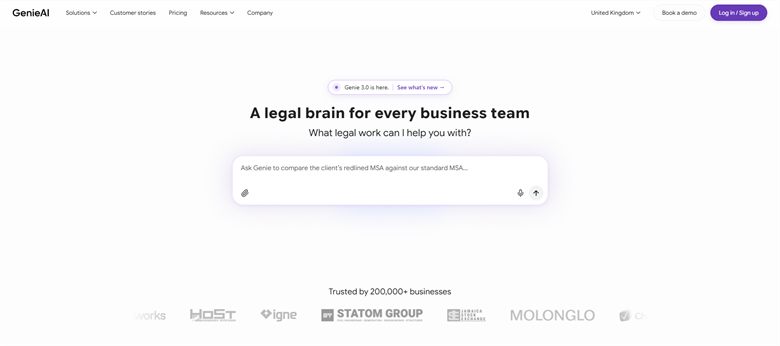
The verdict: SaaS agreements are usually reviewed by whoever wants the software, not by legal, and that person needs to know which four clauses to care about. Plain-language risk flags against positions your business has set fit that exactly, and the free tier means checking one costs nothing.
Pricing: Permanent free plan with no time limit. Pro $75 a month for one user, Business $320 a month for five, Enterprise from $600 a month with SSO, API access and an SLA.
Standout features:
- Risk rated red, amber or green per clause with a plain-language explanation
- Review against positions your legal team has set
- Organisational knowledge graph so a position held with one vendor carries to the next
- Microsoft Word add-in that preserves native track changes
- Free tier with no time limit
Limitations: No renewal tracking, so the auto-renewal it warned you about is then your calendar's problem. It reviews the agreement rather than the vendor, so security posture, uptime history and financial stability all sit outside it, and those decide as many SaaS purchases as the contract does.
2. LegalOn: Best for legal reviewing every SaaS agreement
8.5 out of 10 how this is calculated
The verdict: SaaS agreements are standardised enough that a curated library transfers well between them, which is exactly the case a rented position library is built for. Best review quality here, held back by publishing no price.
Pricing: No public list price, and we could not source a reliable reported figure. Sales-led and quoted on seat count and playbook scope.
Standout features:
- Pre-built position libraries covering SaaS and technology terms
- Suggested revisions with the reasoning attached
- Word integration for redlining
- Review against your own standards as well as theirs
Limitations: No published price and no reported figure we could stand behind, so it cannot be shortlisted without a sales process. It assumes a qualified reader, which does not match who usually reviews a SaaS contract.
3. Juro: Best for routing a constant stream of them
8.0 out of 10 how this is calculated
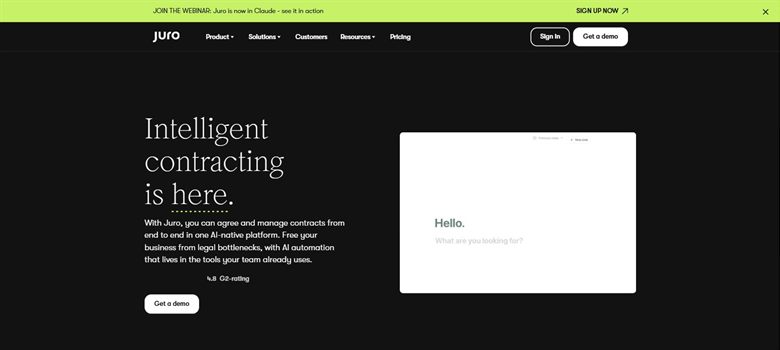
The verdict: Once every team is buying its own software, SaaS agreements arrive weekly and the problem becomes volume rather than difficulty. Routing standard ones through and escalating the rest is the right shape at that point.
Pricing: Sales-led with no public list price. Reported annual contracts run approximately $15,000 to $130,000, with marketplace medians around $31,000 to $34,500, priced on contract volume rather than per seat.
Standout features:
- Approval routing when terms depart from standard
- Templates for your own outbound agreements
- Native electronic signature
- Searchable repository with renewal dates
Limitations: It enforces the positions you set without assessing the clauses, so it manages flow rather than reading contracts. Priced on contract volume, and a small SaaS subscription counts the same as a major commercial agreement.
4. Evisort: Best for finding the SaaS contracts you already signed
7.3 out of 10 how this is calculated
The verdict: Most businesses cannot say how many SaaS subscriptions they are contractually committed to, because they were signed by different teams on different cards. This finds them and reads what they say.
Pricing: No public list price. Reported annual contracts run approximately $30,000 to $150,000. Now part of Workday following acquisition, so renewals may route differently than they did.
Standout features:
- Extraction across scattered and unstructured agreements
- Renewal and obligation identification without manual entry
- Reporting on terms across the estate
- Workflow and approvals alongside extraction
Limitations: It only reads documents it is given, so agreements that never reached a shared drive stay invisible, which is the usual state of small SaaS purchases. The Workday acquisition leaves pricing and roadmap open on a multi-year commitment.
5. Ironclad: Best for renewals and uplifts that slip through
6.7 out of 10 how this is calculated
The verdict: SaaS agreements cost money through automatic renewal at an uplifted price far more often than through a bad clause. This is the mainstream platform that tracks the notice windows.
Pricing: No public list price. Reported annual contracts run approximately $30,000 to $250,000, with a marketplace median near $40,000 across 363 recorded purchases.
Standout features:
- Renewal and obligation tracking with alerts
- Conditional approval routing by value and risk
- Repository and reporting across executed agreements
- Deep procurement and finance integrations
Limitations: Implementation runs to months, so the renewals coming up this quarter are unaffected. The reported median near $40,000 a year is more than many businesses spend on the SaaS it would be tracking.
6. Spellbook: Best for negotiating the enterprise ones
5.8 out of 10 how this is calculated
The verdict: Most SaaS agreements are not negotiated. The few that are, at enterprise scale, turn on liability caps and indemnities where knowing what comparable counterparties accepted is direct leverage.
Pricing: No published list price. Reported at approximately $99 to $199 per user a month, rising to around $350 per user on enterprise plans with a ten-seat minimum. A seven-day trial is offered.
Standout features:
- Drafting and redlining inside Microsoft Word
- Suggestions benchmarked against market standard
- Clause generation from a description
- Seven-day trial
Limitations: It assumes a qualified reader, so it does not help the person who actually receives most SaaS contracts. No repository and no renewal tracking, so it addresses the negotiation and nothing around it.
7. PandaDoc: Best for issuing your own SaaS agreement
5.2 out of 10 how this is calculated
The verdict: The only entry here for the other side of the table. If you are the SaaS vendor sending order forms and standard terms at volume, this does that job at a published $19 per user.
Pricing: Published at $19 per user a month, one of the few vendors in this market to state a list price at all.
Standout features:
- Template-driven order form and agreement generation
- Native electronic signature
- CRM integration with Salesforce and HubSpot
- Analytics on what the recipient opened
Limitations: No clause-level intelligence, so it sends what you put in the template without assessing it. As a review tool for incoming SaaS agreements it does nothing useful, and it is on this page for the sell side only.
How we chose
- Whether it identifies the few clauses worth negotiating rather than reporting on all forty equally.
- How it handles auto-renewal and price uplift, which is where SaaS agreements actually cost money.
- Whether data protection terms are surfaced, since most SaaS agreements carry a DPA behind them.
- Whether the person buying the software can act on the output, because that is usually who reviews it.
- Published price.
- We did not score on security certification checking. A vendor's certifications are a procurement question answered by asking for the certificate and its scope, not something a contract tool verifies from the agreement.
Frequently asked questions
What is the best AI tool for SaaS agreements in 2026?
GenieAI if whoever buys the software also reviews the contract, at a published free tier rising to $75 a month. LegalOn if legal reviews every one and wants the deepest positions. Evisort if the real problem is that nobody knows how many SaaS agreements the business has already signed.
Which clauses in a SaaS agreement actually matter?
Four, usually. The liability cap and what is carved out of it. Auto-renewal, its notice window and any uncapped price uplift. Data protection and security terms, including sub-processors. And the service level, specifically whether the remedy is worth anything or is a service credit you will never claim. Most of the rest is boilerplate nobody will move.
How much do these cost?
PandaDoc publishes $19 per user a month and GenieAI a free tier rising to $75. Spellbook is reported at $99 to $199 per user a month. Juro is reported from about $15,000 a year, Evisort and Ironclad from $30,000. LegalOn publishes nothing and no reliable figure could be sourced.
Is it worth negotiating a vendor's standard SaaS terms?
Below a certain contract value, usually not, and vendors know it. Above it, the terms worth spending effort on are the liability cap, the uplift mechanism and the data terms. Reviewing all forty clauses equally is how SaaS procurement becomes slow without becoming safer.
Who should review a SaaS agreement?
Whoever understands what the tool will actually do with your data, which is usually the person buying it rather than anyone in legal. That argues for a tool a non-lawyer can act on. Escalate anything with uncapped financial exposure, unusual data terms, or a vendor refusing your position twice.
How do we stop SaaS auto-renewals slipping past?
It is a tracking problem, not a review one, and no review tool solves it. Ironclad and Evisort extract and alert on renewal dates; Contractbook does it at small-team prices. This is the single most avoidable SaaS contract loss and it costs businesses more than bad clauses do.
Does a SaaS agreement always need a DPA?
If the vendor will process personal data on your behalf, yes, and most SaaS vendors will. It is usually a separate document incorporated by reference, which means it is easy to sign without reading. Our DPA guide covers the tools for that, and the schedules matter more than the clauses.