
7 Best Contract Tools for Finance Teams in 2026
Quick answer: Finance wants three things from contract software and most of the category supplies none of them: what are we committed to spend, what renews and when, and what do the terms mean for revenue recognition. Those are extraction and reporting problems, not workflow problems. Evisort and Luminance read the terms out of agreements nobody catalogued, and Luminance publishes roughly $41,340 a year. Icertis and Ironclad turn a renewal date into somebody's task with a deadline. A tool that speeds up drafting is answering a question finance did not ask.
Comparison
| Tool | Score | Best for | Price | Key strength |
|---|---|---|---|---|
| Evisort | 9.4 | establishing committed spend | Reported ~$30,000 to $150,000/yr | Reads terms nobody entered anywhere |
| Ironclad | 8.8 | renewals with an owner attached | Reported ~$30,000 to $250,000/yr | Turns a date into a task |
| Icertis | 8.0 | obligations tied to ERP data | No published price | Contract data alongside spend data |
| Luminance | 7.4 | a multilingual estate you can budget for | List ~$41,340/yr for 1,000 documents | The only published price here |
| LinkSquares | 6.6 | reporting as the entire requirement | No published price | Built for post-signature questions |
| Agiloft | 6.0 | the specific fields finance wants | No published price | Model the data you report on |
| Contractbook | 5.2 | smaller businesses, renewals only | Reported ~$39 to $599/mo | Only small-team price here |
Fit by buyer
Scored 1 to 5 for each buyer, where 5 means the tool was built for them and 1 means it is the wrong tool. Scope is different: it is how much of the job the tool does, from a single step to a whole lifecycle, and a low score there means narrow rather than bad. These ratings are the same for a tool wherever it appears; the score shown beside each entry is for this guide specifically. A tool can lead one column and come last in another, and the right answer still changes with who is asking. How we score.
| Tool | Lawyer in Word | In-house legal | Commercial team | Enterprise | Scope | Price |
|---|---|---|---|---|---|---|
| Evisort | 1 | 4 | 2 | 4 | 4 | Reported |
| Ironclad | 2 | 4 | 2 | 5 | 5 | Reported |
| Icertis | 1 | 3 | 1 | 5 | 5 | None |
| Luminance | 3 | 4 | 1 | 4 | 4 | Published |
| LinkSquares | 1 | 4 | 2 | 4 | 4 | None |
| Agiloft | 1 | 3 | 1 | 4 | 5 | None |
| Contractbook | 1 | 3 | 4 | 2 | 3 | Reported |
Which one, for your situation
| If this is your situation | Start with |
|---|---|
| You cannot say what the business is committed to spend | Evisort |
| Renewal dates need an owner and a deadline | Ironclad |
| Procurement obligations need tracking against ERP data | Icertis |
| A multilingual estate and a price you can budget | Luminance |
| Reporting on executed agreements is the whole requirement | LinkSquares |
| You want the fields finance needs, modelled to order | Agiloft |
| A smaller business where renewals are the only exposure | Contractbook |
The 7 best contract tools for finance teams
1. Evisort: Best for establishing committed spend
9.4 out of 10 how this is calculated

The verdict: The most direct answer to finance's first question. Extraction from the document text means agreements signed on cards, by departments, years ago are still readable, and that is where uncommitted commitments hide.
Pricing: No public list price. Reported annual contracts run approximately $30,000 to $150,000. Now part of Workday following acquisition, so renewals may route differently than they did.
Standout features:
- Extraction of payment terms, values and renewal dates
- Reporting across the whole agreement estate
- Obligation identification without manual entry
- Workflow and approvals alongside extraction
Limitations: It reports rather than routes, so a renewal it surfaces still needs an owner. Extraction degrades on older scanned documents, and the verification work lands on your team rather than the vendor's.
2. Ironclad: Best for renewals with an owner attached
8.8 out of 10 how this is calculated
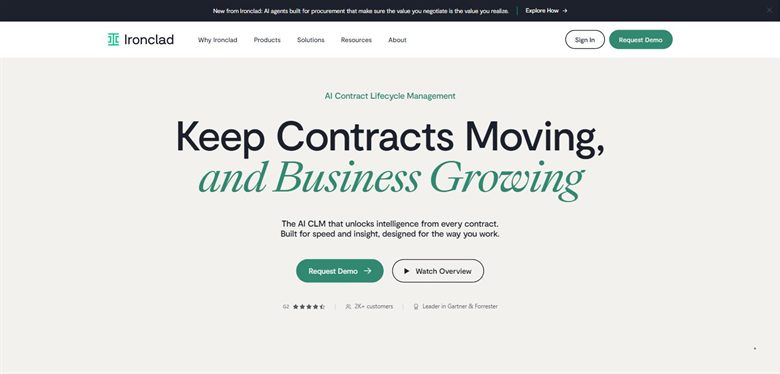
The verdict: Unnoticed auto-renewals are the most avoidable unbudgeted cost most businesses carry. This assigns the date to a person before the notice window closes, which is the step reporting alone never completes.
Pricing: No public list price. Reported annual contracts run approximately $30,000 to $250,000, with a marketplace median near $40,000 across 363 recorded purchases.
Standout features:
- Renewal and obligation tracking with alerts
- Owner assignment against each date
- Repository and reporting across executed agreements
- Finance and procurement system integrations
Limitations: Tracking leans on metadata captured when an agreement was created, so contracts predating the platform are much less visible, which is the opposite of what finance usually needs first. Implementation runs to months.
3. Icertis: Best for obligations tied to ERP data
8.0 out of 10 how this is calculated

The verdict: The strongest link between contract terms and financial systems. For a finance function that wants committed spend reconciled against actual spend, ERP integration is the capability that makes that possible.
Pricing: No published price and no reliable reported figure we could source. Enterprise sales-led, quoted on contract volume and module count. Widely understood to sit at the top of the market alongside Ironclad.
Standout features:
- Obligation tracking with owner assignment and status
- Deep ERP integration for spend and supplier records
- Compliance tracking against policy
- Multi-entity support for group structures
Limitations: Publishes nothing and no reliable reported figure could be sourced, which is a poor position to present to a finance function that will ask. It is a deployment measured in months with a dedicated internal owner.
4. Luminance: Best for a multilingual estate you can budget for
7.4 out of 10 how this is calculated
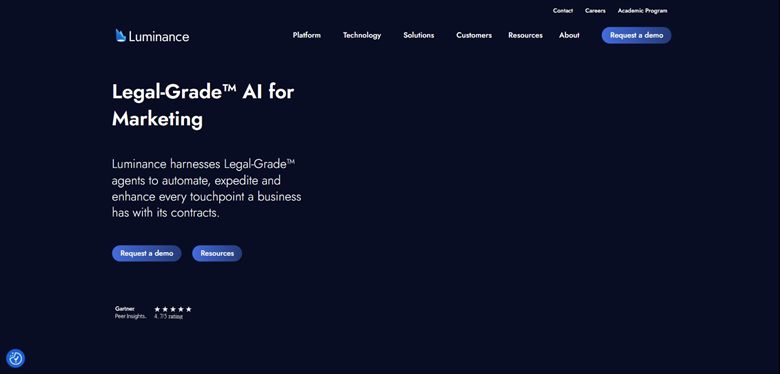
The verdict: Worth naming for the reason finance will appreciate more than most readers: it publishes a number. Unlimited users also means the finance team can have access without another licence conversation.
Pricing: Published list price of approximately $41,340 a year for 1,000 documents with unlimited users. Enterprise deployments are reported from around $25,000 a year depending on volume and modules.
Standout features:
- Analysis across the whole agreement estate
- Coverage across many languages and jurisdictions
- Anomaly detection against learned standards
- Unlimited users on the published tier
Limitations: Priced by document volume, so a high count of short agreements consumes the allowance quickly. It reads well and routes poorly, so a payment term it surfaces does not become anybody's task.
5. LinkSquares: Best for reporting as the entire requirement
6.6 out of 10 how this is calculated

The verdict: Purpose-built for answering questions about executed agreements, which is most of what finance asks legal for. Narrower than the platforms and correspondingly more focused on the job.
Pricing: No published price and no reliable reported figure we could source. Sales-led and quoted on contract volume.
Standout features:
- Analytics across executed agreements
- Clause and term extraction with alerting
- Renewal and obligation notifications
- Reporting on terms across the estate
Limitations: Publishes nothing and no reliable figure exists, which finance will notice. Very little before signature, and no ERP integration of the depth Icertis offers, so the contract data stays separate from the spend data.
6. Agiloft: Best for the specific fields finance wants
6.0 out of 10 how this is calculated
The verdict: Where a finance function goes when the fields it needs, revenue recognition triggers, payment milestones, currency terms, are not what a product ships by default.
Pricing: No published price and no reliable reported figure we could source. Quoted on users and modules, with configuration typically a separate cost.
Standout features:
- No-code configuration of the contract data model
- Conditional logic for complex payment structures
- Extensive permissions and audit trail
- Long track record in complex deployments
Limitations: Configuration is charged separately and usually exceeds the licence in year one, which is exactly the sort of split cost finance dislikes discovering late. Out-of-the-box extraction is weaker, so the fields you model still need populating.
7. Contractbook: Best for smaller businesses, renewals only
5.2 out of 10 how this is calculated
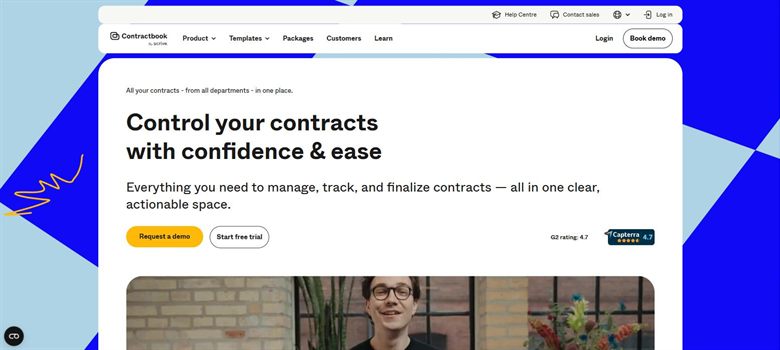
The verdict: For a finance team whose real exposure is a handful of auto-renewals nobody is watching. That is a tracking problem with a very cheap solution and it does not need a platform.
Pricing: No published rate card. Reported between approximately $39 and $599 a month depending on tier, which is the only genuinely small-team price in this category.
Standout features:
- Searchable repository of executed agreements
- Renewal and date reminders
- Data extraction from stored contracts
- Monthly pricing rather than annual contracts
Limitations: Extraction is shallow, so payment terms and values largely need entering by hand. No ERP integration and no reporting depth, so it flags dates rather than answering questions about the estate.
How we chose
- Whether it extracts committed spend and payment terms from executed agreements.
- Renewal and notice-period visibility, since an unnoticed auto-renewal is an unbudgeted cost.
- Whether findings reach an owner with a deadline rather than sitting in a report.
- Integration with finance and ERP systems, which decides whether the data is usable.
- Published price.
- We did not score on drafting or negotiation features. Finance does not draft contracts, and a tool ranked on them would be ranked on capability this reader will never use.
Frequently asked questions
What is the best contract tool for a finance team in 2026?
Evisort if you cannot say what the business is committed to spend, because it reads terms out of agreements nobody catalogued. Ironclad if renewal dates need an owner and a deadline. Icertis if contract data has to reconcile against ERP spend data.
Why does most contract software not help finance?
Because it is built around getting agreements signed, and finance's questions all begin after signature: what are we committed to, what renews, what do the terms mean for recognition. Drafting speed and approval routing, which is most of what the category sells, answer none of those.
How much do these cost?
Luminance publishes roughly $41,340 a year for 1,000 documents with unlimited users. Evisort and Ironclad are reported from around $30,000 a year and Contractbook from about $39 a month. Icertis, LinkSquares and Agiloft publish nothing and no reliable figures could be sourced.
What is the biggest avoidable cost in a contract estate?
Auto-renewal at an uplifted price that nobody noticed in time to serve notice. It is more common and more expensive than any badly negotiated clause, it is entirely a tracking failure, and a review tool of any quality will not prevent it.
Do these help with revenue recognition?
Only indirectly, by surfacing the terms that feed it: performance obligations, payment triggers, variable consideration. None of them performs the accounting judgement, and none should be presented as doing so. Agiloft can be configured to hold the fields your accounting team specifies, which is the closest any of these gets.
Can finance get access without buying its own licence?
Luminance's published tier includes unlimited users, which sidesteps the question. Most others price per seat or per user band, so finance access is a licence conversation. Worth raising during evaluation, because a report finance cannot open is not a report.
Do we need extraction or tracking?
Extraction answers what is in the contracts you already have. Tracking makes sure somebody acts before a date passes. Finance usually needs both and buys one, and the giveaway is whether your first question starts with what or with when.