
7 Best Contract Obligation Tracking Tools in 2026
Quick answer: This is a post-signature problem and most contract software is built for the pre-signature one. Icertis tracks obligations at the largest scale and is the reference implementation, though it publishes nothing. Evisort is the strongest at pulling commitments out of a legacy estate nobody has read, reported at $30,000 to $150,000 a year. LinkSquares comes at the same estate from the reporting side. Three of the seven here publish no price and have no reliable reported figure, which is the highest proportion of any category we cover.
Comparison
| Tool | Score | Best for | Price | Key strength |
|---|---|---|---|---|
| Icertis | 9.4 | obligation management at enterprise scale | No published price | Compliance tracking across the estate |
| Evisort | 8.7 | extracting obligations from a legacy estate | Reported ~$30,000 to $150,000/yr | Extraction at scale |
| LinkSquares | 7.9 | reporting on what you already signed | No published price | Post-signature analytics |
| Agiloft | 7.3 | obligations that do not fit a standard model | No published price | Configurability |
| Ironclad | 6.7 | obligations alongside an existing Ironclad rollout | Reported ~$30,000 to $250,000/yr | One system for before and after signature |
| Luminance | 6.1 | estates spanning languages and jurisdictions | List ~$41,340/yr for 1,000 documents | Publishes a price, which is rare here |
| Contractbook | 5.2 | small teams who mainly need renewal dates | Reported ~$39 to $599/mo | Only small-team price here |
Fit by buyer
Scored 1 to 5 for each buyer, where 5 means the tool was built for them and 1 means it is the wrong tool. Scope is different: it is how much of the job the tool does, from a single step to a whole lifecycle, and a low score there means narrow rather than bad. These ratings are the same for a tool wherever it appears; the score shown beside each entry is for this guide specifically. A tool can lead one column and come last in another, and the right answer still changes with who is asking. How we score.
| Tool | Lawyer in Word | In-house legal | Commercial team | Enterprise | Scope | Price |
|---|---|---|---|---|---|---|
| Icertis | 1 | 3 | 1 | 5 | 5 | None |
| Evisort | 1 | 4 | 2 | 4 | 4 | Reported |
| LinkSquares | 1 | 4 | 2 | 4 | 4 | None |
| Agiloft | 1 | 3 | 1 | 4 | 5 | None |
| Ironclad | 2 | 4 | 2 | 5 | 5 | Reported |
| Luminance | 3 | 4 | 1 | 4 | 4 | Published |
| Contractbook | 1 | 3 | 4 | 2 | 3 | Reported |
Which one, for your situation
| If this is your situation | Start with |
|---|---|
| You are tracking obligations across a large enterprise with procurement depth | Icertis |
| The problem is thousands of signed agreements nobody has read | Evisort |
| You need reporting on what your executed contracts commit you to | LinkSquares |
| Your obligations are unusual enough that configuration is the point | Agiloft |
| You already run Ironclad and want obligations in the same place | Ironclad |
| The estate spans languages and jurisdictions | Luminance |
| You are small and mainly need renewal dates not to slip | Contractbook |
The 7 best contract obligation tracking tools
1. Icertis: Best for obligation management at enterprise scale
9.4 out of 10 how this is calculated

The verdict: The reference implementation for this problem. Obligation and compliance tracking is a first-class part of the product rather than a report bolted onto a repository, which is what separates it from most of this list.
Pricing: No published price and no reliable reported figure we could source. Enterprise sales-led, quoted on contract volume and module count. Widely understood to sit at the top of the market alongside Ironclad.
Standout features:
- Obligation extraction with owner assignment and status
- Compliance tracking against regulatory and internal policy
- Deep ERP and procurement integration
- Multi-entity and multi-jurisdiction support
Limitations: No published price and nothing reliably reported, so the budget conversation starts blind. It is an enterprise deployment measured in months with a dedicated internal owner, which puts it out of reach for teams whose obligation problem is real but whose estate is a few hundred contracts.
2. Evisort: Best for extracting obligations from a legacy estate
8.7 out of 10 how this is calculated

The verdict: The answer when the obligations you are worried about are in contracts nobody has read since signing. It is built to make sense of a pile rather than to manage a process, which is the right shape for this problem.
Pricing: No public list price. Reported annual contracts run approximately $30,000 to $150,000. Now part of Workday following acquisition, so renewals may route differently than they did.
Standout features:
- Extraction across large and unstructured document sets
- Obligation and renewal identification without manual entry
- Reporting on terms across the whole estate
- Workflow and approvals alongside extraction
Limitations: Extraction accuracy degrades on older scanned documents, and the cleanup is real work that lands on your team rather than the vendor's. The Workday acquisition adds uncertainty about how it will be sold, priced and developed, which matters on a multi-year commitment.
3. LinkSquares: Best for reporting on what you already signed
7.9 out of 10 how this is calculated

The verdict: Approaches the estate from the reporting end rather than the workflow end, which suits a team being asked what are we committed to rather than one managing an approval queue.
Pricing: No published price and no reliable reported figure we could source. Sales-led and quoted on contract volume.
Standout features:
- Analytics across executed agreements
- Clause and term extraction with alerting
- Renewal and obligation notifications
- Drafting and workflow added later in its life
Limitations: No published pricing and nothing reliably reported. Its pre-signature workflow is weaker than the platforms it competes with, so buying it as a full contract system usually disappoints, and the alerting is only as good as the extraction underneath it.
4. Agiloft: Best for obligations that do not fit a standard model
7.3 out of 10 how this is calculated

The verdict: Where teams go when their obligations are specific enough that an opinionated product gets in the way. You are trading a working default for a configurable one, and configuration is work you are paying for twice.
Pricing: No published price and no reliable reported figure we could source. Quoted on users and modules, with configuration typically a separate cost.
Standout features:
- No-code configuration of the obligation data model
- Contract, procurement and sourcing modules
- Extensive permissions and audit trail
- Long track record in complex deployments
Limitations: Configuration is charged separately and is usually the larger half of the first-year cost, which the licence quote does not show. Teams expecting something faster to deploy than a full platform are routinely disappointed, and the flexibility is only worth paying for if your obligations genuinely are unusual.
5. Ironclad: Best for obligations alongside an existing Ironclad rollout
6.7 out of 10 how this is calculated
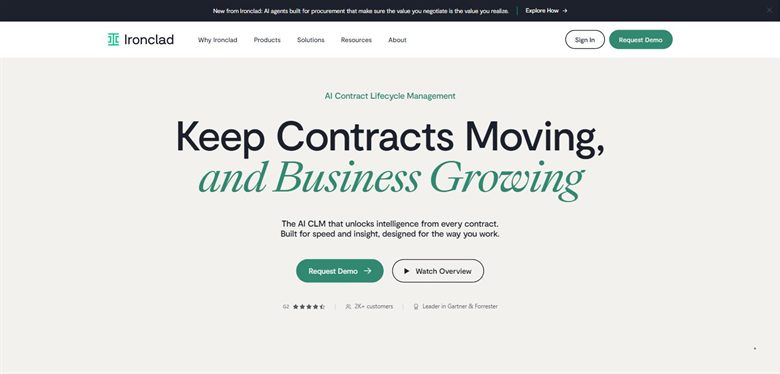
The verdict: Strong as a repository and workflow, lighter on obligations than the post-signature specialists above it. Worth choosing when you already run it, and rarely worth buying for obligation tracking alone.
Pricing: No public list price. Reported annual contracts run approximately $30,000 to $250,000, with a marketplace median near $40,000 across 363 recorded purchases.
Standout features:
- Repository with metadata and renewal tracking
- Reporting across executed agreements
- Conditional workflow and approval routing
- Deep Salesforce and procurement integration
Limitations: Obligation extraction is shallower than Evisort or Icertis, and much of what it tracks depends on metadata captured at signature rather than pulled from the document afterwards. That makes it weak precisely where the problem is hardest, which is the legacy estate signed before you bought it.
6. Luminance: Best for estates spanning languages and jurisdictions
6.1 out of 10 how this is calculated
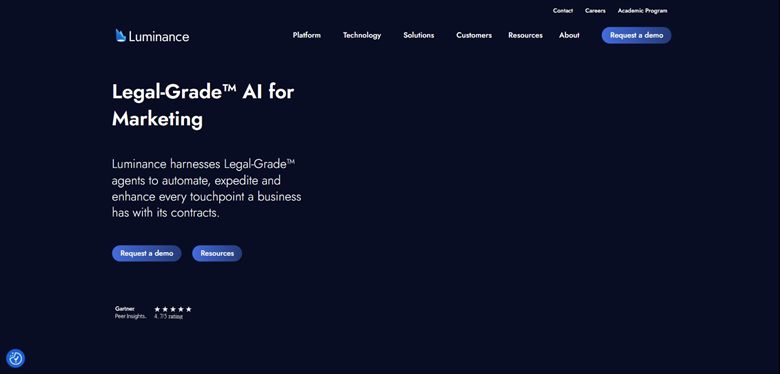
The verdict: The only tool on this page with a published list price, in a category where five of seven will not state one. Reads the estate rather than relying on what was keyed in, which is the right approach for obligations.
Pricing: Published list price of approximately $41,340 a year for 1,000 documents with unlimited users. Enterprise deployments are reported from around $25,000 a year depending on volume and modules.
Standout features:
- Extraction across many languages and jurisdictions
- Anomaly detection against the rest of the estate
- Unlimited users on the published tier
- Analysis of contracts signed long before purchase
Limitations: Priced by document volume, so an estate of many small contracts costs the same as one of a few large ones and the economics can work out badly. It is an analysis tool first, so the alerting and ownership assignment around an obligation are thinner than the dedicated platforms.
7. Contractbook: Best for small teams who mainly need renewal dates
5.2 out of 10 how this is calculated
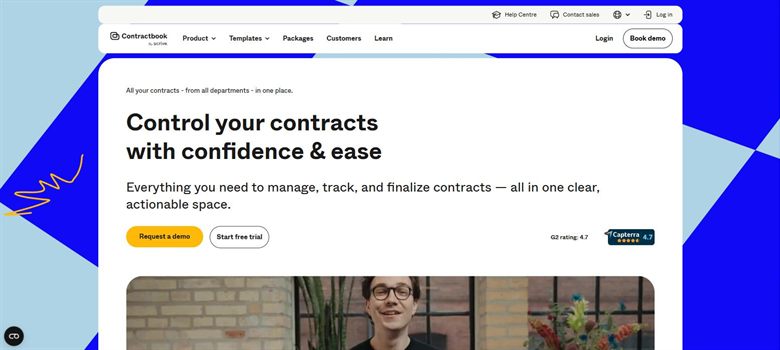
The verdict: The honest option when the obligation problem is really a renewal problem. A few hundred contracts and a calendar that nobody maintains does not need a six-figure platform.
Pricing: No published rate card. Reported between approximately $39 and $599 a month depending on tier, which is the only genuinely small-team price in this category.
Standout features:
- Data extraction with renewal reminders
- Searchable repository
- Template-driven creation alongside tracking
- Monthly pricing rather than annual contracts
Limitations: It tracks dates well and obligations poorly, so delivery commitments, reporting duties and payment milestones largely fall outside what it will surface. The tier spread from $39 to $599 is wide and undisclosed, which makes the cost of growth impossible to plan for.
How we chose
- Whether it finds obligations in contracts already signed, rather than only tracking ones entered by hand.
- Extraction accuracy on old and scanned documents, since that is where the estate actually lives.
- Whether the alert reaches the person who has to act, rather than the legal inbox.
- What counts as an obligation: renewals and expiries only, or delivery, reporting and payment terms too.
- Published price, which in this category is mostly absent.
- We did not score on the number of clause types a vendor claims to extract. Every vendor counts differently, and accuracy on your ten most important terms matters more than breadth across two hundred.
Frequently asked questions
What is the best contract obligation tracking tool in 2026?
Icertis at enterprise scale, where obligation management is a first-class part of the product. Evisort when the problem is a legacy estate nobody has read, reported at $30,000 to $150,000 a year. Contractbook for small teams whose real need is renewal dates, reported from around $39 a month.
What counts as a contract obligation?
Anything the contract commits either side to do or not do. Renewal and expiry dates are the ones everyone tracks, but the expensive misses are usually elsewhere: delivery milestones, service levels, reporting duties, audit rights, insurance maintenance and price review windows. Ask any vendor which of those it extracts, because the answers differ more than the marketing suggests.
How much does obligation tracking software cost?
Luminance publishes roughly $41,340 a year for 1,000 documents. Evisort and Ironclad are reported from about $30,000 a year and Contractbook from around $39 a month. Icertis, LinkSquares and Agiloft publish nothing and no reliable reported figure could be sourced for any of them.
Why do so few of these vendors publish a price?
Three of the seven here publish nothing and have no reliable reported figure, the highest proportion of any category we cover. The category is sold almost entirely to enterprises through procurement, where pricing is set on contract volume and module count and every deal is negotiated. That is an explanation rather than a defence, and it makes comparison genuinely difficult.
Can I track obligations without buying dedicated software?
For a few hundred contracts, a maintained spreadsheet and calendar reminders will do it, and the honest answer is that many teams should start there. The case for software arrives when nobody knows what is in the older agreements, because that is a reading problem at a scale humans do not solve, and it is what extraction is genuinely good at.
Will these tools work on contracts signed years ago?
That is the main reason to buy one, and it is also where they are weakest. Extraction quality falls on scanned documents, unusual formatting and anything predating a consistent template. Test on your oldest and worst documents during evaluation rather than the clean recent ones the vendor will suggest.
Is obligation tracking part of contract management software?
Usually as a feature rather than a focus. Most contract platforms are built around getting an agreement signed, and what happens afterwards is a repository with dates attached. If the obligations are your actual problem, the post-signature specialists here handle it better than a general platform will.