
7 Best AI Contract Negotiation Tools in 2026
Quick answer: Negotiation is a different purchase from review, and the difference is the playbook. Review tells you what a clause says. Negotiation tells you what to do about it, given positions your organisation has already agreed. Robin AI is built around that idea and is reported from about $500 a month. Juro handles the exchange with the counterparty and the approvals behind it. LegalOn is the strongest position library in the category, though it publishes no price at all. If your contracts are not negotiated and you just need them checked, our review guide is the cheaper answer.
Comparison
| Tool | Score | Best for | Price | Key strength |
|---|---|---|---|---|
| Robin AI | 9.2 | consistent positions across repeat agreements | From ~$500/mo | The playbook is the product |
| Juro | 8.7 | negotiation and approval in one place | Reported ~$15,000 to $130,000/yr | Counterparty exchange without email |
| LegalOn | 7.8 | the strongest position library | No published price | Depth of pre-built positions |
| Spellbook | 7.2 | negotiating where the other side works | Reported ~$99 to $199 per user/mo | Stays inside Microsoft Word |
| Ironclad | 6.7 | approval routing at scale | Reported ~$30,000 to $250,000/yr | Getting sign-off from the right people |
| GenieAI | 5.9 | commercial teams negotiating without waiting for legal | Free plan, then $75/mo; Enterprise from $600/mo | Plain-language risk flags on every clause |
| Luminance | 5.4 | negotiation across a large enterprise estate | List ~$41,340/yr for 1,000 documents | Publishes a list price at enterprise scale |
Fit by buyer
Scored 1 to 5 for each buyer, where 5 means the tool was built for them and 1 means it is the wrong tool. Scope is different: it is how much of the job the tool does, from a single step to a whole lifecycle, and a low score there means narrow rather than bad. These ratings are the same for a tool wherever it appears; the score shown beside each entry is for this guide specifically. A tool can lead one column and come last in another, and the right answer still changes with who is asking. How we score.
| Tool | Lawyer in Word | In-house legal | Commercial team | Enterprise | Scope | Price |
|---|---|---|---|---|---|---|
| Robin AI | 3 | 3 | 4 | 2 | 2 | Reported |
| Juro | 2 | 4 | 4 | 4 | 4 | Reported |
| LegalOn | 4 | 5 | 2 | 3 | 2 | None |
| Spellbook | 5 | 4 | 2 | 2 | 2 | Reported |
| Ironclad | 2 | 4 | 2 | 5 | 5 | Reported |
| GenieAI | 3 | 5 | 5 | 3 | 2 | Published |
| Luminance | 3 | 4 | 1 | 4 | 4 | Published |
Which one, for your situation
| If this is your situation | Start with |
|---|---|
| You negotiate the same agreement repeatedly and want consistent positions | Robin AI |
| The exchange and the approvals both need to live in one place | Juro |
| You want the strongest position library and can absorb an unpublished price | LegalOn |
| Negotiation happens in Word and you want it to stay there | Spellbook |
| Approval routing across a large organisation is the hard part | Ironclad |
| A commercial team negotiates without legal support | GenieAI |
| You are negotiating at volume across a large enterprise estate | Luminance |
The 7 best AI contract negotiation tools
1. Robin AI: Best for consistent positions across repeat agreements
9.2 out of 10 how this is calculated

The verdict: The clearest expression of what a negotiation tool should be. You define your positions once, and every subsequent negotiation applies them without a lawyer re-deciding the same question.
Pricing: Subscription tiered by features and volume, reported from around $500 a month for small teams, with enterprise pricing set on contract volume.
Standout features:
- Playbook of agreed positions with fallbacks
- Redlining against your standards rather than generic ones
- Word and browser workflows
- Human legal support available on higher tiers
Limitations: The playbook has to be built and maintained before the tool earns anything, and that build is where most deployments stall rather than in the software. At around $500 a month it sits above the per-seat tools while being thinner than the platforms on repository and reporting.
2. Juro: Best for negotiation and approval in one place
8.7 out of 10 how this is calculated
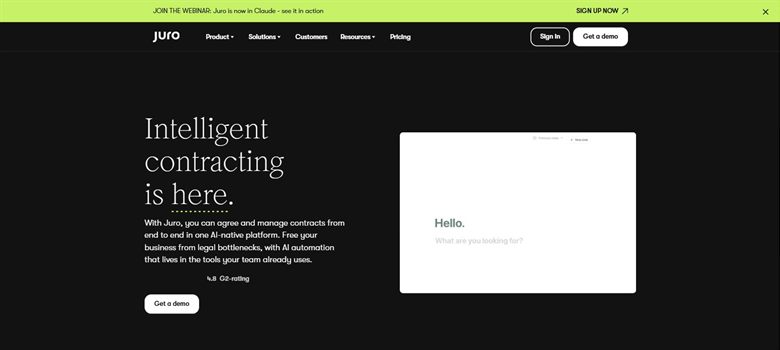
The verdict: Handles the part most tools ignore: the counterparty is a participant, not a file you receive. Negotiating in a shared browser document removes the version confusion that email attachments create.
Pricing: Sales-led with no public list price. Reported annual contracts run approximately $15,000 to $130,000, with marketplace medians around $31,000 to $34,500, priced on contract volume rather than per seat.
Standout features:
- Browser-based negotiation with the counterparty in the document
- Approval workflows usable by sales and operations
- Native electronic signature at the end of the thread
- Full audit trail of who changed what
Limitations: The shared-document model only works if the counterparty agrees to use it, and larger counterparties routinely refuse and send a Word file back. Priced on contract volume with no published figure, so the cost of growth cannot be modelled before a sales conversation.
3. LegalOn: Best for the strongest position library
7.8 out of 10 how this is calculated
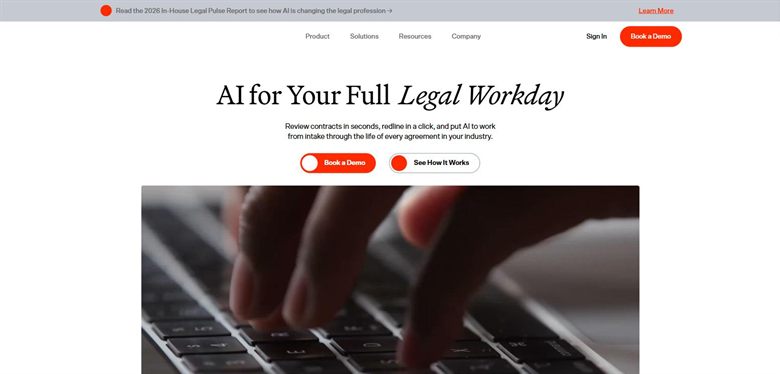
The verdict: Built by lawyers around what a reviewing lawyer actually decides, and it shows in the quality of the suggested positions. The absence of any published or reliably reported price is the reason it is not higher here.
Pricing: No public list price, and we could not source a reliable reported figure. Sales-led and quoted on seat count and playbook scope.
Standout features:
- Review against your standards with suggested revisions
- Pre-built position libraries by agreement type
- Word integration for redlining
- Explanations attached to each suggestion
Limitations: No published price and no reported figure we could stand behind, which makes budgeting impossible without entering a sales process. Coverage is strongest on common commercial agreements and thinner on anything bespoke, and it assumes a reader who can judge whether a suggested position is right for the deal.
4. Spellbook: Best for negotiating where the other side works
7.2 out of 10 how this is calculated
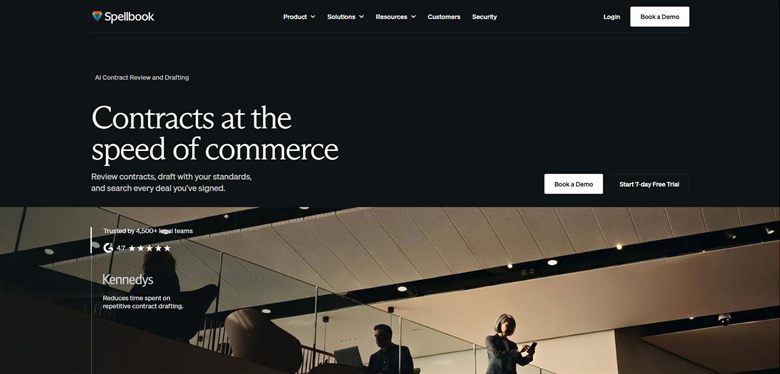
The verdict: Negotiation still happens in tracked changes in Word, whatever the platforms would prefer. Working in that file rather than importing and exporting it removes a step every round trip.
Pricing: No published list price. Reported at approximately $99 to $199 per user a month, rising to around $350 per user on enterprise plans with a ten-seat minimum. A seven-day trial is offered.
Standout features:
- Redline suggestions inside Microsoft Word
- Positions benchmarked against market standard
- Clause generation alongside review
- Seven-day trial
Limitations: It has no repository, no approval workflow and no counterparty portal, so it improves the drafting half of a negotiation and leaves the process half untouched. The ten-seat minimum on enterprise plans makes it awkward for the small teams the per-seat price otherwise suits.
5. Ironclad: Best for approval routing at scale
6.7 out of 10 how this is calculated
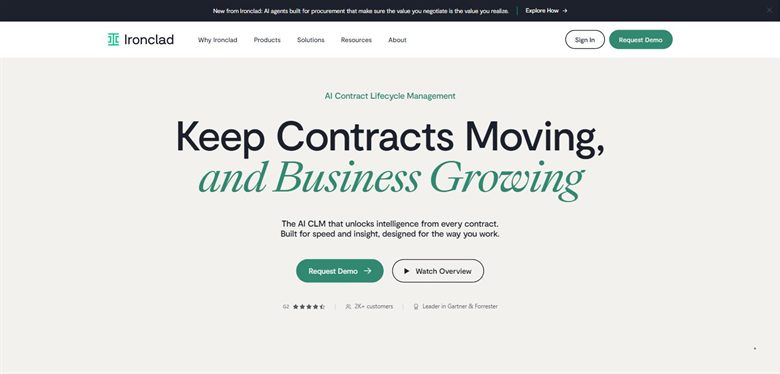
The verdict: In large organisations the negotiation is rarely with the counterparty. It is with finance, security and the deal desk, and this routes that better than anything else here.
Pricing: No public list price. Reported annual contracts run approximately $30,000 to $250,000, with a marketplace median near $40,000 across 363 recorded purchases.
Standout features:
- Conditional approval routing by value, risk and department
- Negotiation tracked against the approved position
- Full repository and reporting
- Deep integration with Salesforce and procurement systems
Limitations: Implementation runs to months and needs an internal owner, so the tool is unavailable for the period you most wanted it. The reported median near $40,000 a year is far above what a team buying purely for negotiation support would justify.
6. GenieAI: Best for commercial teams negotiating without waiting for legal
5.9 out of 10 how this is calculated
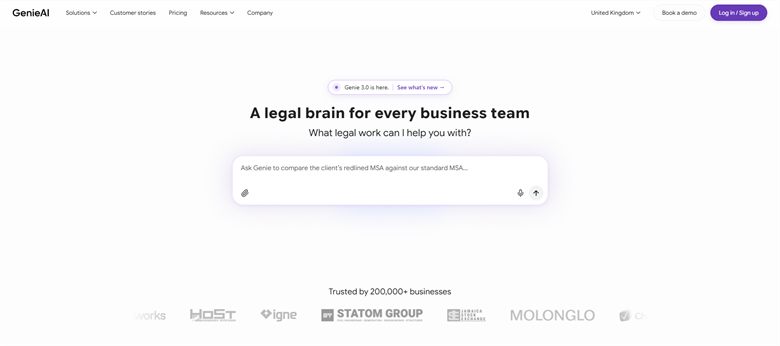
The verdict: Useful where the person negotiating is not a lawyer and needs to know which clauses are worth arguing about. Ranked here rather than higher because negotiation happens in Word and this does not.
Pricing: Permanent free plan with no time limit. Pro $75 a month for one user, Business $320 a month for five, Enterprise from $600 a month with SSO, API access and an SLA.
Standout features:
- Risk rated red, amber or green per clause
- Drafting, review and negotiation in one workspace
- Microsoft Word add-in that preserves native track changes
- Plain-language explanation of what a clause does
- Free tier with no time limit
Limitations: It is built for business teams executing against agreed standards rather than for a firm negotiating bespoke paper, so the further a negotiation departs from those positions the less it contributes. There is no approval routing, so it supports the negotiator rather than the process around them, and the positions have to be set before it is at full strength.
7. Luminance: Best for negotiation across a large enterprise estate
5.4 out of 10 how this is calculated
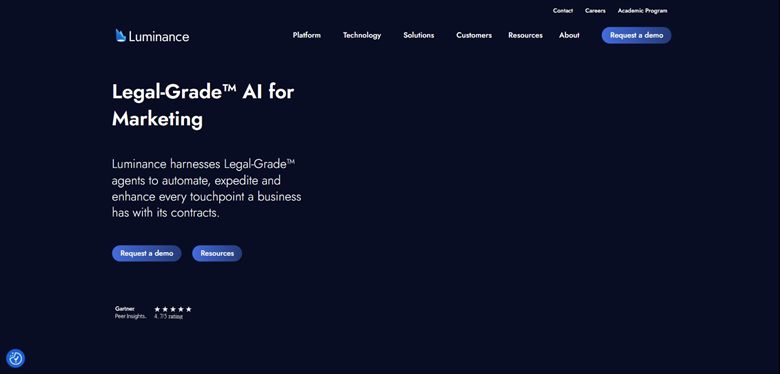
The verdict: One of the few enterprise vendors to publish anything, which alone is worth noting. The negotiation product works against the same model that reads the rest of the estate, so positions are informed by what you have already signed.
Pricing: Published list price of approximately $41,340 a year for 1,000 documents with unlimited users. Enterprise deployments are reported from around $25,000 a year depending on volume and modules.
Standout features:
- Negotiation informed by the whole contract estate
- Automated redlining against learned standards
- Unlimited users on the published tier
- Coverage across many languages and jurisdictions
Limitations: Priced by document volume rather than seats, so a team negotiating a small number of large agreements pays for capacity it will not use. The published figure of roughly $41,340 a year puts it beyond most in-house teams, and it expects an estate large enough for the model to learn from.
How we chose
- Whether the tool holds a playbook: your agreed positions, fallbacks and walk-away points.
- What happens when the counterparty responds, since negotiation is a loop rather than a single pass.
- Who is allowed to negotiate without escalating, which is the actual bottleneck in most teams.
- Whether redlines survive the round trip to Microsoft Word, where the other side almost certainly works.
- Published price, and whether the playbook build is included or charged separately.
- We did not score on the size of any vendor's clause database. A position library that is not yours is a starting point, and every serious deployment replaces it.
Frequently asked questions
What is the best AI contract negotiation tool in 2026?
Robin AI if you negotiate the same agreements repeatedly and want consistent positions, reported from about $500 a month. Juro if the exchange and the approvals need to sit together. LegalOn has the strongest position library but publishes no price. The right answer depends on whether your bottleneck is deciding the position or getting it approved.
What is the difference between contract review and contract negotiation software?
Review reads a contract and tells you what is in it. Negotiation applies your organisation's agreed positions and tells you what to change, then manages the exchange with the other side. A review tool answers what does this clause say. A negotiation tool answers what do we do about it, and who has to approve that.
How much do contract negotiation tools cost?
Robin AI is reported from around $500 a month and Spellbook at $99 to $199 per user a month. GenieAI publishes a free plan rising to $75. At the platform end, Juro is reported from about $15,000 a year and Ironclad from $30,000. LegalOn publishes nothing and no reliable figure could be sourced.
What is a contract playbook and do I need one?
A record of your agreed positions on each common clause, including what you will accept, what you will trade and where you stop. It is what turns negotiation from a series of individual judgements into a repeatable process. If more than one person negotiates on your behalf, you need one whether or not you buy software to hold it.
Will these tools work if the counterparty uses Word?
Spellbook works inside Word directly and is the safest choice on that basis. The browser-based platforms export to Word and re-import the response, which usually works but can lose comment threads and complex formatting. Test that round trip with a real counterparty document before committing, because it is the step that breaks most often.
Can a commercial team negotiate without legal involvement?
For standard agreements inside a defined playbook, that is the point of the category and it works. The risk is the clause the playbook did not anticipate, where a confident suggestion is worse than no suggestion. Tools that flag uncertainty rather than presenting every position with equal confidence handle that better.
Is there a free contract negotiation tool?
GenieAI runs a permanent free plan with no time limit, which covers risk flagging and drafting though not playbook management. Spellbook offers a seven-day trial. Nothing else here has a free tier, and the playbook-driven tools in particular are sold on annual contracts.