
7 Best AI Tools for Construction Contracts in 2026
Quick answer: Construction contracts break the pattern most legal AI is built for. They sit on standard forms with schedules of amendments, they change constantly through variations, and the terms that cost money are notice periods and payment mechanisms rather than clauses argued at signature. So the useful split is between tools that read amendments against a base form and tools that track what happens over a multi-year project. GenieAI handles the first for a commercial team at a published free tier rising to $75 a month. Icertis and Ironclad handle the second. Nothing here understands a standard form as a standard form, which is the gap worth knowing about.
Comparison
| Tool | Score | Best for | Price | Key strength |
|---|---|---|---|---|
| GenieAI | 9.3 | commercial staff reviewing without legal | Free plan, then $75/mo; Enterprise from $600/mo | Plain-language risk for a non-lawyer |
| Icertis | 8.7 | a large construction supply chain | No published price | Obligations with named owners |
| Ironclad | 8.1 | obligations across long projects | Reported ~$30,000 to $250,000/yr | Tracking dates that expire |
| Evisort | 7.3 | reading a project portfolio nobody has summarised | Reported ~$30,000 to $150,000/yr | Extraction across scanned site documents |
| Spellbook | 6.5 | a lawyer marking up amendment schedules | Reported ~$99 to $199 per user/mo | Word-native, where schedules live |
| Robin AI | 5.8 | consistency across many subcontracts | From ~$500/mo | One position across every package |
| Contractbook | 5.2 | smaller contractors needing dates | Reported ~$39 to $599/mo | Only small-team price here |
Fit by buyer
Scored 1 to 5 for each buyer, where 5 means the tool was built for them and 1 means it is the wrong tool. Scope is different: it is how much of the job the tool does, from a single step to a whole lifecycle, and a low score there means narrow rather than bad. These ratings are the same for a tool wherever it appears; the score shown beside each entry is for this guide specifically. A tool can lead one column and come last in another, and the right answer still changes with who is asking. How we score.
| Tool | Lawyer in Word | In-house legal | Commercial team | Enterprise | Scope | Price |
|---|---|---|---|---|---|---|
| GenieAI | 3 | 5 | 5 | 3 | 2 | Published |
| Icertis | 1 | 3 | 1 | 5 | 5 | None |
| Ironclad | 2 | 4 | 2 | 5 | 5 | Reported |
| Evisort | 1 | 4 | 2 | 4 | 4 | Reported |
| Spellbook | 5 | 4 | 2 | 2 | 2 | Reported |
| Robin AI | 3 | 3 | 4 | 2 | 2 | Reported |
| Contractbook | 1 | 3 | 4 | 2 | 3 | Reported |
Which one, for your situation
| If this is your situation | Start with |
|---|---|
| Commercial staff review subcontracts without legal | GenieAI |
| Procurement runs a large supply chain | Icertis |
| Obligations and notice dates across long projects | Ironclad |
| You cannot say what your existing project contracts committed you to | Evisort |
| A lawyer marks up amendment schedules in Word | Spellbook |
| Consistent positions across many subcontracts | Robin AI |
| A smaller contractor needing storage and dates | Contractbook |
The 7 best AI tools for construction contracts
1. GenieAI: Best for commercial staff reviewing without legal
9.3 out of 10 how this is calculated
The verdict: Construction contracts are reviewed by quantity surveyors, commercial managers and project directors far more often than by lawyers, and that reader needs to know which amendments in a schedule actually shift risk. Plain-language flags against positions the business has agreed fit that.
Pricing: Permanent free plan with no time limit. Pro $75 a month for one user, Business $320 a month for five, Enterprise from $600 a month with SSO, API access and an SLA.
Standout features:
- Risk rated red, amber or green per clause with plain-language explanation
- Review against positions your legal team has set
- Organisational knowledge graph so a position held on one subcontract carries to the next
- Microsoft Word add-in that preserves native track changes
- Free tier with no time limit
Limitations: It reads the document rather than the project, so the notice periods and time bars it flags are then somebody's calendar problem: no repository, no reminders and no signature. It is built for a business contracting regularly rather than for a practice running adjudications, so work that turns on citable authority belongs with a research tool.
2. Icertis: Best for a large construction supply chain
8.7 out of 10 how this is calculated

The verdict: Construction is a procurement business more than most, with hundreds of subcontractors and suppliers per project. This is the platform built for that direction of travel rather than adapted to it.
Pricing: No published price and no reliable reported figure we could source. Enterprise sales-led, quoted on contract volume and module count. Widely understood to sit at the top of the market alongside Ironclad.
Standout features:
- Procurement and sourcing contract management
- Obligation tracking with owner assignment and status
- Deep ERP integration for project and cost systems
- Multi-entity support for joint ventures and SPVs
Limitations: No published price and no reported figure we could source, and it is a deployment measured in months with a dedicated owner. Clause-level reading is shallower than the review tools, so it governs contracts better than it interprets them.
3. Ironclad: Best for obligations across long projects
8.1 out of 10 how this is calculated
The verdict: The mainstream platform for the part of construction contracting that costs money, which is not the negotiation but the notice you failed to serve within twenty-eight days on a contract signed three years ago.
Pricing: No public list price. Reported annual contracts run approximately $30,000 to $250,000, with a marketplace median near $40,000 across 363 recorded purchases.
Standout features:
- Obligation and renewal tracking with alerts
- Conditional approval routing by value and risk
- Repository linking main contracts to subcontracts
- Finance and procurement integrations
Limitations: Obligation tracking depends heavily on what was captured when a contract was created, so a project portfolio predating the platform is much less visible. Implementation runs to months, which on a live project is a long time.
4. Evisort: Best for reading a project portfolio nobody has summarised
7.3 out of 10 how this is calculated
The verdict: Construction estates are unusually messy: signed on site, scanned, filed by project rather than by counterparty. Extraction that works on that is worth more here than in most industries.
Pricing: No public list price. Reported annual contracts run approximately $30,000 to $150,000. Now part of Workday following acquisition, so renewals may route differently than they did.
Standout features:
- Extraction across large and unstructured document sets
- Obligation and notice date identification without manual entry
- Reporting on terms across a project portfolio
- Workflow and approvals alongside extraction
Limitations: Extraction quality falls on poorly scanned documents, which construction produces more of than most sectors, so the cleanup is real. The Workday acquisition leaves pricing and roadmap less settled on a long commitment.
5. Spellbook: Best for a lawyer marking up amendment schedules
6.5 out of 10 how this is calculated
The verdict: Amendment schedules are negotiated in Word with tracked changes, and this works in that file rather than importing it. For the in-house lawyer or external adviser doing the markup, that removes a step per round.
Pricing: No published list price. Reported at approximately $99 to $199 per user a month, rising to around $350 per user on enterprise plans with a ten-seat minimum. A seven-day trial is offered.
Standout features:
- Drafting and redlining inside Microsoft Word
- Suggestions benchmarked against market standard
- Same-day setup with no implementation
- Seven-day trial
Limitations: It assumes a qualified reader, so the commercial manager who actually handles most subcontracts cannot use it unaided. Market benchmarking is thinner on construction terms than on general commercial ones, since these agreements are less standardised across parties.
6. Robin AI: Best for consistency across many subcontracts
5.8 out of 10 how this is calculated

The verdict: A main contractor issuing dozens of subcontract packages per project has exactly the drift problem a playbook solves. Different commercial managers accept different amendments and nobody compares them until a claim.
Pricing: Subscription tiered by features and volume, reported from around $500 a month for small teams, with enterprise pricing set on contract volume.
Standout features:
- Playbook of agreed positions with fallbacks
- Redlining against your standards rather than generic ones
- Word and browser workflows
- Human legal support available on higher tiers
Limitations: The playbook has to be written first, and construction positions vary by project and by form, which makes that exercise larger than in a business with one standard agreement. No obligation tracking after signature.
7. Contractbook: Best for smaller contractors needing dates
5.2 out of 10 how this is calculated
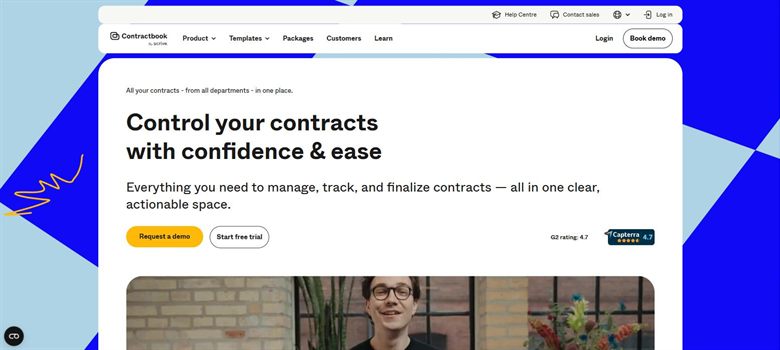
The verdict: For a subcontractor or smaller main contractor whose real exposure is a signed agreement nobody can find and a date nobody diarised. That is a filing problem and it is cheap to solve.
Pricing: No published rate card. Reported between approximately $39 and $599 a month depending on tier, which is the only genuinely small-team price in this category.
Standout features:
- Searchable repository of executed agreements
- Date and renewal reminders
- Template-driven creation with signing
- Monthly pricing rather than annual contracts
Limitations: No understanding of construction terms at all, so an unusual amendment schedule is a document you are reading yourself. No project structure, so contracts sit as a flat list rather than under the job they belong to.
How we chose
- How it handles amendments to a standard form, since that is how these contracts are actually written.
- Whether it tracks obligations across a project lifetime rather than to signature.
- Notice periods and time bars, which are where construction claims are won and lost.
- Whether site and commercial staff can act on the output, because legal is rarely in the room.
- Published price.
- We did not score on standard-form awareness. No tool here treats JCT, NEC or FIDIC as a known base with known amendments, so scoring it would be scoring an absence.
Frequently asked questions
What is the best AI tool for construction contracts in 2026?
GenieAI if commercial staff review subcontracts without legal, at a published free tier rising to $75 a month. Icertis if procurement runs a large supply chain. Ironclad for tracking obligations and notice dates across long projects, at a reported median near $40,000 a year.
Do any of these understand JCT, NEC or FIDIC?
Not as standard forms with known baselines, which is the honest answer and the biggest gap in this category. They read an amended form as text rather than as a set of departures from a known base, so a schedule of amendments is assessed on its wording rather than against what the unamended clause said.
What actually costs money in a construction contract?
Rarely the clause argued at signature. It is the notice period nobody served within the time bar, the variation instructed without confirmation, and the payment mechanism that made an application invalid. Those are tracking problems across a project rather than review problems at the start.
How much do these cost?
GenieAI publishes a free tier rising to $75 a month and Contractbook is reported from around $39. Spellbook is reported at $99 to $199 per user and Robin AI from about $500 a month. Ironclad and Evisort are reported from around $30,000 a year. Icertis publishes nothing.
Who should review subcontracts?
In most contractors, the commercial manager or quantity surveyor rather than a lawyer, which argues for a tool a non-lawyer can act on. Escalate anything changing the payment mechanism, anything shortening a notice period, and any amendment to the liability or programme provisions.
Can these track notice periods and time bars?
Ironclad, Icertis and Evisort can, once the dates are extracted or entered, and that is genuinely where the value is in this sector. Review tools will flag that a notice period is short; none of them will tell you it expires on Thursday. Those are different purchases and construction businesses need the second more than they expect.
Does joint venture structure matter for tool choice?
It does at scale, and it is easy to overlook. Projects run through SPVs and joint ventures mean contracts sit under entities rather than under one company, and only Icertis and Ironclad handle multi-entity structures properly. A flat repository makes reporting across a JV portfolio much harder than it needs to be.