
7 Best AI Tools for Master Service Agreements in 2026
Quick answer: An MSA is the hardest routine contract most businesses sign: sixty pages, internal cross-references, statements of work that inherit from it, and terms that bind for years after whoever negotiated it has left. That makes consistency worth more than speed. LegalOn and GenieAI lead on getting the same positions into every MSA, the first with a lawyer-authored library and the second with your own at a published price. Robin AI is the answer when several people negotiate MSAs and give different answers. Luminance is the answer when the question is what your existing MSAs already committed you to.
Comparison
| Tool | Score | Best for | Price | Key strength |
|---|---|---|---|---|
| LegalOn | 9.1 | a lawyer-authored library for every MSA | No published price | Depth on long negotiated agreements |
| GenieAI | 8.6 | your own positions applied consistently | Free plan, then $75/mo; Enterprise from $600/mo | Positions that persist across agreements |
| Robin AI | 7.9 | several negotiators, one position | From ~$500/mo | The playbook is the product |
| Spellbook | 7.2 | a lawyer negotiating in Word | Reported ~$99 to $199 per user/mo | Market-standard benchmarking |
| Luminance | 6.7 | what your existing MSAs already committed you to | List ~$41,340/yr for 1,000 documents | Reads the whole estate at once |
| Ironclad | 6.1 | MSAs needing multiple approvers | Reported ~$30,000 to $250,000/yr | Routing and post-signature tracking |
| Juro | 5.3 | issuing MSAs from a template legal owns | Reported ~$15,000 to $130,000/yr | Commercial teams can run it |
Fit by buyer
Scored 1 to 5 for each buyer, where 5 means the tool was built for them and 1 means it is the wrong tool. Scope is different: it is how much of the job the tool does, from a single step to a whole lifecycle, and a low score there means narrow rather than bad. These ratings are the same for a tool wherever it appears; the score shown beside each entry is for this guide specifically. A tool can lead one column and come last in another, and the right answer still changes with who is asking. How we score.
| Tool | Lawyer in Word | In-house legal | Commercial team | Enterprise | Scope | Price |
|---|---|---|---|---|---|---|
| LegalOn | 4 | 5 | 2 | 3 | 2 | None |
| GenieAI | 3 | 5 | 5 | 3 | 2 | Published |
| Robin AI | 3 | 3 | 4 | 2 | 2 | Reported |
| Spellbook | 5 | 4 | 2 | 2 | 2 | Reported |
| Luminance | 3 | 4 | 1 | 4 | 4 | Published |
| Ironclad | 2 | 4 | 2 | 5 | 5 | Reported |
| Juro | 2 | 4 | 4 | 4 | 4 | Reported |
Which one, for your situation
| If this is your situation | Start with |
|---|---|
| You want a lawyer-authored position library for every MSA | LegalOn |
| You want your own agreed positions applied consistently | GenieAI |
| Several people negotiate MSAs and answer differently | Robin AI |
| A qualified lawyer negotiates them in Word | Spellbook |
| You need to know what your existing MSAs committed you to | Luminance |
| The MSA has to route through several approvers | Ironclad |
| Commercial teams issue MSAs from a template legal owns | Juro |
The 7 best AI tools for master service agreements
1. LegalOn: Best for a lawyer-authored library for every MSA
9.1 out of 10 how this is calculated
The verdict: MSAs are exactly the agreement type a curated position library was built for: long, common in shape, and negotiated on a predictable set of clauses. This is the strongest review quality here and the reason it tops a page it does not top elsewhere.
Pricing: No public list price, and we could not source a reliable reported figure. Sales-led and quoted on seat count and playbook scope.
Standout features:
- Pre-built position libraries covering MSA clause types
- Suggested revisions with the reasoning attached
- Word integration for redlining
- Review against your own standards as well as theirs
Limitations: No published price and no reported figure we could stand behind, so it cannot be shortlisted without a sales process. It assumes a qualified reader, and it reviews the document in front of it rather than tracking what your other MSAs already say.
2. GenieAI: Best for your own positions applied consistently
8.6 out of 10 how this is calculated
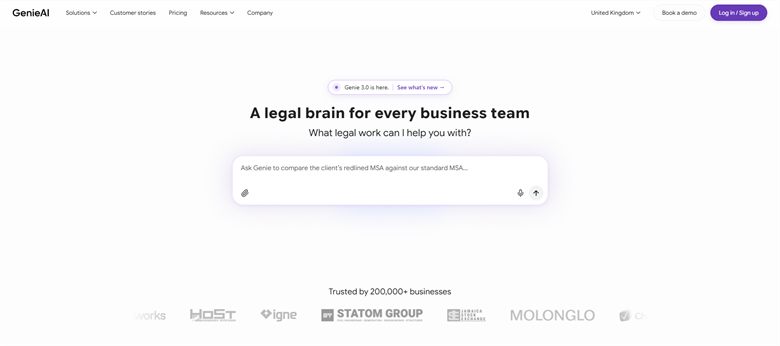
The verdict: The strongest option when the MSA positions that matter are specific to your business rather than generic, which in project-based industries they usually are. The knowledge graph means a position agreed on one MSA is available on the next rather than being re-argued.
Pricing: Permanent free plan with no time limit. Pro $75 a month for one user, Business $320 a month for five, Enterprise from $600 a month with SSO, API access and an SLA.
Standout features:
- Review and redlining against your organisation's own playbook
- Organisational knowledge graph that surfaces prior positions into each negotiation
- Risk rated red, amber or green per clause
- Microsoft Word add-in that preserves native track changes
- Free tier with no time limit
Limitations: It works against standards somebody has set, so the first MSA gets generic help until your positions are recorded. There is no approval routing, so an MSA needing sign-off from finance and security still moves by email, and no obligation tracking once it is signed.
3. Robin AI: Best for several negotiators, one position
7.9 out of 10 how this is calculated

The verdict: MSAs are where inconsistency across negotiators becomes expensive, because the terms bind for years and nobody revisits them. Encoding the fallback positions once is worth more here than on any shorter agreement.
Pricing: Subscription tiered by features and volume, reported from around $500 a month for small teams, with enterprise pricing set on contract volume.
Standout features:
- Playbook of agreed positions with fallbacks and walk-away points
- Redlining against your standards rather than generic ones
- Word and browser workflows
- Human legal support available on higher tiers
Limitations: The playbook has to be built before anything works, and for MSAs that is a substantial exercise because the clause set is long. At around $500 a month it costs more than the per-seat tools while doing less on storage and reporting.
4. Spellbook: Best for a lawyer negotiating in Word
7.2 out of 10 how this is calculated
The verdict: Useful on MSAs specifically because knowing what counterparties typically accept is worth a lot when you are deciding whether to hold a line on liability caps or indemnities across a multi-year commitment.
Pricing: No published list price. Reported at approximately $99 to $199 per user a month, rising to around $350 per user on enterprise plans with a ten-seat minimum. A seven-day trial is offered.
Standout features:
- Drafting and redlining inside Microsoft Word
- Suggestions benchmarked against market standard
- Clause generation from a description
- Seven-day trial
Limitations: It reads the document in front of it, so it will not notice that this MSA contradicts the position you took on the last one. No repository and no playbook, so consistency across agreements is still your problem.
5. Luminance: Best for what your existing MSAs already committed you to
6.7 out of 10 how this is calculated
The verdict: Answers the question that keeps people awake about MSAs, which is not the one being signed but the forty already in force with terms nobody remembers agreeing. It is also the only tool here at this tier to publish a price.
Pricing: Published list price of approximately $41,340 a year for 1,000 documents with unlimited users. Enterprise deployments are reported from around $25,000 a year depending on volume and modules.
Standout features:
- Analysis across every MSA already signed
- Anomaly detection against learned standards
- Unlimited users on the published tier
- Coverage across many languages and jurisdictions
Limitations: It reads what you have rather than helping with what you are negotiating, so it complements a review tool rather than replacing one. Priced by document volume, which suits a wide estate and penalises a business with a small number of very long agreements.
6. Ironclad: Best for MSAs needing multiple approvers
6.1 out of 10 how this is calculated
The verdict: An MSA usually needs more than legal to approve it, and it creates obligations that outlive the deal team. This is the only tool here that handles both ends properly.
Pricing: No public list price. Reported annual contracts run approximately $30,000 to $250,000, with a marketplace median near $40,000 across 363 recorded purchases.
Standout features:
- Conditional approval routing by value, risk and department
- Obligation and renewal tracking after signature
- Repository linking MSAs to their statements of work
- Deep Salesforce and procurement integration
Limitations: Implementation runs to months, so the MSA on your desk today is unaffected. Its clause-level review is shallower than the dedicated review tools, which means it manages the process around the document better than it reads the document.
7. Juro: Best for issuing MSAs from a template legal owns
5.3 out of 10 how this is calculated
The verdict: Works where you are the one issuing the MSA and want it out of legal's hands. Less useful when you are receiving the counterparty's paper, which for MSAs is at least half the time.
Pricing: Sales-led with no public list price. Reported annual contracts run approximately $15,000 to $130,000, with marketplace medians around $31,000 to $34,500, priced on contract volume rather than per seat.
Standout features:
- Guided creation from templates legal controls
- Approval routing when terms depart from standard
- Native electronic signature
- Repository linking agreements to their schedules
Limitations: The browser-native model works poorly for MSAs specifically, because they are long, heavily marked up and the counterparty usually insists on Word. Priced on contract volume with no published figure.
How we chose
- Whether the tool holds a position across a long document, since the same term appears in several places in an MSA and they have to agree.
- Whether it handles the relationship between the MSA and the statements of work that inherit from it.
- Consistency across MSAs, which matters more than any single negotiation because these bind for years.
- Whether the counterparty round trip works, because an MSA is negotiated in Word by people on both sides.
- Published price, and whether it scales by seat or by contract volume.
- We did not score on turnaround-time claims. Every vendor quotes a percentage saved and none publishes the baseline, so the numbers are not comparable and we do not repeat them.
Frequently asked questions
What is the best AI tool for master service agreements in 2026?
LegalOn for the deepest lawyer-authored positions, though it publishes no price. GenieAI for applying your own positions consistently, at a published free tier rising to $75 a month. Robin AI when several people negotiate MSAs and give different answers to the same clause.
What makes an MSA harder than a normal contract?
Length, internal cross-references, and the statements of work that inherit from it. The same term often appears in several places and has to agree in all of them, and the agreement binds for years after the person who negotiated it has moved on. Consistency matters more than speed, which is the opposite of most contract advice.
How much do these cost?
GenieAI publishes a free tier rising to $75 a month and Luminance roughly $41,340 a year for 1,000 documents. Spellbook is reported at $99 to $199 per user a month and Robin AI from around $500. Juro is reported from about $15,000 a year and Ironclad from $30,000. LegalOn publishes nothing.
Which clauses should we always check in an MSA?
Liability caps and their carve-outs, indemnities, termination for convenience and its notice period, IP ownership on anything created under a statement of work, and the order of precedence between the MSA and the SOWs. That last one is the most commonly overlooked and the most likely to cause an argument later.
Do these tools understand the link between an MSA and its SOWs?
The platforms do, in the sense of storing them together and inheriting metadata. The review tools mostly do not, and read each document on its own. If a term in an SOW contradicts the MSA it hangs off, no tool here will reliably tell you, which remains a human check.
Should we use our MSA or the counterparty's paper?
Yours if you can, because the drafting party sets the defaults and most negotiations move less far than either side expects. When you cannot, the tools that help are the ones holding your positions rather than the ones that draft well, because you are now reacting rather than writing.
How do we stop MSA positions drifting between deals?
Record the positions somewhere the tool enforces rather than in a document people are meant to consult. That is the difference between a playbook tool such as Robin AI or a standards-based tool such as GenieAI, and a review tool that reads whatever is in front of it. Drift is what costs money on multi-year agreements and it is invisible until you look across them.