
7 Best Clause Library and Contract Knowledge Tools in 2026
Quick answer: Ask any vendor which of three things they mean. A rented library is the vendor's positions, written by their lawyers, useful on day one and never quite yours: LegalOn is the strongest. An authored library is your own approved positions, which takes work to build and then compounds: GenieAI publishes a price and a free tier for this, Ironclad and Juro do it inside a platform. A learned library is extracted from agreements you have already signed, which is Luminance. Most teams want the second and buy the first, then discover a year in that the positions they actually argue about were never in the vendor's library.
Comparison
| Tool | Score | Best for | Price | Key strength |
|---|---|---|---|---|
| GenieAI | 9.3 | building and enforcing your own positions | Free plan, then $75/mo; Enterprise from $600/mo | Your positions, applied consistently |
| LegalOn | 8.5 | a lawyer-authored library on day one | No published price | Depth of pre-built positions |
| Ironclad | 8.1 | a library inside approval routing | Reported ~$30,000 to $250,000/yr | Clauses tied to who must approve them |
| Juro | 7.3 | templates non-legal staff create from | Reported ~$15,000 to $130,000/yr | Library the business can actually use |
| Luminance | 6.7 | extracting positions from what you signed | List ~$41,340/yr for 1,000 documents | The library builds itself |
| Spellbook | 5.8 | knowing what the market accepts | Reported ~$99 to $199 per user/mo | Benchmarks outward, not inward |
| Agiloft | 5.3 | clause models that do not fit a standard shape | No published price | Configurability |
Fit by buyer
Scored 1 to 5 for each buyer, where 5 means the tool was built for them and 1 means it is the wrong tool. Scope is different: it is how much of the job the tool does, from a single step to a whole lifecycle, and a low score there means narrow rather than bad. These ratings are the same for a tool wherever it appears; the score shown beside each entry is for this guide specifically. A tool can lead one column and come last in another, and the right answer still changes with who is asking. How we score.
| Tool | Lawyer in Word | In-house legal | Commercial team | Enterprise | Scope | Price |
|---|---|---|---|---|---|---|
| GenieAI | 3 | 5 | 5 | 3 | 2 | Published |
| LegalOn | 4 | 5 | 2 | 3 | 2 | None |
| Ironclad | 2 | 4 | 2 | 5 | 5 | Reported |
| Juro | 2 | 4 | 4 | 4 | 4 | Reported |
| Luminance | 3 | 4 | 1 | 4 | 4 | Published |
| Spellbook | 5 | 4 | 2 | 2 | 2 | Reported |
| Agiloft | 1 | 3 | 1 | 4 | 5 | None |
Which one, for your situation
| If this is your situation | Start with |
|---|---|
| You want to build and enforce your own positions | GenieAI |
| You want a lawyer-authored library working on day one | LegalOn |
| The library has to sit inside enterprise approval routing | Ironclad |
| Non-legal staff create contracts from templates you control | Juro |
| You would rather extract positions from what you have already signed | Luminance |
| You want to know what the market accepts, not what you accept | Spellbook |
| Your clause model is unusual enough that configuration is the point | Agiloft |
The 7 best clause library and knowledge tools
1. GenieAI: Best for building and enforcing your own positions
9.3 out of 10 how this is calculated
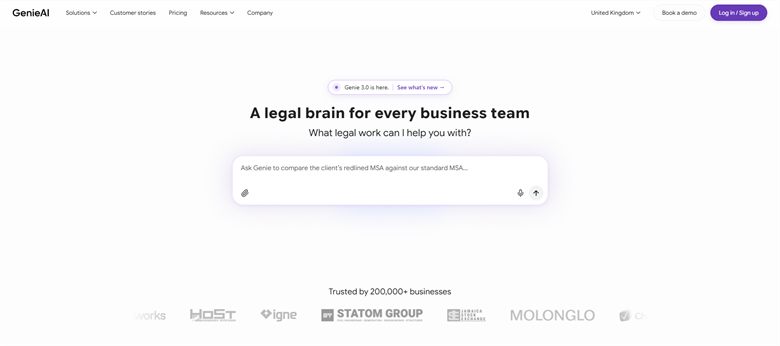
The verdict: The clearest answer for a team that wants the library to be theirs. Approved clauses and your own positions are applied at the point of drafting rather than sitting in a folder, and the knowledge graph underneath means the library gets more useful as you use it rather than going stale the way a document store does. It is also the only tool here whose price you can read before starting.
Pricing: Permanent free plan with no time limit. Pro $75 a month for one user, Business $320 a month for five, Enterprise from $600 a month with SSO, API access and an SLA.
Standout features:
- Managed template and clause library
- Organisational knowledge graph that surfaces prior policies and precedent into each transaction
- Review and redlining against your organisation's own playbook
- Microsoft Word add-in that preserves native track changes
- Free tier with no time limit
Limitations: The value depends on the positions being set, so a team that has never written its standards down starts with a generic library and has to do that work first. It is not a full CLM: no procurement routing, no obligation tracking across a large estate and no enterprise approval routing, so the library governs drafting rather than a process.
2. LegalOn: Best for a lawyer-authored library on day one
8.5 out of 10 how this is calculated
The verdict: The best rented library in the category, written by lawyers and useful before you have decided anything yourself. That immediacy is the whole argument, and the trade is that the positions are the vendor's rather than yours.
Pricing: No public list price, and we could not source a reliable reported figure. Sales-led and quoted on seat count and playbook scope.
Standout features:
- Pre-built position libraries by agreement type
- Suggested revisions with the reasoning attached
- Word integration for redlining
- Review against your own standards as well as theirs
Limitations: No published price and no reported figure we could stand behind, so the cost of the library cannot be established without a sales process. Coverage is strongest on common commercial agreements, and the clauses a business actually argues about are often the ones a general library does not anticipate.
3. Ironclad: Best for a library inside approval routing
8.1 out of 10 how this is calculated
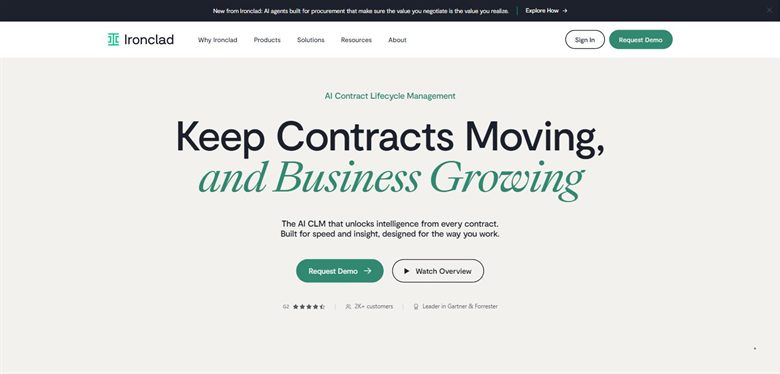
The verdict: Strongest where the library has to do more than suggest. Tying an approved clause to the approval it triggers when someone departs from it is the thing a standalone library cannot do.
Pricing: No public list price. Reported annual contracts run approximately $30,000 to $250,000, with a marketplace median near $40,000 across 363 recorded purchases.
Standout features:
- Clause library tied to conditional approval routing
- Version history on approved language
- Repository and reporting across executed agreements
- Deep Salesforce and procurement integration
Limitations: Building the library is part of an implementation measured in months, so it is unavailable during the period you most wanted it. The reported median near $40,000 a year is far above a tool bought only to hold clauses, and it assumes an internal owner for the duration.
4. Juro: Best for templates non-legal staff create from
7.3 out of 10 how this is calculated
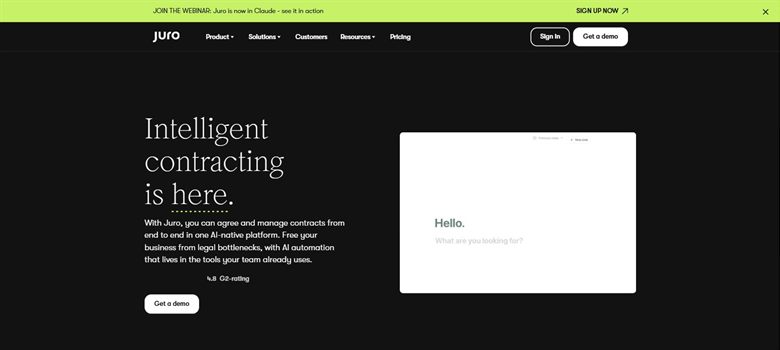
The verdict: The library exists so that sales and operations can create contracts without legal seeing each one. That is a narrower use of a clause library than the others here, and for a lot of teams it is the only one that matters.
Pricing: Sales-led with no public list price. Reported annual contracts run approximately $15,000 to $130,000, with marketplace medians around $31,000 to $34,500, priced on contract volume rather than per seat.
Standout features:
- Template and clause management with guided fields
- Approval rules attached to non-standard language
- Browser-based so non-legal staff need no training
- Searchable repository of what was actually used
Limitations: Clause-level intelligence is thinner than the review tools, so it enforces the language you set rather than telling you whether that language is any good. Priced on contract volume with no published figure, so the cost of growth cannot be modelled in advance.
5. Luminance: Best for extracting positions from what you signed
6.7 out of 10 how this is calculated
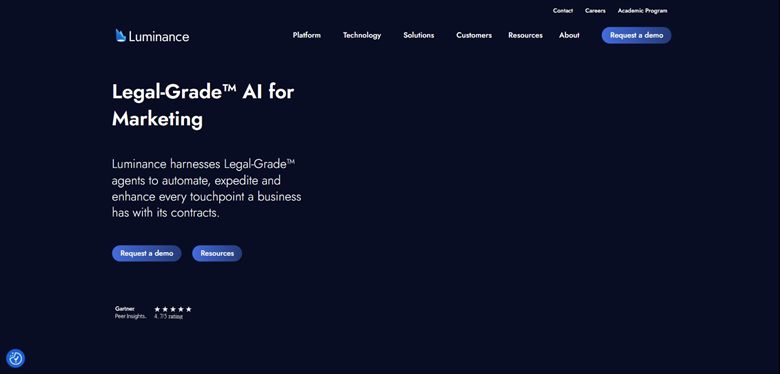
The verdict: The third kind of library, and the one nobody asks for by name. Instead of authoring positions, it derives them from agreements you have already signed, which is the fastest route to a library that reflects what your business actually does rather than what it says it does.
Pricing: Published list price of approximately $41,340 a year for 1,000 documents with unlimited users. Enterprise deployments are reported from around $25,000 a year depending on volume and modules.
Standout features:
- Positions learned from the existing contract estate
- Anomaly detection against those learned standards
- Unlimited users on the published tier
- Coverage across many languages and jurisdictions
Limitations: It reflects what you have signed, including the concessions you should not have made, so a bad estate produces a bad library and somebody has to curate it. Priced by document volume rather than seats, and at roughly $41,340 a year it is an expensive way to hold clauses if that is all you need.
6. Spellbook: Best for knowing what the market accepts
5.8 out of 10 how this is calculated
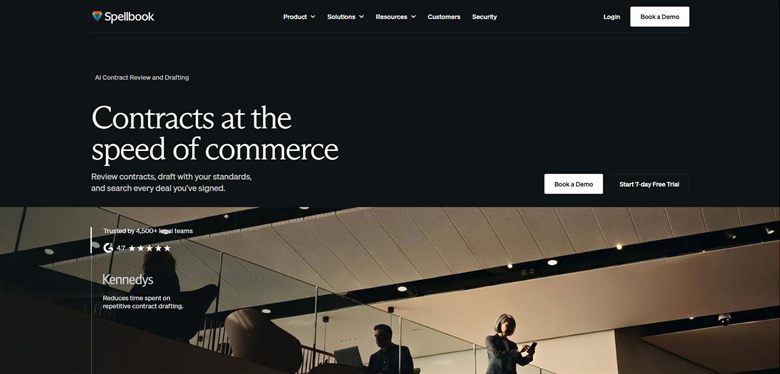
The verdict: Included because it answers the question a library cannot. Your positions tell you what you want; this tells you what counterparties typically accept, which is the number you need when deciding whether to hold a line.
Pricing: No published list price. Reported at approximately $99 to $199 per user a month, rising to around $350 per user on enterprise plans with a ten-seat minimum. A seven-day trial is offered.
Standout features:
- Suggestions benchmarked against market standard
- Drafting and redlining inside Microsoft Word
- Clause generation from a description
- Seven-day trial
Limitations: It is not a clause library and does not hold your positions, so it complements one rather than replacing it. There is nothing to export and nothing that compounds: you are renting a view of the market rather than building an asset.
7. Agiloft: Best for clause models that do not fit a standard shape
5.3 out of 10 how this is calculated
The verdict: Where teams go when their clause model is genuinely unusual: multi-entity, heavily conditional, or tied to regulatory categories no product anticipates. You are trading an opinionated tool for a configurable one, and configuration is work you pay for.
Pricing: No published price and no reliable reported figure we could source. Quoted on users and modules, with configuration typically a separate cost.
Standout features:
- No-code configuration of the clause and approval data model
- Conditional logic beyond what fixed products allow
- Extensive permissions and audit trail
- Long track record in complex deployments
Limitations: Configuration is charged separately and is usually the larger half of the first-year cost, which the licence quote does not show. It publishes no price at all, and the flexibility is only worth paying for if your clause model genuinely is unusual rather than just undocumented.
How we chose
- Which of the three kinds of library it is, since they are sold under one name and are not substitutes.
- Who can add and change a clause: a lawyer only, or an operations person with review.
- Whether the library is enforced at the point of drafting or only available to search.
- Whether you can export what you build, which decides how much of the work you keep if you leave.
- Published price, and whether library building is included or a professional services line.
- We did not score on clause counts. A library of two thousand clauses nobody in your business agreed to is a search problem, not an asset.
Frequently asked questions
What is the best clause library software in 2026?
It depends which kind you want. GenieAI if you are building your own positions and want a published price, from a free tier to $75 a month. LegalOn if you want a lawyer-authored library working immediately, though it publishes no price. Ironclad if the library has to trigger approvals, reported at a median near $40,000 a year.
What actually is a clause library?
Three different things sold under one name. A rented library is the vendor's positions, written by their lawyers. An authored library is your own approved language, which you build and maintain. A learned library is extracted from agreements you have already signed. They are not substitutes, and asking a vendor which one they mean is the single most useful question in this evaluation.
How much does a clause library cost?
GenieAI publishes a free tier rising to $75 a month, which is the only readable price in the category. Ironclad is reported at a median near $40,000 a year and Juro from about $15,000. Luminance publishes roughly $41,340 for 1,000 documents. LegalOn and Agiloft publish nothing and no reliable figure could be sourced.
Should we build our own library or buy one?
Buy one if you need something working this quarter and your agreements are common commercial types. Build one if the clauses you argue about are specific to your business, which is usually true in project-based and regulated industries. Most teams buy first and build second, and the wasted step is smaller than it sounds because a rented library shows you what a good one looks like.
Can we export a library if we leave the vendor?
Ask before signing and get the answer in writing. The underlying language is yours, but the structure around it, the conditions, fallbacks and approval rules, is usually held in a proprietary format that does not export cleanly. That structure is most of the work, and it is the practical lock-in in this category.
Who should be allowed to change an approved clause?
This is a governance question the tool only partly answers. The pattern that works is a small number of people who can change approved language and a much larger number who can use it, with any departure flagged rather than blocked. Tools that let anyone edit the library produce drift, and tools that let nobody edit it produce a library people work around.
Does a clause library replace legal review?
For agreements that stay inside the library, largely yes, and that is the point: the review already happened when the clause was approved. It does nothing for the agreement that falls outside it, which is where the value of a good library shows up as a much smaller pile of genuinely unusual documents rather than as no review at all.