
6 Best AI Tools for Solo Practitioners in 2026
Quick answer: Most legal AI is priced for firms with a procurement function, and a solo practitioner runs into that immediately: seat minimums, database subscriptions underneath the AI layer, and quotes that require a sales process. Paxton AI exists specifically for this gap, though it publishes no figure either. Spellbook at a reported $99 to $199 per user a month with a seven-day trial is the most straightforward purchase here for transactional work. Clio Draft is the answer for court forms. The incumbents are not realistically available at this size and the honest advice is to stop evaluating them.
Comparison
| Tool | Score | Best for | Price | Key strength |
|---|---|---|---|---|
| Spellbook | 9.2 | transactional work in Word | Reported ~$99 to $199 per user/mo | Buyable by one person, working the same day |
| Clio Draft | 8.4 | court forms and litigation documents | Add-on, reported from ~$40/mo plus $30 per user | Maintained forms across fifty states |
| Paxton AI | 7.6 | research at solo budgets | No published price | Built for exactly this buyer |
| Lexis+ AI | 6.9 | work where the corpus is not optional | Reported ~$3,000 to $8,000 per user/yr | Licensed primary law and Shepard's |
| Gavel | 6.1 | automating documents you repeat | $83 to $417/mo, published | Publishes its full rate card |
| vLex Vincent | 5.2 | questions crossing jurisdictions | No published price | Breadth of jurisdictions |
Fit by buyer
Scored 1 to 5 for each buyer, where 5 means the tool was built for them and 1 means it is the wrong tool. Scope is different: it is how much of the job the tool does, from a single step to a whole lifecycle, and a low score there means narrow rather than bad. These ratings are the same for a tool wherever it appears; the score shown beside each entry is for this guide specifically. A tool can lead one column and come last in another, and the right answer still changes with who is asking. How we score.
| Tool | Lawyer in Word | In-house legal | Commercial team | Enterprise | Scope | Price |
|---|---|---|---|---|---|---|
| Spellbook | 5 | 4 | 2 | 2 | 2 | Reported |
| Clio Draft | 4 | 2 | 1 | 2 | 2 | Reported |
| Paxton AI | 3 | 3 | 1 | 2 | 3 | None |
| Lexis+ AI | 4 | 4 | 1 | 4 | 4 | Reported |
| Gavel | 3 | 4 | 3 | 3 | 3 | Published |
| vLex Vincent | 4 | 3 | 1 | 3 | 4 | None |
Which one, for your situation
| If this is your situation | Start with |
|---|---|
| Transactional work drafted and reviewed in Word | Spellbook |
| Litigation and court forms | Clio Draft |
| Research on a budget the incumbents do not serve | Paxton AI |
| Authority-heavy work where the corpus is not optional | Lexis+ AI |
| Automating the documents you produce repeatedly | Gavel |
| Cross-border questions | vLex Vincent |
The 6 best AI tools for solo practitioners
1. Spellbook: Best for transactional work in Word
9.2 out of 10 how this is calculated
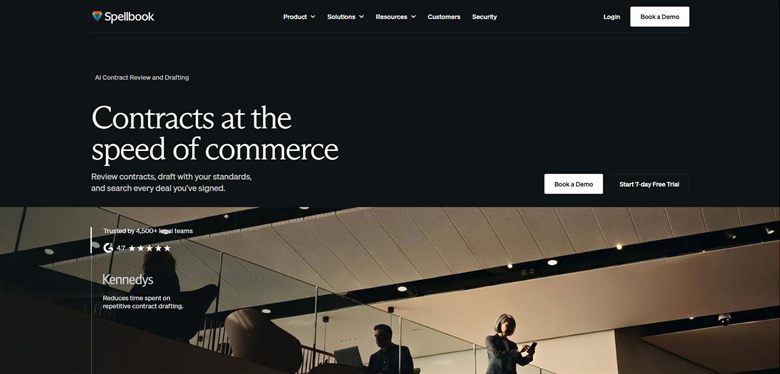
The verdict: The most practical purchase on this page. One seat, a seven-day trial, working the afternoon you install it, and it improves the drafting and review that fills most transactional practice.
Pricing: No published list price. Reported at approximately $99 to $199 per user a month, rising to around $350 per user on enterprise plans with a ten-seat minimum. A seven-day trial is offered.
Standout features:
- Drafting, review and redlining inside Microsoft Word
- Suggestions benchmarked against market standard
- Same-day setup with no implementation
- Seven-day trial
Limitations: Contracts only, so it does nothing for litigation, research or anything outside transactional work. The ten-seat minimum on enterprise plans means the higher tier is closed to you, so check which features sit where before committing.
2. Clio Draft: Best for court forms and litigation documents
8.4 out of 10 how this is calculated
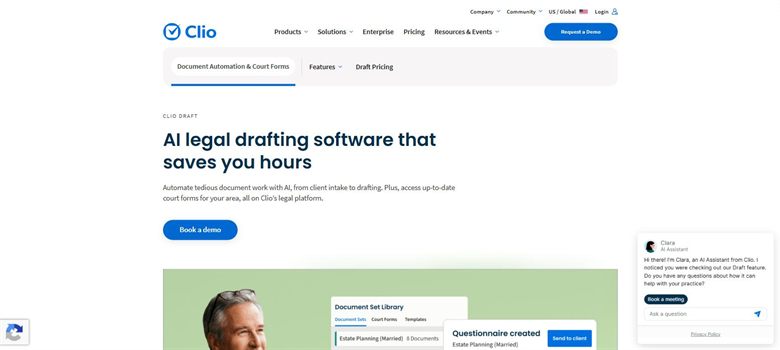
The verdict: The strongest option for a litigation-focused solo, because filling a state form correctly from matter data you already hold is a narrow job that general tools do badly.
Pricing: Sold as a paid add-on to a Clio subscription rather than standalone, and quoted by sales. Reported configurations run from about $40 a month plus $30 per user for the court forms library, up to about $120 a month plus $30 per user for the full feature set. The Clio subscription underneath is a separate cost.
Standout features:
- Maintained library of jurisdiction-specific court forms
- Populates documents from existing Clio matter data
- Word-based document assembly
- Electronic filing in supported jurisdictions
Limitations: It assumes you already run Clio, so the real cost is two subscriptions and it makes little sense standalone. Local and county coverage varies even where the state library is complete, so check the courts you actually file in.
3. Paxton AI: Best for research at solo budgets
7.6 out of 10 how this is calculated
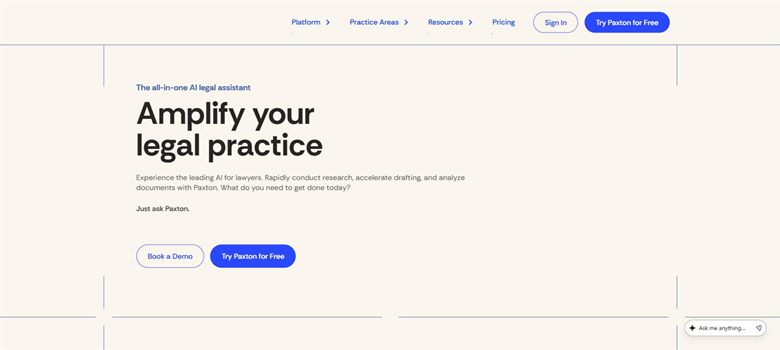
The verdict: The only research tool here designed around the constraint this page is about. Whether the corpus is deep enough depends entirely on your practice area, and that is the whole evaluation rather than a detail of it.
Pricing: No published list price and no reliable reported figure we could source. Positioned well below the incumbents, and sold per user.
Standout features:
- Priced for solo and small firms
- Citation-linked answers
- Document analysis alongside research
- US case law focus
Limitations: It does not license the editorial layers that make Shepard's and KeyCite valuable, so citation treatment is materially weaker, and treatment is what a solo without a research assistant most needs. It publishes no price despite cost being its central argument.
4. Lexis+ AI: Best for work where the corpus is not optional
6.9 out of 10 how this is calculated
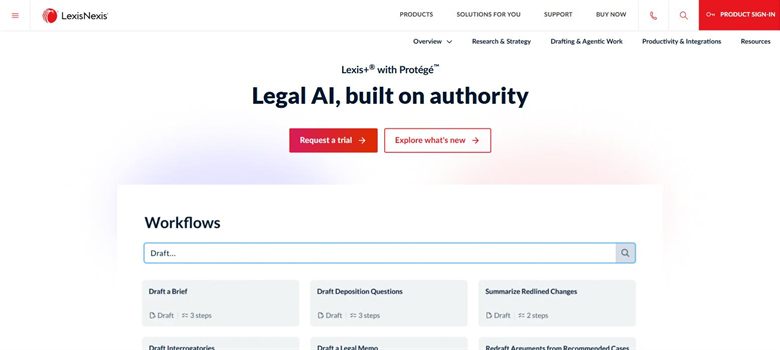
The verdict: Included because for some practices it is not optional. If your work turns on citable authority and treatment, no cheaper tool substitutes, and the honest answer is that this is a cost of practising rather than a discretionary purchase.
Pricing: No public list price. Reported at approximately $3,000 to $8,000 per user a year for core services, with specialist modules charged separately. The database licence and the AI layer are usually priced as one.
Standout features:
- Licensed case law, statutes and secondary sources
- Shepard's citation validation
- Answers linked to the underlying authority
- Broad US coverage
Limitations: At a reported $3,000 to $8,000 per user a year on top of a database subscription, it is a significant fixed cost for a sole practice. Coverage outside the US and UK is patchier than the marketing suggests.
5. Gavel: Best for automating documents you repeat
6.1 out of 10 how this is calculated
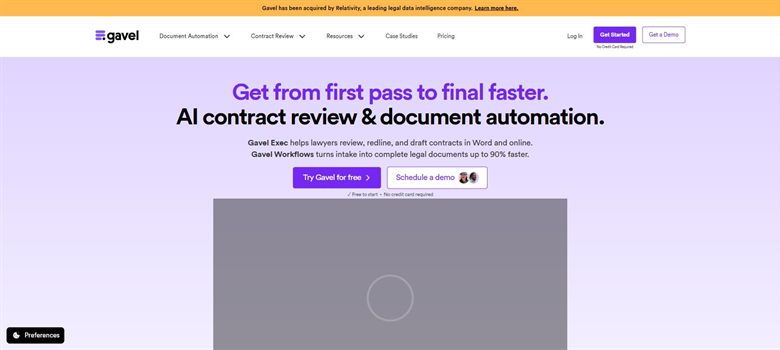
The verdict: The one tool here whose price you can read on the website, and the right purchase for a solo whose practice repeats: the same agreements, wills or filings with different facts each time.
Pricing: Published in full. Lite $83 a month for one builder seat and ten templates, Standard $210 a month or $165 billed annually, Pro $290 a month, Scale from $417 billed annually. Seven-day trials on the first three tiers.
Standout features:
- No-code builder working from your existing Word documents
- Client-facing intake forms that populate the document
- Word and PDF output with formatting preserved
- Seven-day trial
Limitations: Automating your templates is real work before it saves any, and at ten templates on the Lite tier a broad practice outgrows it quickly. It has no court forms library, so litigation practices need something alongside it.
6. vLex Vincent: Best for questions crossing jurisdictions
5.2 out of 10 how this is calculated
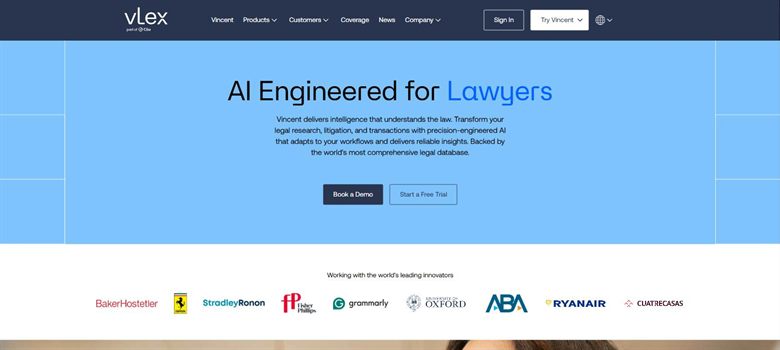
The verdict: Worth knowing about for a solo whose practice crosses borders, where breadth of corpus matters more than depth in any one jurisdiction and the US incumbents are thinner than they appear.
Pricing: No published price and no reliable reported figure we could source. Sold per user with pricing that varies by jurisdiction coverage.
Standout features:
- Coverage across many jurisdictions
- Cross-border comparison of legal concepts
- Answers linked to source documents
- Now part of Clio following acquisition
Limitations: Depth in any single jurisdiction sits below the incumbents in their home markets. No published price, and the Clio acquisition leaves how it will be sold to individual practitioners less settled.
How we chose
- Whether a single user can buy it at all, which several tools here make difficult.
- Seat minimums, which exclude solo practitioners from tiers they would otherwise qualify for and are rarely stated on a pricing page.
- Whether a database subscription is required underneath the AI layer.
- Whether there is a trial that does not require a sales conversation.
- Published price.
- We did not score on firm-wide features: knowledge management, practice-group workflows, multi-user permissions. A solo practitioner is paying for those and cannot use them.
Frequently asked questions
What is the best AI tool for a solo practitioner in 2026?
Spellbook for transactional work, at a reported $99 to $199 per user a month with a seven-day trial and no minimum. Clio Draft for litigation and court forms. Gavel at a published $83 a month if your practice repeats the same documents with different facts.
Why is most legal AI unaffordable for a solo practice?
Because it is priced for firms with a procurement function. The specific obstacles are seat minimums, database subscriptions required underneath an AI layer, and quotes that need a sales process. Those exclude a single practitioner from tiers they would otherwise qualify for, regardless of willingness to pay.
Which of these can one person actually buy?
Spellbook, Gavel and Paxton AI are all buyable by a single user, and Gavel publishes its full rate card. Clio Draft requires a Clio subscription underneath. Lexis+ AI and vLex Vincent both sit on database subscriptions and are sold through a process rather than a checkout.
Do I need a licensed research corpus?
It depends entirely on practice area. If your work turns on citable authority and treatment, no cheaper tool substitutes and the incumbent subscription is a cost of practising. If your work is transactional, you can skip the whole research category and spend the money on drafting instead.
Which has a genuine trial?
Spellbook offers seven days and Gavel offers seven days on its first three tiers. Paxton, Lexis and vLex are sales-led. For a solo practitioner, a trial that does not require a call is worth more than a slightly better product you cannot evaluate.
What should I avoid?
Anything with a seat minimum, anything requiring implementation, and anything where the price cannot be established without a meeting. Harvey and the enterprise platforms are not realistically available at this size, and time spent evaluating them is time not spent practising.
Is legal AI worth it for a sole practice at all?
For repeated document work, clearly, because that is where an hour saved is an hour billable elsewhere. For research it depends on whether you already pay for a corpus. The one thing worth avoiding is buying breadth: a solo practice benefits from one tool doing the task that fills most of the week.