
8 Best Contract Management Software Platforms in 2026
Quick answer: Contract lifecycle management solves volume, approvals and obligations, not drafting quality. Ironclad is the most complete platform and is reported at $30,000 to $250,000 a year, with a marketplace median near $40,000. Icertis sits above it for enterprises with procurement complexity. Juro is reported from $15,000 and is the most usable of the group for teams without a dedicated legal ops function. Before buying any of them, check whether your problem is actually volume, because most teams who buy a CLM wanted a review tool.
Comparison
| Tool | Score | Best for | Price | Key strength |
|---|---|---|---|---|
| Ironclad | 9.4 | the most complete end-to-end platform | Reported ~$30,000 to $250,000/yr | Workflow depth |
| Icertis | 8.8 | enterprise procurement at scale | No published price | Procurement and supply-side depth |
| Juro | 8.2 | teams without a legal ops function | Reported ~$15,000 to $130,000/yr | Usability |
| Evisort | 7.6 | making sense of a large legacy estate | Reported ~$30,000 to $150,000/yr | Extraction from existing agreements |
| LinkSquares | 7.0 | reporting on contracts you have already signed | No published price | Post-signature analytics |
| Agiloft | 6.5 | unusual workflows that need configuring | No published price | Configurability |
| Contractbook | 5.8 | small teams needing storage and templates | Reported ~$39 to $599/mo | Lowest entry point |
| GenieAI | 5.2 | teams who do not have a volume problem yet | Free plan, then $75/mo | Review and drafting rather than lifecycle |
Fit by buyer
Scored 1 to 5 for each buyer, where 5 means the tool was built for them and 1 means it is the wrong tool. Scope is different: it is how much of the job the tool does, from a single step to a whole lifecycle, and a low score there means narrow rather than bad. These ratings are the same for a tool wherever it appears; the score shown beside each entry is for this guide specifically. A tool can lead one column and come last in another, and the right answer still changes with who is asking. How we score.
| Tool | Lawyer in Word | In-house legal | Commercial team | Enterprise | Scope | Price |
|---|---|---|---|---|---|---|
| Ironclad | 2 | 4 | 2 | 5 | 5 | Reported |
| Icertis | 1 | 3 | 1 | 5 | 5 | None |
| Juro | 2 | 4 | 4 | 4 | 4 | Reported |
| Evisort | 1 | 4 | 2 | 4 | 4 | Reported |
| LinkSquares | 1 | 4 | 2 | 4 | 4 | None |
| Agiloft | 1 | 3 | 1 | 4 | 5 | None |
| Contractbook | 1 | 3 | 4 | 2 | 3 | Reported |
| GenieAI | 3 | 5 | 5 | 3 | 2 | Published |
Which one, for your situation
| If this is your situation | Start with |
|---|---|
| You want the most complete platform and have budget for implementation | Ironclad |
| Procurement complexity across a large enterprise is the driver | Icertis |
| You want something a team can actually use without legal ops | Juro |
| The problem is thousands of legacy agreements nobody has read | Evisort |
| You need reporting on what is in the contracts you already signed | LinkSquares |
| Your workflows are unusual and you need to configure heavily | Agiloft |
| You are small, need storage and templates, and cannot spend five figures | Contractbook |
| You do not have a volume problem yet and want review and drafting instead | GenieAI |
The 8 best contract management platforms
1. Ironclad: Best for the most complete end-to-end platform
9.4 out of 10 how this is calculated
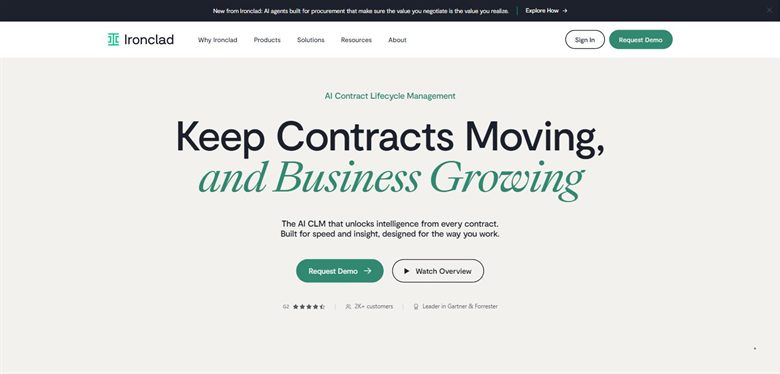
The verdict: The category benchmark. Workflow design, approvals and repository are all strong, and the marketplace data suggests most buyers land near $40,000 rather than the headline low end.
Pricing: No public list price. Reported annual contracts run approximately $30,000 to $250,000, with a marketplace median near $40,000 across 363 recorded purchases.
Standout features:
- Configurable approval workflows
- Repository with obligation tracking
- Data extraction from executed agreements
- Reporting across the contract estate
Limitations: Implementation is a project measured in months and generally needs an internal owner. If clause-level review is the actual need, most of what you are buying goes unused, and the price does not distinguish between the two.
2. Icertis: Best for enterprise procurement at scale
8.8 out of 10 how this is calculated

The verdict: Built for the buy side as much as the sell side, which is the reason large enterprises choose it over Ironclad. The trade is complexity.
Pricing: No published price and no reliable reported figure we could source. Enterprise sales-led, quoted on contract volume and module count. Widely understood to sit at the top of the market alongside Ironclad.
Standout features:
- Procurement and sourcing contract management
- Obligation and compliance tracking at scale
- Deep ERP integration
- Multi-entity and multi-jurisdiction support
Limitations: Aimed squarely at large enterprises, and the configuration effort reflects that. No published pricing at all. A mid-sized team would be buying a platform designed for a company several times its size.
3. Juro: Best for teams without a legal ops function
8.2 out of 10 how this is calculated
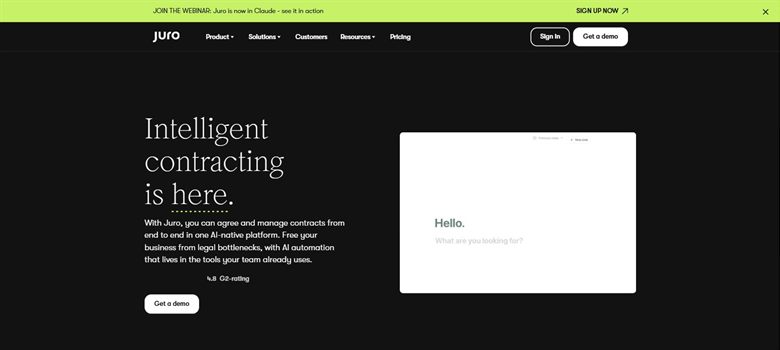
The verdict: The most usable platform here, which matters more than feature count when the people routing contracts are in sales rather than legal.
Pricing: Sales-led with no public list price. Reported annual contracts run approximately $15,000 to $130,000, with marketplace medians around $31,000 to $34,500, priced on contract volume rather than seats.
Standout features:
- Browser-based creation, negotiation and signature
- Approval workflows that non-legal staff can follow
- Native e-signature
- Searchable repository with reporting
Limitations: Lighter than Ironclad or Icertis on obligation tracking and complex procurement workflows. Priced on volume, so growth changes the bill in ways that are hard to forecast at signing.
4. Evisort: Best for making sense of a large legacy estate
7.6 out of 10 how this is calculated
The verdict: Strongest where the problem is what you already signed rather than what you are about to. Extraction across thousands of legacy agreements is the thing it does better than the workflow-first platforms.
Pricing: No public list price. Reported annual contracts run approximately $30,000 to $150,000. Now part of Workday following acquisition, so renewals may route differently than they did.
Standout features:
- Data extraction across large document sets
- Obligation and renewal identification
- Reporting on terms across the estate
- Workflow and approvals
Limitations: Extraction is never as clean as the demo, and the cleanup effort is real. The Workday acquisition also introduces uncertainty about roadmap and how it is sold going forward.
5. LinkSquares: Best for reporting on contracts you have already signed
7.0 out of 10 how this is calculated

The verdict: Post-signature first, pre-signature second, which is the opposite of most of this list. Useful when the question is what is in the portfolio rather than how the next one gets approved.
Pricing: No published price and no reliable reported figure we could source. Sales-led and quoted on contract volume.
Standout features:
- Analytics across executed agreements
- Clause and term extraction
- Renewal and obligation alerts
- Drafting and workflow added later in its life
Limitations: Weaker on pre-signature workflow than Ironclad or Juro, so teams whose pain is approvals rather than reporting are buying the wrong half. No published pricing.
6. Agiloft: Best for unusual workflows that need configuring
6.5 out of 10 how this is calculated
The verdict: The most configurable platform here, which is either the reason to buy it or the reason not to. Teams with genuinely unusual processes get further than they would with an opinionated product.
Pricing: No published price and no reliable reported figure we could source. Quoted on users and modules, with configuration typically a separate cost.
Standout features:
- No-code configuration of workflows and data model
- Contract, procurement and sourcing modules
- Long track record in complex deployments
- Extensive permissions and audit
Limitations: Configurability means configuration. The scope and onboarding overhead outweigh the gain unless you need the full suite, and teams expecting an out-of-the-box product tend to be surprised by the setup effort.
7. Contractbook: Best for small teams needing storage and templates
5.8 out of 10 how this is calculated
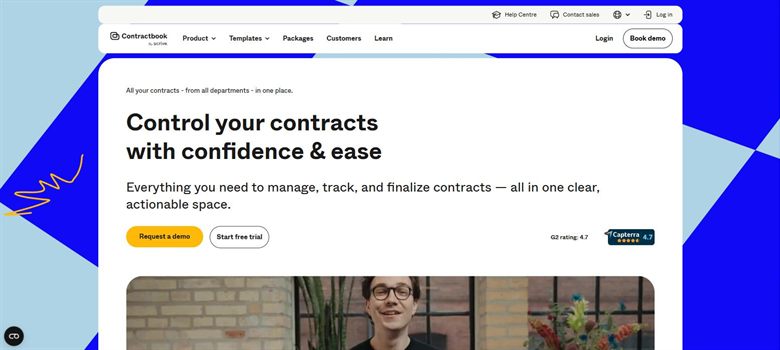
The verdict: The entry point to contract management rather than a full CLM. For a company with a few hundred agreements and no legal team, that is usually the right size of answer.
Pricing: No published rate card. Reported between approximately $39 and $599 a month depending on tier, which is the only genuinely small-team price in this category.
Standout features:
- Template-driven creation
- Searchable repository
- Data extraction and renewal reminders
- Monthly pricing rather than annual contracts
Limitations: Not comparable to Ironclad or Icertis on workflow depth, obligation management or reporting. The gap between its tiers is wide and undisclosed, so growth means a conversation.
8. GenieAI: Best for teams who do not have a volume problem yet
5.2 out of 10 how this is calculated
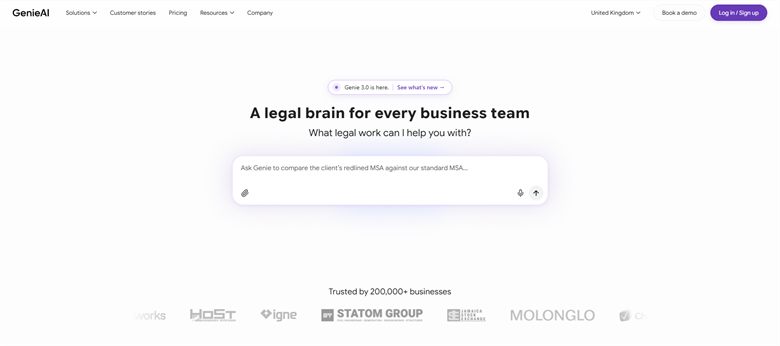
The verdict: Included because a large share of CLM enquiries are not really CLM enquiries. If the pain is that contracts take too long to draft and check rather than that nobody can find them, this category is the wrong purchase.
Pricing: Permanent free plan with no time limit. Pro $75 a month for one user, Business $320 a month for five, Enterprise from $600 a month.
Standout features:
- Drafting, review and negotiation in one workspace
- Managed template and clause library
- Microsoft Word add-in that preserves native track changes
- Risk rated red, amber or green
- Free tier to test before committing to anything
Limitations: It is not a CLM. There is no procurement workflow, no obligation tracking across a large estate, and no enterprise approval routing. Once contract volume genuinely becomes a process problem, a platform on this list is the right answer and this is not.
How we chose
- What happens after signature: obligation tracking, renewal alerts, reporting, or just storage.
- Approval workflow: can non-legal staff route a contract correctly without asking?
- Data extraction from legacy agreements, and how much cleanup it needs.
- Implementation: weeks or months, and whether it needs a dedicated owner internally.
- Reported price against contract volume, since these are almost never priced per seat.
- We did not score on integration counts. Every platform lists Salesforce; what matters is whether the integration writes back.
Frequently asked questions
What is the best contract management software in 2026?
Ironclad is the most complete platform and the usual benchmark, reported at $30,000 to $250,000 a year. Icertis leads for enterprise procurement. Juro is the most usable for teams without a legal ops function. The right answer depends on whether your problem is workflow, procurement or legacy data.
How much does CLM software cost?
Reported annual contracts run from about $15,000 (Juro) to $250,000 (Ironclad), with marketplace medians in the $31,000 to $40,000 range. Four of the eight platforms here publish no price and we could not source reliable figures for them. Contractbook is the exception at a reported $39 to $599 a month.
Do I actually need a CLM?
Ask what breaks today. If contracts are slow to draft and nobody is sure what to push back on, that is a review and drafting problem. If contracts get signed and then nobody can find them, renewals lapse, or approvals happen over email, that is a lifecycle problem and this category is the answer. Buying a CLM to fix the first problem is the most expensive mistake in this market.
How long does CLM implementation take?
Weeks for the lighter platforms and months for the enterprise ones, and the variable is rarely the software. It is how clean your existing agreements are and whether someone internally owns the project. Budget for that person's time as part of the cost.
What is the difference between CLM and contract review software?
Review software examines a document in front of you and tells you what is wrong with it. CLM manages contracts across their life: creation, approval, signature, storage, obligations and renewal. Several products claim both and most are noticeably better at one.
Can CLM software extract data from old contracts?
Yes, and this is where Evisort and LinkSquares are strongest. Expect to review the output rather than trust it: extraction accuracy depends heavily on document quality, and scanned PDFs from a decade ago are where it degrades.
Is there affordable contract management for small teams?
Contractbook is the only platform here with a genuinely small-team entry price, reported from around $39 a month. Below that, most teams are better served by a drafting or review tool plus disciplined storage than by a cut-down CLM.