
7 Best Ironclad Alternatives in 2026
Quick answer: Two of the three reasons people leave Ironclad are the quote and the implementation, and both are worth pausing on before replacing one platform with another. If contracts were slow because drafting and review were slow rather than because approvals were tangled, GenieAI addresses that directly at a published free tier rising to $75 a month, and no platform here will. If approval routing across finance, security and legal genuinely is the requirement, Icertis is the like-for-like at the same tier and Juro is the closest platform at a lower entry point, reported from $15,000 a year.
Comparison
| Tool | Score | Best for | Price | Key strength |
|---|---|---|---|---|
| GenieAI | 9.3 | teams reacting to the price whose delay was never in approvals | Free plan, then $75/mo; Enterprise from $600/mo | Answers the cheaper question first |
| Icertis | 8.7 | enterprises that need procurement depth | No published price | Buy-side contract management |
| Juro | 8.0 | a real platform at a lower entry point | Reported ~$15,000 to $130,000/yr | Usability and faster rollout |
| Evisort | 7.3 | extracting sense from a legacy estate | Reported ~$30,000 to $150,000/yr | Data extraction at scale |
| LinkSquares | 6.6 | reporting across executed agreements | No published price | Post-signature analytics |
| Agiloft | 6.0 | processes too unusual for an opinionated platform | No published price | Configurability |
| Contractbook | 5.2 | teams too small for enterprise CLM | Reported ~$39 to $599/mo | Only small-team price here |
Fit by buyer
Scored 1 to 5 for each buyer, where 5 means the tool was built for them and 1 means it is the wrong tool. Scope is different: it is how much of the job the tool does, from a single step to a whole lifecycle, and a low score there means narrow rather than bad. These ratings are the same for a tool wherever it appears; the score shown beside each entry is for this guide specifically. A tool can lead one column and come last in another, and the right answer still changes with who is asking. How we score.
| Tool | Lawyer in Word | In-house legal | Commercial team | Enterprise | Scope | Price |
|---|---|---|---|---|---|---|
| GenieAI | 3 | 5 | 5 | 3 | 2 | Published |
| Icertis | 1 | 3 | 1 | 5 | 5 | None |
| Juro | 2 | 4 | 4 | 4 | 4 | Reported |
| Evisort | 1 | 4 | 2 | 4 | 4 | Reported |
| LinkSquares | 1 | 4 | 2 | 4 | 4 | None |
| Agiloft | 1 | 3 | 1 | 4 | 5 | None |
| Contractbook | 1 | 3 | 4 | 2 | 3 | Reported |
Which one, for your situation
| If this is your situation | Start with |
|---|---|
| You need the same capability and procurement depth at enterprise scale | Icertis |
| You want a real platform but the quote was too high | Juro |
| Your problem is the legacy estate, not the next contract | Evisort |
| You need reporting on what you already signed | LinkSquares |
| Your workflows are unusual enough that configuration is the point | Agiloft |
| You are too small for any of the above | Contractbook |
| The real problem is drafting and review, not lifecycle | GenieAI |
The 7 best Ironclad alternatives
1. GenieAI: Best for teams reacting to the price whose delay was never in approvals
9.3 out of 10 how this is calculated
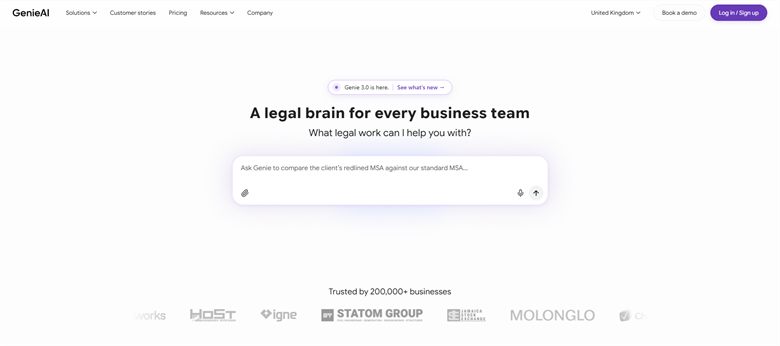
The verdict: First because of the order in which these questions should be asked, not because it does what Ironclad does. A large share of people searching for Ironclad alternatives are reacting to the cost, and the cheapest useful move is to establish whether approval routing was ever the requirement. If the delay was in drafting and knowing what to push back on, this fixes it for a published fraction of the price. If it was genuinely in approvals, read on: Icertis and Juro are the real replacements.
Pricing: Permanent free plan with no time limit. Pro $75 a month for one user, Business $320 a month for five, Enterprise from $600 a month with SSO, API access and an SLA.
Standout features:
- Drafting and clause-level review in one workspace
- Risk rated red, amber or green with a plain-language reason
- Your own positions applied consistently by non-lawyers
- Microsoft Word add-in that preserves native track changes
- Published pricing with a permanent free tier
Limitations: It has no repository, no approval workflow and no signature, so it is not an Ironclad replacement and being listed first does not make it one. If contracts genuinely stall in approvals across departments, that is what Ironclad does well and this does not do at all.
2. Icertis: Best for enterprises that need procurement depth
8.7 out of 10 how this is calculated

The verdict: The like-for-like swap, and often the one large enterprises pick over Ironclad when procurement matters as much as sales. It is not a cheaper alternative and does not claim to be.
Pricing: No published price and no reliable reported figure we could source. Enterprise sales-led, quoted on contract volume and modules, and generally understood to sit alongside Ironclad at the top of the market.
Standout features:
- Procurement and sourcing contract management
- Obligation and compliance tracking at scale
- Deep ERP integration
- Multi-entity and multi-jurisdiction support
Limitations: If you left Ironclad over price or implementation length, this solves neither. Configuration effort is at least comparable and the buying process is longer.
3. Juro: Best for a real platform at a lower entry point
8.0 out of 10 how this is calculated
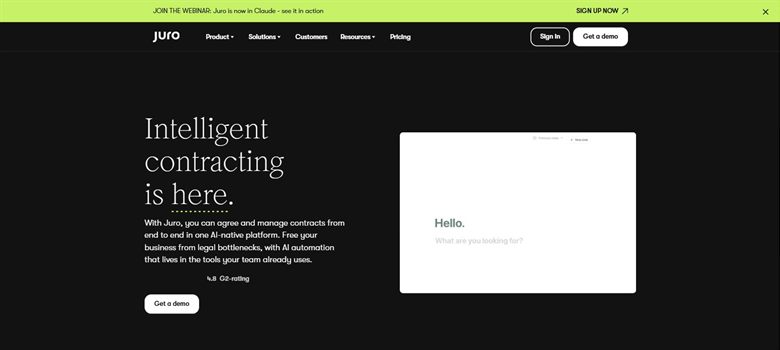
The verdict: The most common landing spot for teams who wanted Ironclad and could not justify it. Entry point is lower, rollout is faster, and non-legal staff can operate it without training.
Pricing: Sales-led with no public list price. Reported annual contracts run approximately $15,000 to $130,000, with marketplace medians around $31,000 to $34,500, against Ironclad's median near $40,000.
Standout features:
- Browser-based creation, negotiation and signature
- Approval workflows usable by sales and ops
- Native e-signature
- Searchable repository with reporting
Limitations: Lighter than Ironclad on obligation tracking and complex procurement routing. Priced on contract volume, so the saving narrows as you grow, and at the top of its range the gap closes almost entirely.
4. Evisort: Best for extracting sense from a legacy estate
7.3 out of 10 how this is calculated

The verdict: A better answer than Ironclad when the problem is thousands of agreements nobody has read, rather than the workflow for the next one.
Pricing: No public list price. Reported annual contracts run approximately $30,000 to $150,000. Now part of Workday, so renewal and roadmap may route differently than they did.
Standout features:
- Extraction across large document sets
- Obligation and renewal identification
- Reporting on terms across the estate
- Workflow and approvals
Limitations: Extraction accuracy degrades on older scanned documents, and cleanup is real work. The Workday acquisition adds uncertainty about how it will be sold and developed.
5. LinkSquares: Best for reporting across executed agreements
6.6 out of 10 how this is calculated

The verdict: Comes at the same estate from the other end. Strong on what is in the contracts you have, lighter on how the next one gets approved.
Pricing: No published price and no reliable reported figure we could source. Sales-led and quoted on contract volume.
Standout features:
- Analytics across executed agreements
- Clause and term extraction
- Renewal and obligation alerts
- Drafting and workflow added later in its life
Limitations: A poor swap if you specifically wanted Ironclad's pre-signature workflow, which is what most Ironclad buyers are buying. No published pricing.
6. Agiloft: Best for processes too unusual for an opinionated platform
6.0 out of 10 how this is calculated

The verdict: Where teams go when Ironclad's opinions did not fit their process. You are trading an opinionated product for a configurable one, and configuration is work.
Pricing: No published price and no reliable reported figure we could source. Quoted on users and modules, with configuration typically charged separately.
Standout features:
- No-code configuration of workflow and data model
- Contract, procurement and sourcing modules
- Long track record in complex deployments
- Extensive permissions and audit
Limitations: Scope and onboarding overhead outweigh the gain unless you genuinely need the full suite. Teams expecting something faster to deploy than Ironclad are usually disappointed.
7. Contractbook: Best for teams too small for enterprise CLM
5.2 out of 10 how this is calculated
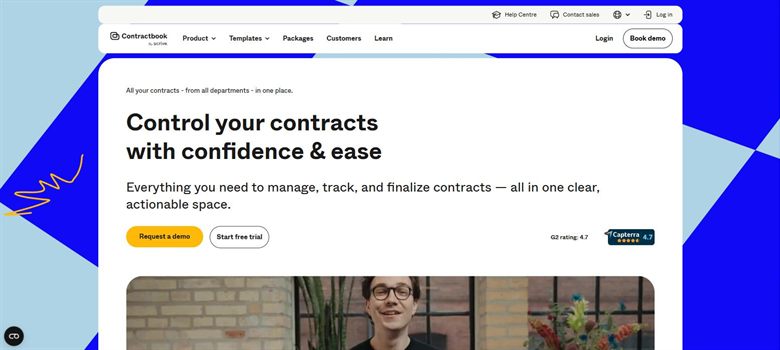
The verdict: The honest answer for teams who looked at Ironclad, saw the quote, and realised they have a few hundred agreements rather than a few thousand.
Pricing: No published rate card. Reported between approximately $39 and $599 a month depending on tier, which is an order of magnitude below anything else on this list.
Standout features:
- Template-driven creation
- Searchable repository
- Data extraction and renewal reminders
- Monthly pricing rather than annual contracts
Limitations: Not comparable to Ironclad on workflow depth, obligation management or reporting. The tier spread is wide and undisclosed, so growth means a conversation you cannot model in advance.
How we chose
- Whether you need a lifecycle platform at all, or a cheaper tool that fixes the actual delay.
- Implementation effort, since that is the second most common reason people leave.
- Reported price against Ironclad's marketplace median of about $40,000 a year.
- Whether a team without legal ops can run it.
- What you give up: obligation tracking, procurement workflow, reporting depth.
- We did not score on integration counts, and we have not scored Ironclad itself. This is a page about the alternatives.
Frequently asked questions
What is the best alternative to Ironclad in 2026?
Icertis for enterprises needing equivalent depth with stronger procurement. Juro for teams who want a real platform at a lower entry point, reported from about $15,000 a year. Contractbook for small teams, reported from around $39 a month.
Why do people look for Ironclad alternatives?
Three reasons in roughly this order: the quote, which marketplace data puts at a median near $40,000 a year; the implementation, which runs to months and needs an internal owner; and the discovery partway through evaluation that the problem was contract review rather than lifecycle management.
Is there a cheaper alternative to Ironclad?
Juro is reported from $15,000 a year against Ironclad's $30,000 low end, and Contractbook from around $39 a month for much less capability. Icertis, Agiloft and LinkSquares publish no prices and we could not source reliable figures, so cheaper is not something we can confirm for those.
How much does Ironclad cost?
No public list price. Reported annual contracts run approximately $30,000 to $250,000, with a marketplace median near $40,000 across 363 recorded purchases. The spread is driven by contract volume, seats and which modules are licensed.
Do I need a CLM at all, or just contract review software?
If contracts get signed and then nobody can find them, renewals lapse, or approvals happen over email, you have a lifecycle problem and these platforms are the answer. If contracts are slow to draft and nobody is sure what to push back on, that is a review problem and a CLM is an expensive way not to solve it.
How long does it take to switch from Ironclad?
Longer than the sales process suggests. Migration means exporting the repository, mapping metadata that rarely lines up between platforms, and rebuilding approval workflows. Budget months rather than weeks, and count the internal owner's time as part of the cost.
Which Ironclad alternative is easiest to implement?
Juro among the real platforms, largely because it expects to be operated by people outside legal. Contractbook is faster still but is solving a smaller problem. Icertis and Agiloft are both at least as involved as Ironclad.