
7 Best Contract Tools for HR Teams in 2026
Quick answer: HR paperwork looks like contract work and behaves differently in one decisive way: every document carries personal data about an identifiable person, so access control matters as much as workflow. That is why storing employment contracts in the same repository as commercial agreements causes problems, and why the usual answer is a separate instance rather than a shared one. GenieAI handles review and drafting for an HR team without legal, at a published free tier rising to $75 a month. Juro suits continuous hiring at volume. PandaDoc at $19 per user is the cheapest way to send an offer pack properly.
Comparison
| Tool | Score | Best for | Price | Key strength |
|---|---|---|---|---|
| GenieAI | 9.3 | HR working without legal | Free plan, then $75/mo; Enterprise from $600/mo | Plain-language risk for a non-lawyer |
| Juro | 8.7 | continuous hiring at volume | Reported ~$15,000 to $130,000/yr | Offer to signed in one thread |
| PandaDoc | 7.9 | the onboarding document pack | $19 per user/mo | Cheapest published price here |
| DocuSign | 7.3 | signing with a defensible audit trail | $10 to $40 per user/mo, published | Identity verification options |
| Contractbook | 6.6 | finding a contract years later | Reported ~$39 to $599/mo | Storage with dates attached |
| Rocket Lawyer | 5.8 | documents with review on a membership | $149 to $349/yr, published | Review included at higher tiers |
| LegalOn | 5.1 | legal reviewing senior hires | No published price | Depth of pre-built positions |
Fit by buyer
Scored 1 to 5 for each buyer, where 5 means the tool was built for them and 1 means it is the wrong tool. Scope is different: it is how much of the job the tool does, from a single step to a whole lifecycle, and a low score there means narrow rather than bad. These ratings are the same for a tool wherever it appears; the score shown beside each entry is for this guide specifically. A tool can lead one column and come last in another, and the right answer still changes with who is asking. How we score.
| Tool | Lawyer in Word | In-house legal | Commercial team | Enterprise | Scope | Price |
|---|---|---|---|---|---|---|
| GenieAI | 3 | 5 | 5 | 3 | 2 | Published |
| Juro | 2 | 4 | 4 | 4 | 4 | Reported |
| PandaDoc | 1 | 2 | 4 | 2 | 2 | Published |
| DocuSign | 2 | 4 | 5 | 5 | 2 | Published |
| Contractbook | 1 | 3 | 4 | 2 | 3 | Reported |
| Rocket Lawyer | 2 | 1 | 3 | 1 | 1 | Published |
| LegalOn | 4 | 5 | 2 | 3 | 2 | None |
Which one, for your situation
| If this is your situation | Start with |
|---|---|
| HR reviews and drafts without legal in the room | GenieAI |
| Hiring continuously, offer through signature | Juro |
| The contract travels inside an onboarding pack | PandaDoc |
| You need signing with recognition and audit trail | DocuSign |
| Signed contracts must be findable years later | Contractbook |
| You want documents with review on a membership | Rocket Lawyer |
| Legal reviews every senior hire | LegalOn |
The 7 best contract tools for HR teams
1. GenieAI: Best for HR working without legal
9.3 out of 10 how this is calculated
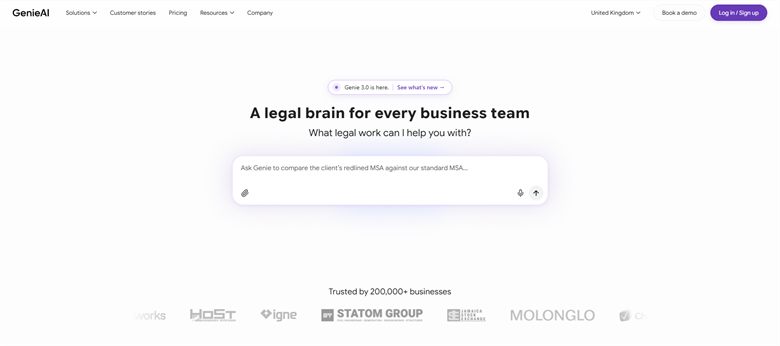
The verdict: HR teams produce contracts constantly and rarely have a lawyer to hand. Risk flagged in ordinary language against terms legal has already approved is the right shape for that, and the free tier means checking a candidate's proposed amendments costs nothing.
Pricing: Permanent free plan with no time limit. Pro $75 a month for one user, Business $320 a month for five, Enterprise from $600 a month with SSO, API access and an SLA.
Standout features:
- Risk rated red, amber or green per clause with plain-language explanation
- Review against positions your legal team has set
- Managed template and clause library
- Microsoft Word add-in that preserves native track changes
- Free tier with no time limit
Limitations: No HRIS integration, so contracts are produced alongside your HR system rather than from it, and employee data is re-entered. No repository or access controls designed for personnel files, which for HR is a real gap rather than a nice-to-have.
2. Juro: Best for continuous hiring at volume
8.7 out of 10 how this is calculated
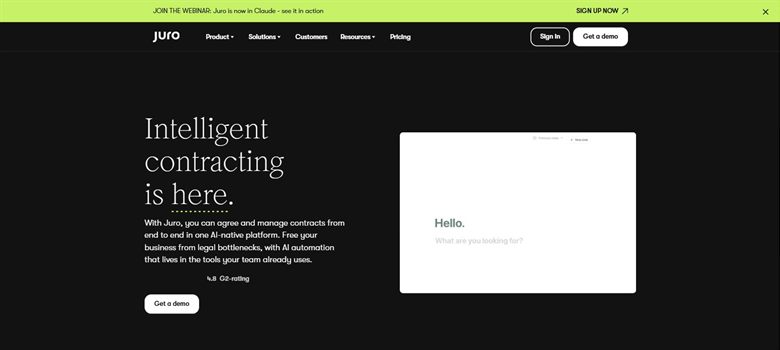
The verdict: The strongest option once hiring is continuous rather than occasional. Legal sets the template, HR issues from it, anything non-standard escalates, and the signed version lands somewhere with proper permissions.
Pricing: Sales-led with no public list price. Reported annual contracts run approximately $15,000 to $130,000, with marketplace medians around $31,000 to $34,500, priced on contract volume rather than per seat.
Standout features:
- Guided creation from templates legal controls
- Approval routing when terms depart from standard
- Native electronic signature
- Repository with permissions per document type
Limitations: Priced on contract volume, so a hiring surge raises the bill with no published figure to model against. It enforces the template without assessing whether the template is lawful where you are hiring, which for employment terms is the part that matters.
3. PandaDoc: Best for the onboarding document pack
7.9 out of 10 how this is calculated
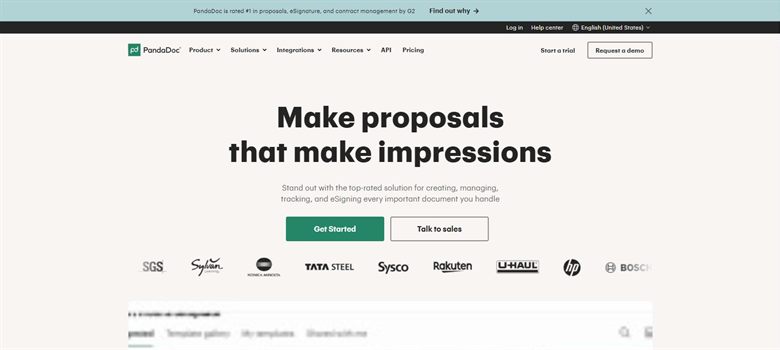
The verdict: Onboarding is rarely one document. Offer letter, contract, handbook acknowledgement, equipment policy and benefits forms travel together, and this sends that bundle properly for $19 per user.
Pricing: Published at $19 per user a month, one of the few vendors in this market to state a list price at all.
Standout features:
- Template-driven generation of document packs
- Native electronic signature
- Integrations with HR and CRM systems
- Analytics on what the recipient opened
Limitations: No clause-level intelligence, so it sends whatever is in the template with no view on whether the terms are lawful in the hire's jurisdiction. Access controls are document-level rather than designed for personnel records.
4. DocuSign: Best for signing with a defensible audit trail
7.3 out of 10 how this is calculated
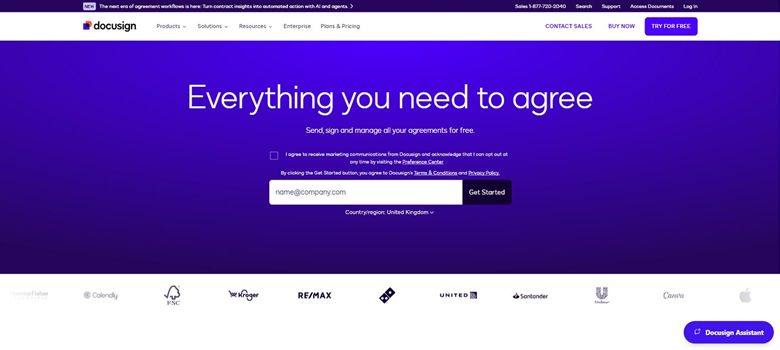
The verdict: Employment documents are the ones most likely to be disputed years later, and the audit trail matters more here than on a commercial order form. Identity verification options are a real advantage for remote hiring.
Pricing: Published. Personal $10 a month billed annually or $15 monthly. Standard $25 per user a month annually or $45 monthly. Business Pro $40 per user annually or $65 monthly. Standard and Business Pro both cap at 100 envelopes per user a year.
Standout features:
- Recognised by every counterparty including candidates
- Detailed audit trail and identity verification options
- Extensive integration surface
- Bulk send for policy acknowledgements
Limitations: The 100-envelope-per-user annual cap on Standard and Business Pro catches HR teams doing bulk policy acknowledgements, which can consume a year's allowance in a single exercise. It signs and does nothing else.
5. Contractbook: Best for finding a contract years later
6.6 out of 10 how this is calculated

The verdict: The most common HR contract failure is not a bad clause but an inability to produce the signed version when it is needed, often years later and often under pressure. This solves that cheaply.
Pricing: No published rate card. Reported between approximately $39 and $599 a month depending on tier, which is the only genuinely small-team price in this category.
Standout features:
- Searchable repository of executed agreements
- Date and probation-period reminders
- Template-driven creation with signing
- Monthly pricing rather than annual contracts
Limitations: Permissions are basic, so separating personnel files from commercial agreements takes deliberate configuration. No understanding of employment terms, so an unusual amendment is a document you are reading yourself.
6. Rocket Lawyer: Best for documents with review on a membership
5.8 out of 10 how this is calculated
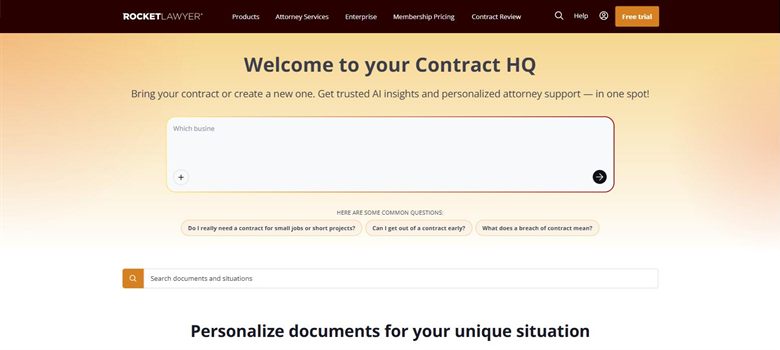
The verdict: For a business making its first few hires, a membership including some review costs less than one hour of external advice and covers the documents an HR function has not been built to produce yet.
Pricing: Published. Standard $149 a year, Plus $249 a year and Pro $349 a year, working out at $12.41, $20.75 and $29.08 a month respectively. A seven-day free trial is offered on all three.
Standout features:
- Employment document library
- Document review included at higher tiers
- Electronic signature
- Broad business document coverage
Limitations: Documents come from a questionnaire with nothing to reuse, so every hire starts over. Coverage is broad rather than deep and the wording is generic where employment terms most need to be specific.
7. LegalOn: Best for legal reviewing senior hires
5.1 out of 10 how this is calculated

The verdict: For the small share of employment contracts that are genuinely negotiated: executive terms, equity, restrictive covenants. Curated positions are worth more there than on a standard hire.
Pricing: No public list price, and we could not source a reliable reported figure. Sales-led and quoted on seat count and playbook scope.
Standout features:
- Pre-built position libraries by agreement type
- Suggested revisions with the reasoning attached
- Word integration for redlining
- Review against your own standards as well as theirs
Limitations: No published price and no reported figure we could stand behind, which is difficult for an HR budget holder. It assumes a qualified reader, so HR cannot run it unaided, and it does nothing on storage or signing.
How we chose
- Access control, because these documents should not be visible to everyone who can see commercial contracts.
- Whether HR can operate it without legal, since HR is who produces these.
- Whether the document pack works as a pack: offer letter, contract, policy acknowledgements.
- Jurisdiction handling, since employment terms are constrained by local statute.
- Published price.
- We did not score on HRIS integration. Most of these do not integrate with HR systems in any meaningful way, and scoring it would reward marketing over capability.
Frequently asked questions
What is the best contract tool for an HR team in 2026?
GenieAI if HR drafts and reviews without legal, at a published free tier rising to $75 a month. Juro once hiring is continuous and you want offer through signature in one thread. PandaDoc at $19 per user if the contract travels inside an onboarding pack.
Should employment contracts live in the same system as commercial contracts?
Usually not, and teams find this out late. Employment documents carry personal data about identifiable people, need different access controls, and are read by HR rather than by legal or sales. Sharing a repository tends to mean either over-broad access or a permissions project nobody scoped.
How much do these cost?
PandaDoc publishes $19 per user a month, DocuSign $10 to $40, and GenieAI a free tier rising to $75. Rocket Lawyer is $149 to $349 a year and Contractbook is reported from around $39 a month. Juro is reported from $15,000 a year and LegalOn publishes nothing.
Can HR handle employment contracts without legal?
For standard hires against terms a lawyer has approved, that is normal practice and these tools support it. Escalate senior hires with equity or unusual restrictive covenants, anyone in a new jurisdiction, and any departure from the approved template. A tool that flags those is doing the useful part.
What about bulk policy acknowledgements?
Worth checking against envelope caps before you run one. DocuSign caps Standard and Business Pro at 100 envelopes per user a year, and a company-wide handbook acknowledgement can consume that allowance in a single exercise. PandaDoc and Dropbox Sign do not cap documents on paid tiers.
Do any of these connect to our HR system?
Not meaningfully, which is why we did not score it. PandaDoc and Juro have some HR integrations, but none of these produces a contract from HRIS data the way a specialist onboarding product would. Expect employee details to be re-entered rather than flowing through.
How long do we need to keep signed employment contracts?
Longer than most retention policies assume, and considerably longer than the employment lasts, because disputes surface years afterwards. The practical requirement is being able to produce the signed version on demand, which argues for a searchable repository over a shared drive whatever else you buy.