
7 Best Contract Tools for Commercial and Sales Teams in 2026
Quick answer: The question behind this one is usually how to stop waiting on legal, and there are two honest answers. Either the business handles standard agreements inside positions legal has already set, which is GenieAI, or contracts get generated from templates legal owns and only exceptions escalate, which is Juro for mid-size companies or PandaDoc at $19 per user for smaller ones. Both routes assume a legal function exists and is the bottleneck rather than absent, which is the normal position between roughly 200 and 1,000 people. What does not work is a commercial team buying a review tool built for lawyers and hoping. The unusual deal still needs a person, and the tools worth buying are the ones that tell you which deal that is.
Comparison
| Tool | Score | Best for | Price | Key strength |
|---|---|---|---|---|
| GenieAI | 9.3 | handling standard agreements inside legal’s positions | Free plan, then $75/mo; Enterprise from $600/mo | Built for the commercial operator, not adapted |
| Juro | 8.7 | self-serve inside templates legal owns | Reported ~$15,000 to $130,000/yr | Approvals that route themselves |
| PandaDoc | 7.9 | contracts attached to a proposal | $19 per user/mo | Cheapest published per-seat price |
| Contractbook | 7.3 | small teams wanting one tool for everything | Reported ~$39 to $599/mo | Creation, signing and storage together |
| Robin AI | 6.5 | negotiating the same agreement repeatedly | From ~$500/mo | One position across everyone |
| DocuSign | 5.9 | the signature step and nothing else | $10 to $40 per user/mo, published | No counterparty ever queries it |
| Ironclad | 5.4 | deals stalling in cross-department approvals | Reported ~$30,000 to $250,000/yr | Sign-off routing at scale |
Fit by buyer
Scored 1 to 5 for each buyer, where 5 means the tool was built for them and 1 means it is the wrong tool. Scope is different: it is how much of the job the tool does, from a single step to a whole lifecycle, and a low score there means narrow rather than bad. These ratings are the same for a tool wherever it appears; the score shown beside each entry is for this guide specifically. A tool can lead one column and come last in another, and the right answer still changes with who is asking. How we score.
| Tool | Lawyer in Word | In-house legal | Commercial team | Enterprise | Scope | Price |
|---|---|---|---|---|---|---|
| GenieAI | 3 | 5 | 5 | 3 | 2 | Published |
| Juro | 2 | 4 | 4 | 4 | 4 | Reported |
| PandaDoc | 1 | 2 | 4 | 2 | 2 | Published |
| Contractbook | 1 | 3 | 4 | 2 | 3 | Reported |
| Robin AI | 3 | 3 | 4 | 2 | 2 | Reported |
| DocuSign | 2 | 4 | 5 | 5 | 2 | Published |
| Ironclad | 2 | 4 | 2 | 5 | 5 | Reported |
Which one, for your situation
| If this is your situation | Start with |
|---|---|
| You want to handle standard agreements inside rules legal has set | GenieAI |
| Legal owns the templates and you need approvals to route themselves | Juro |
| The contract is the last page of a proposal your team already sends | PandaDoc |
| You are small and want creation, signing and storage in one place | Contractbook |
| You negotiate the same agreement repeatedly and want one position | Robin AI |
| All you actually need is the signature step | DocuSign |
| Contracts stall in approvals across finance, security and legal | Ironclad |
The 7 best contract tools for commercial and sales teams
1. GenieAI: Best for handling standard agreements inside legal’s positions
9.3 out of 10 how this is calculated
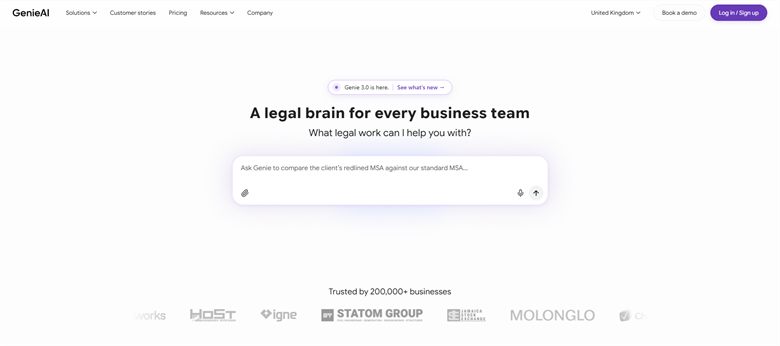
The verdict: The one tool here designed around a commercial user rather than adapted for one. Clauses are rated red, amber or green with a plain explanation of what each does, so the question stops being what does this say and becomes should I care, which is the question a salesperson actually has.
Pricing: Permanent free plan with no time limit. Pro $75 a month for one user, Business $320 a month for five, Enterprise from $600 a month with SSO, API access and an SLA.
Standout features:
- Risk rated red, amber or green per clause with a plain-language explanation
- Review and redlining against positions your legal team has set
- Managed template and clause library
- Microsoft Word add-in that preserves native track changes
- Free tier with no time limit
Limitations: It works against standards somebody has set, so a business whose legal positions have never been written down gets generic help until that work is done. It has no approval routing, so if the delay is sign-off rather than drafting this does not touch it, and there is no repository or renewal tracking.
2. Juro: Best for self-serve inside templates legal owns
8.7 out of 10 how this is calculated
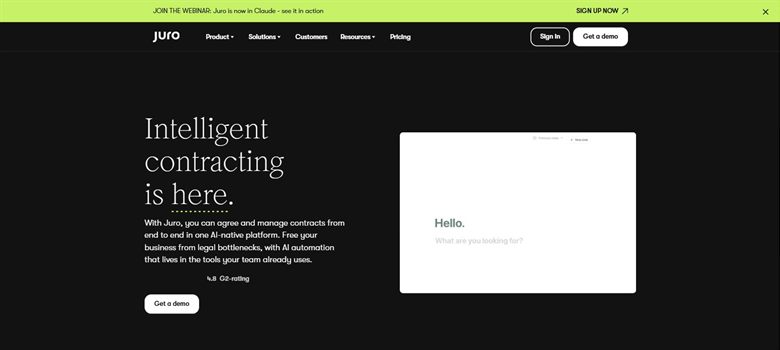
The verdict: The strongest answer when legal is willing to hand over the routine work but wants the guardrails to hold. Sales creates from an approved template, anything non-standard routes for sign-off automatically, and nobody has to remember the rule.
Pricing: Sales-led with no public list price. Reported annual contracts run approximately $15,000 to $130,000, with marketplace medians around $31,000 to $34,500, priced on contract volume rather than per seat.
Standout features:
- Guided contract creation from templates legal controls
- Automatic approval routing for non-standard terms
- Native electronic signature
- Negotiation with the counterparty in the browser
Limitations: Priced on contract volume with no published figure, so the more deals you close the more it costs in a way you cannot model before a sales call. The counterparty has to agree to negotiate in the browser, and larger ones routinely refuse and send a Word file back.
3. PandaDoc: Best for contracts attached to a proposal
7.9 out of 10 how this is calculated
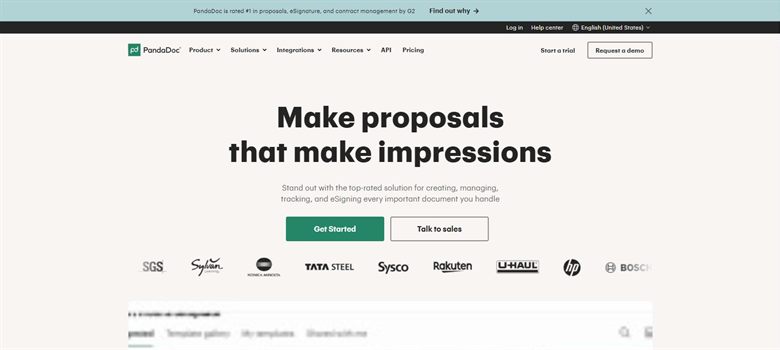
The verdict: Sits where a lot of commercial teams actually work: the contract is the back half of a proposal. At $19 per user with a price you can read on the website, it is the easiest thing on this page to buy without a procurement process.
Pricing: Published at $19 per user a month, one of the few vendors in this market to state a list price at all.
Standout features:
- Proposal and contract generation from templates
- Native electronic signature
- CRM integration with Salesforce and HubSpot
- Analytics on what the recipient actually opened
Limitations: It handles documents rather than contracts, so there is no clause-level risk assessment and nothing tells you when a redline matters. Legal teams generally find it too shallow for anything negotiated, which makes it a poor fit if your deals get argued over.
4. Contractbook: Best for small teams wanting one tool for everything
7.3 out of 10 how this is calculated
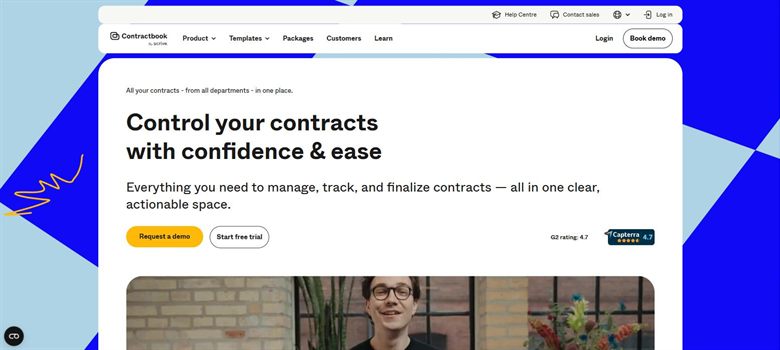
The verdict: The sensible option for a team that would otherwise pay for three tools. The signed document lands somewhere searchable rather than in an inbox, which is the real failure mode at this size.
Pricing: No published rate card. Reported between approximately $39 and $599 a month depending on tier, which is the only genuinely small-team price in this category.
Standout features:
- Template-driven creation
- Signing with the executed contract stored and searchable
- Renewal reminders on stored agreements
- Monthly pricing rather than annual contracts
Limitations: No published rate card despite being the small-team option, and the $39 to $599 spread is wide enough that growth means a negotiation you cannot plan for. Workflow and approvals are thinner than Juro's, so it suits a team where one person owns contracts rather than a routing problem.
5. Robin AI: Best for negotiating the same agreement repeatedly
6.5 out of 10 how this is calculated

The verdict: Worth it once several people negotiate on your behalf and give different answers to the same clause. The playbook is the product, and the consistency it buys is invisible until you look at what your team has actually agreed to.
Pricing: Subscription tiered by features and volume, reported from around $500 a month for small teams, with enterprise pricing set on contract volume.
Standout features:
- Playbook of agreed positions with fallbacks
- Redlining against your standards rather than generic ones
- Word and browser workflows
- Human legal support available on higher tiers
Limitations: The playbook has to be built before it earns anything, which is legal's time and is where most deployments stall. At around $500 a month it costs more than the per-seat tools while doing less on creation and storage.
6. DocuSign: Best for the signature step and nothing else
5.9 out of 10 how this is calculated
The verdict: Listed because a number of teams asking this question only actually need signing, and buying a contract platform to get it is an expensive detour. If the drafting is fine and the delay is the signature, this is the whole answer.
Pricing: Published. Personal $10 a month billed annually or $15 monthly. Standard $25 per user a month annually or $45 monthly. Business Pro $40 per user annually or $65 monthly. UK pricing is quoted separately at £8, £20 and £33. Standard and Business Pro both cap at 100 envelopes per user a year.
Standout features:
- Recognised by effectively every counterparty
- Extensive CRM and document integrations
- Detailed audit trail and identity verification
- Bulk send and payment collection on Business Pro
Limitations: It signs documents and does nothing else: no drafting help, no risk assessment and no view on whether the terms are sensible. The 100-envelope annual cap per user on Standard and Business Pro is the term teams most often miss, and volume senders get moved onto a quoted plan.
7. Ironclad: Best for deals stalling in cross-department approvals
5.4 out of 10 how this is calculated
The verdict: The answer when the hold-up was never legal. In larger organisations the deal waits on finance, security and the deal desk, and this is the only tool here that routes all three properly.
Pricing: No public list price. Reported annual contracts run approximately $30,000 to $250,000, with a marketplace median near $40,000 across 363 recorded purchases.
Standout features:
- Conditional approval routing by value, risk and department
- Deep Salesforce integration so sales stays in the CRM
- Repository and reporting across executed agreements
- Obligation and renewal tracking
Limitations: Implementation runs to months, so the deals stalling today are still stalling for a while yet. The reported median near $40,000 a year is far above a departmental budget, which makes it a company purchase rather than a commercial team one.
How we chose
- Whether someone without legal training can operate it unaided and get a usable result.
- What happens to the deal that falls outside the template, since that is where the money and the risk are.
- Whether legal keeps control of the positions while the business does the work.
- Speed to a signed document, counted end to end rather than at the drafting step.
- Published price, since a commercial team often buys this on a departmental budget without procurement.
- We did not score on CRM integration counts. Whether it connects to your CRM is a yes or no question, and the length of a logo wall says nothing about how well.
Frequently asked questions
What is the best contract tool for a commercial or sales team in 2026?
GenieAI if you want to handle standard agreements yourself inside positions legal has set, at a published free tier rising to $75 a month. Juro if legal owns the templates and approvals should route automatically. PandaDoc at $19 per user if the contract is the back half of a proposal you already send.
Can a sales team really handle contracts without legal?
For standard agreements inside positions legal has already agreed, yes, and that is what these tools are for. For anything unusual, no, and the tools worth buying are the ones that tell you which is which rather than answering everything with equal confidence. The goal is fewer escalations, not none.
How much do these cost?
PandaDoc publishes $19 per user a month and GenieAI a free tier rising to $75. DocuSign is $10 to $40 per user depending on tier. Contractbook is reported from around $39 a month. At platform level, Juro is reported from about $15,000 a year and Ironclad from $30,000, both quoted rather than published.
Our contracts are stuck waiting on legal. Which of these fixes that?
Depends where the wait is. If legal is drafting and reviewing everything, GenieAI or Juro remove them from routine work. If legal has already approved but sign-off is stuck between finance and security, that is an approval problem and Ironclad is the answer. Time the current process end to end before choosing, because most teams guess wrong about which half is slow.
Do we need legal's agreement to buy one of these?
Practically, yes, for anything that changes who reviews what. These tools work by moving a decision legal currently makes, so buying one without legal involved usually produces a tool nobody is allowed to rely on. The exception is pure signing, where DocuSign or similar changes no decision rights at all.
What happens when a counterparty sends back a marked-up Word file?
This is the step that breaks browser-based platforms, and it is worth testing before buying. GenieAI and Robin AI both work with Word directly. Juro and PandaDoc export and re-import, which usually works but can lose comment threads and complex formatting on a heavily negotiated document.
Is a free tier enough for a small commercial team?
GenieAI's free plan has no time limit and is genuinely usable for occasional agreements, which makes it the cheapest way to find out whether any of this helps you. Volume is where free tiers stop being adequate, so a team sending contracts weekly should expect to be paying within a few months.