
7 Best AI Tools for Employment Contracts in 2026
Quick answer: Employment contracts differ from commercial ones in a way that changes the shortlist: the terms are constrained by statute rather than negotiated, and those statutes differ by country and often by state. So the question is less which tool drafts well and more which one knows where you are hiring. GenieAI is the strongest for an HR or ops team producing them without legal, at a published free tier rising to $75 a month. LegalOn has the deepest positions but publishes no price. If you are hiring across borders, treat any tool's jurisdiction coverage as the first thing to test rather than the last.
Comparison
| Tool | Score | Best for | Price | Key strength |
|---|---|---|---|---|
| GenieAI | 9.3 | HR and ops producing contracts without legal | Free plan, then $75/mo; Enterprise from $600/mo | Built for the non-lawyer operator |
| LegalOn | 8.5 | legal reviewing every hire | No published price | Depth of pre-built positions |
| Juro | 8.0 | hiring at volume, offer through signature | Reported ~$15,000 to $130,000/yr | One flow from offer to signed |
| Spellbook | 7.2 | bespoke terms for senior hires | Reported ~$99 to $199 per user/mo | Word-native drafting |
| PandaDoc | 6.6 | offer letters inside a document pack | $19 per user/mo | Cheapest published per-seat price |
| Contractbook | 5.9 | small teams hiring occasionally | Reported ~$39 to $599/mo | Only small-team price here |
| Rocket Lawyer | 5.2 | occasional documents with review included | $149 to $349/yr, published | Membership covers document plus advice |
Fit by buyer
Scored 1 to 5 for each buyer, where 5 means the tool was built for them and 1 means it is the wrong tool. Scope is different: it is how much of the job the tool does, from a single step to a whole lifecycle, and a low score there means narrow rather than bad. These ratings are the same for a tool wherever it appears; the score shown beside each entry is for this guide specifically. A tool can lead one column and come last in another, and the right answer still changes with who is asking. How we score.
| Tool | Lawyer in Word | In-house legal | Commercial team | Enterprise | Scope | Price |
|---|---|---|---|---|---|---|
| GenieAI | 3 | 5 | 5 | 3 | 2 | Published |
| LegalOn | 4 | 5 | 2 | 3 | 2 | None |
| Juro | 2 | 4 | 4 | 4 | 4 | Reported |
| Spellbook | 5 | 4 | 2 | 2 | 2 | Reported |
| PandaDoc | 1 | 2 | 4 | 2 | 2 | Published |
| Contractbook | 1 | 3 | 4 | 2 | 3 | Reported |
| Rocket Lawyer | 2 | 1 | 3 | 1 | 1 | Published |
Which one, for your situation
| If this is your situation | Start with |
|---|---|
| HR or ops produces contracts without a lawyer | GenieAI |
| Legal reviews every hire and wants the deepest positions | LegalOn |
| Hiring at volume with offer and signature in one flow | Juro |
| A lawyer drafts bespoke terms for senior hires | Spellbook |
| The offer letter is part of a wider document pack | PandaDoc |
| A small team hiring occasionally | Contractbook |
| You need documents and review on a membership | Rocket Lawyer |
The 7 best AI tools for employment contracts
1. GenieAI: Best for HR and ops producing contracts without legal
9.3 out of 10 how this is calculated
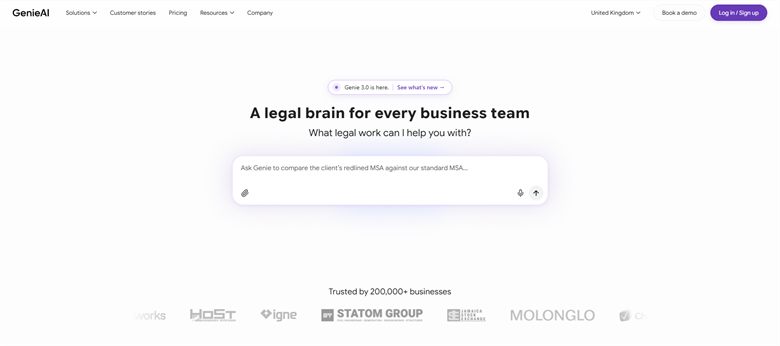
The verdict: The right shape for how employment contracts actually get produced, which is by an HR or operations person working from a template legal approved months ago. Risk flagged in plain language matters more here than drafting sophistication, because the reader is not a lawyer.
Pricing: Permanent free plan with no time limit. Pro $75 a month for one user, Business $320 a month for five, Enterprise from $600 a month with SSO, API access and an SLA.
Standout features:
- Risk rated red, amber or green per clause with a plain-language explanation
- Managed template and clause library
- Review against positions your legal team has set
- Microsoft Word add-in that preserves native track changes
- Free tier with no time limit
Limitations: It works against standards somebody has set, so a business that has never had its employment terms reviewed gets generic help until it does. It has no HR system integration, so contracts are produced alongside your HRIS rather than from it, and there is no onboarding workflow attached.
2. LegalOn: Best for legal reviewing every hire
8.5 out of 10 how this is calculated

The verdict: The best review quality here, and employment is a category where lawyer-authored positions earn their keep because so much of the document is constrained rather than chosen. The absence of any price is what keeps it second.
Pricing: No public list price, and we could not source a reliable reported figure. Sales-led and quoted on seat count and playbook scope.
Standout features:
- Pre-built position libraries by agreement type
- Suggested revisions with the reasoning attached
- Word integration for redlining
- Review against your own standards as well as theirs
Limitations: No published price and no reported figure we could stand behind, which is a particular problem for an HR budget holder who cannot get a number to compare. It assumes a qualified reader, so handing it to an HR team without legal support does not work.
3. Juro: Best for hiring at volume, offer through signature
8.0 out of 10 how this is calculated
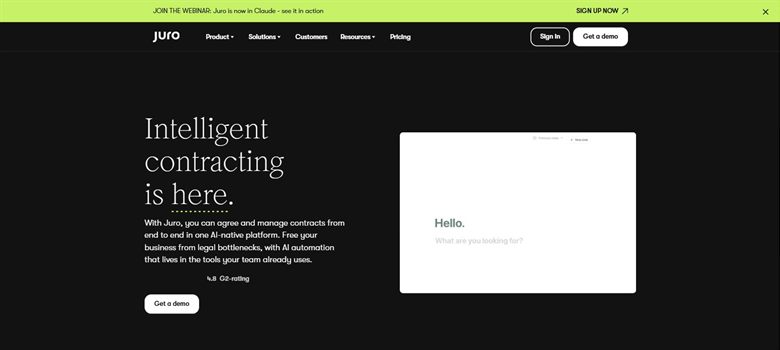
The verdict: The strongest option once hiring is continuous rather than occasional. Offer, contract and signature in one thread, with legal setting the template and never seeing a standard hire again.
Pricing: Sales-led with no public list price. Reported annual contracts run approximately $15,000 to $130,000, with marketplace medians around $31,000 to $34,500, priced on contract volume rather than per seat.
Standout features:
- Guided creation from templates legal controls
- Approval routing when terms depart from standard
- Native electronic signature
- Searchable repository of every executed contract
Limitations: Priced on contract volume, so a hiring surge raises the bill, and there is no published figure to model that against. It enforces the template you set without assessing whether the template is right, which for employment terms is the part that matters most.
4. Spellbook: Best for bespoke terms for senior hires
7.2 out of 10 how this is calculated
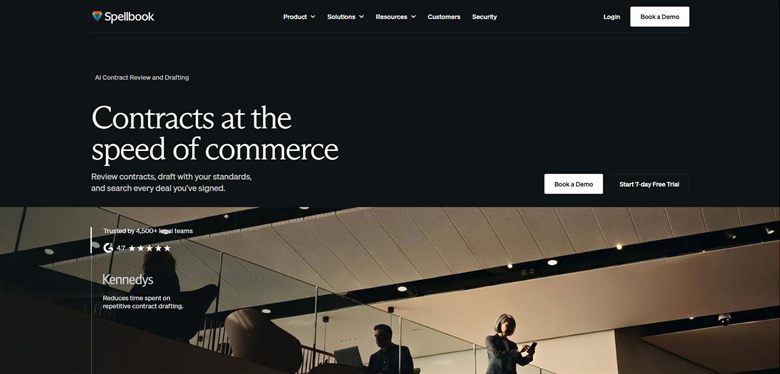
The verdict: Right for the small share of employment contracts that are genuinely negotiated: executive terms, equity, restrictive covenants worth arguing about. For the standard hire it is more tool than the job needs.
Pricing: No published list price. Reported at approximately $99 to $199 per user a month, rising to around $350 per user on enterprise plans with a ten-seat minimum. A seven-day trial is offered.
Standout features:
- Drafting and redlining inside Microsoft Word
- Suggestions benchmarked against market standard
- Clause generation from a description
- Seven-day trial
Limitations: It assumes a qualified reader, so HR cannot run it unaided, and it holds no template library or repository. Benchmarking against market standard is less useful in employment than in commercial work, because the binding constraint is statute rather than what other parties accept.
5. PandaDoc: Best for offer letters inside a document pack
6.6 out of 10 how this is calculated
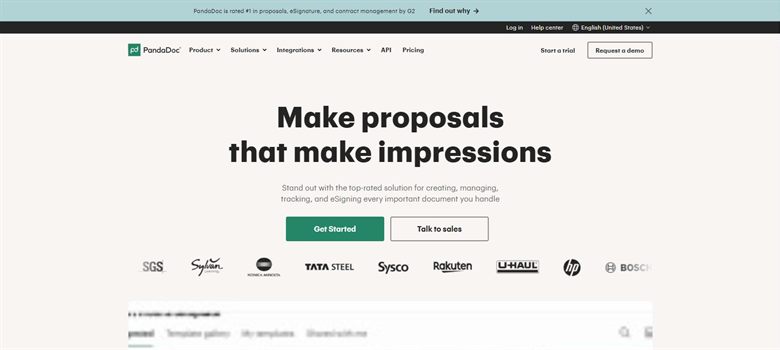
The verdict: Sensible when the employment contract travels with an offer letter, handbook acknowledgement and policy pack, which is how most onboarding actually works. At $19 per user it is the cheapest way to send that bundle properly.
Pricing: Published at $19 per user a month, one of the few vendors in this market to state a list price at all.
Standout features:
- Template-driven generation of document packs
- Native electronic signature
- Integrations with HR and CRM systems
- Analytics on what the recipient opened
Limitations: No clause-level legal intelligence, so it sends whatever you put in the template without any view on whether the terms are lawful where you are hiring. It is a document tool applied to employment rather than a tool that understands employment.
6. Contractbook: Best for small teams hiring occasionally
5.9 out of 10 how this is calculated

The verdict: Adequate for a business making a handful of hires a year that mainly needs the signed contract stored somewhere findable rather than in a folder on someone's laptop.
Pricing: No published rate card. Reported between approximately $39 and $599 a month depending on tier, which is the only genuinely small-team price in this category.
Standout features:
- Template-driven creation
- Signing with the executed contract stored and searchable
- Renewal and date reminders on stored agreements
- Monthly pricing rather than annual contracts
Limitations: Template substitution rather than anything that understands employment law, so an unusual hire is a document you are writing yourself. The undisclosed tier spread makes growth impossible to plan for.
7. Rocket Lawyer: Best for occasional documents with review included
5.2 out of 10 how this is calculated
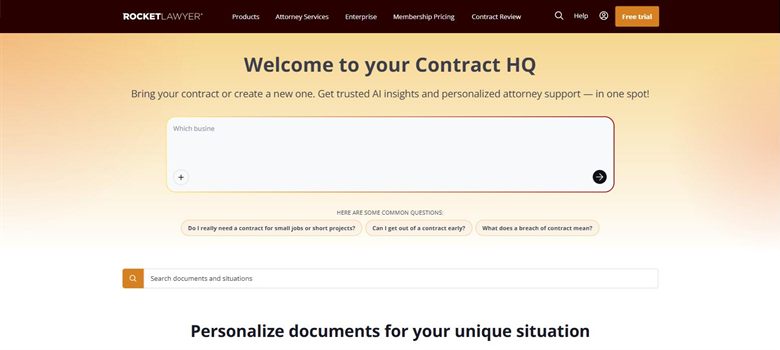
The verdict: The cheapest route to an employment contract with some professional review attached, which for a business making its first few hires is a reasonable trade against a tool it will barely use.
Pricing: Published. Standard $149 a year, Plus $249 a year and Pro $349 a year, working out at $12.41, $20.75 and $29.08 a month respectively. A seven-day free trial is offered on all three.
Standout features:
- Employment document library
- Document review included at higher tiers
- Electronic signature
- Business formation and registered agent services
Limitations: Documents come from a questionnaire and are not automated, so there is nothing to reuse at volume and every hire starts over. Coverage is broad rather than deep, and the annual headline rate depends on paying twelve months upfront.
How we chose
- Jurisdiction coverage, since an employment contract that is fine in one country can be void in another.
- Whether HR can operate it without legal, because HR is usually who actually produces these.
- How the tool handles the clauses that are statutorily constrained rather than negotiable.
- Whether it keeps a consistent set of terms across every hire, which is where inconsistency creates exposure.
- Published price, and whether jurisdiction packs cost extra.
- We did not score on employment law currency. No vendor publishes how often its templates are reviewed against changing legislation, so any claim we made about it would be unverifiable. Ask that question directly in a demo.
Frequently asked questions
What is the best AI tool for employment contracts in 2026?
GenieAI if HR or operations produces them without legal, at a published free tier rising to $75 a month. LegalOn if legal reviews every hire and wants the deepest positions, though it publishes no price. Juro if hiring is continuous and you want offer through signature in one flow.
Why are employment contracts different from other contracts?
Most of the document is constrained by statute rather than negotiated, and those statutes differ by country and often by state. A commercial contract is mostly about what the parties agree. An employment contract is largely about what they are permitted to agree, which makes jurisdiction coverage the thing to test first.
Can HR produce employment contracts without a lawyer?
For standard hires against terms a lawyer has already approved, that is normal practice and these tools support it. The cases to escalate are senior hires with equity or unusual restrictive covenants, anyone in a new jurisdiction, and any departure from the approved template. A tool that flags those rather than answering everything is doing the useful part.
How much do these cost?
PandaDoc publishes $19 per user a month, GenieAI a free tier rising to $75, and Rocket Lawyer $149 to $349 a year. Spellbook is reported at $99 to $199 per user a month. Juro is reported from about $15,000 a year. LegalOn publishes nothing and no reliable figure could be sourced.
Do these tools handle multiple jurisdictions?
To very different degrees, and vendors are vague about it. Ask specifically which countries and states are covered, when those templates were last reviewed against local legislation, and what happens when you hire somewhere unsupported. A tool that produces a confident contract for a jurisdiction it does not really cover is worse than one that refuses.
What about restrictive covenants and non-competes?
This is the clause most likely to be unenforceable and the rules move. Enforceability varies sharply by jurisdiction and has changed materially in several markets recently. Treat any tool's default wording as a starting point that needs checking against current local rules rather than as settled, and it is the specific clause worth escalating.
Should the employment contract live in the same system as commercial contracts?
Usually not, and teams often discover that late. Employment agreements carry personal data, need different access controls, and are read by HR rather than by legal or sales. Storing them in a commercial contract repository tends to mean either over-broad access or a separate permissions project nobody scoped.