
7 Best Legal AI Tools for Scale-Ups in 2026
Quick answer: Scale-ups buy legal tooling at the point where the founder stops reading every contract and nobody has replaced them. The specific trap at this stage is pricing model: Juro and Ironclad both price on contract volume, so the bill rises exactly as the business succeeds, while GenieAI, PandaDoc and Contractbook price per seat or per tier and stay predictable. GenieAI leads here because a first in-house hire needs standards enforced rather than a platform implemented, at a published free tier rising to $75 a month. Buy volume-priced platforms deliberately rather than by default.
Comparison
| Tool | Score | Best for | Price | Key strength |
|---|---|---|---|---|
| GenieAI | 9.3 | a first legal hire setting standards | Free plan, then $75/mo; Enterprise from $600/mo | Standards that survive the first legal hire |
| Juro | 8.7 | taking legal out of the sales queue | Reported ~$15,000 to $130,000/yr | Deploys in weeks, not months |
| PandaDoc | 7.9 | standard paper sales can send itself | $19 per user/mo | Published price that scales per head |
| Contractbook | 7.3 | storage and renewals before a platform | Reported ~$39 to $599/mo | Small-team price with a repository |
| Spellbook | 6.5 | once you have hired a lawyer | Reported ~$99 to $199 per user/mo | Useful the day they start |
| Robin AI | 5.8 | several negotiators, one position | From ~$500/mo | Stops terms drifting between people |
| Ironclad | 5.4 | genuine approval complexity | Reported ~$30,000 to $250,000/yr | Depth you will grow into |
Fit by buyer
Scored 1 to 5 for each buyer, where 5 means the tool was built for them and 1 means it is the wrong tool. Scope is different: it is how much of the job the tool does, from a single step to a whole lifecycle, and a low score there means narrow rather than bad. These ratings are the same for a tool wherever it appears; the score shown beside each entry is for this guide specifically. A tool can lead one column and come last in another, and the right answer still changes with who is asking. How we score.
| Tool | Lawyer in Word | In-house legal | Commercial team | Enterprise | Scope | Price |
|---|---|---|---|---|---|---|
| GenieAI | 3 | 5 | 5 | 3 | 2 | Published |
| Juro | 2 | 4 | 4 | 4 | 4 | Reported |
| PandaDoc | 1 | 2 | 4 | 2 | 2 | Published |
| Contractbook | 1 | 3 | 4 | 2 | 3 | Reported |
| Spellbook | 5 | 4 | 2 | 2 | 2 | Reported |
| Robin AI | 3 | 3 | 4 | 2 | 2 | Reported |
| Ironclad | 2 | 4 | 2 | 5 | 5 | Reported |
Which one, for your situation
| If this is your situation | Start with |
|---|---|
| Your first legal hire needs standards enforced across the business | GenieAI |
| Sales volume is the pressure and legal is the queue | Juro |
| Contracts are standard and sales just needs to send them | PandaDoc |
| You need signed agreements stored and renewals flagged | Contractbook |
| You have hired a lawyer who works in Word | Spellbook |
| Several people negotiate and give different answers | Robin AI |
| You have reached genuine enterprise approval complexity | Ironclad |
The 7 best legal AI tools for scale-ups
1. GenieAI: Best for a first legal hire setting standards
9.3 out of 10 how this is calculated
The verdict: The stage problem is that everyone is signing things and nobody agrees what is acceptable. Setting positions once and having the business work inside them is the right first move, and it costs the same whether you close ten deals this month or a hundred.
Pricing: Permanent free plan with no time limit. Pro $75 a month for one user, Business $320 a month for five, Enterprise from $600 a month with SSO, API access and an SLA.
Standout features:
- Review and redlining against positions your team has set
- Risk rated red, amber or green with plain-language explanations
- Organisational knowledge graph so decisions carry forward as the team grows
- Microsoft Word add-in that preserves native track changes
- Free tier with no time limit
Limitations: No repository, no approval routing and no renewal tracking, so once contract volume becomes a process problem you will be adding a platform alongside it. Standards have to be set before it does its best work, which is a task a scale-up often has nobody to do.
2. Juro: Best for taking legal out of the sales queue
8.7 out of 10 how this is calculated
The verdict: The platform most often chosen at this stage, and deservedly: weeks rather than months to deploy, and non-legal staff run it unaided. It removes legal from routine agreements, which is the structural fix rather than a speed improvement.
Pricing: Sales-led with no public list price. Reported annual contracts run approximately $15,000 to $130,000, with marketplace medians around $31,000 to $34,500, priced on contract volume rather than per seat.
Standout features:
- Guided creation from templates legal controls
- Approval routing when terms depart from standard
- Native electronic signature
- Searchable repository with renewal dates
Limitations: Priced on contract volume, so the bill rises as the business grows and cannot be modelled before a sales conversation. That is a poor fit for a scale-up budget and it is the single thing to negotiate hardest on. The browser negotiation model also breaks when a larger counterparty insists on Word.
3. PandaDoc: Best for standard paper sales can send itself
7.9 out of 10 how this is calculated
The verdict: Underrated at this stage. If nothing in your agreements gets argued over, $19 per user buys the whole job, and the money saved against a platform funds the first legal hire who will decide what you actually need.
Pricing: Published at $19 per user a month, one of the few vendors in this market to state a list price at all.
Standout features:
- Template-driven document and contract generation
- Native electronic signature
- CRM integration with Salesforce and HubSpot
- Analytics on what recipients opened
Limitations: No clause-level intelligence and no meaningful negotiation support, so it stops being adequate the moment counterparties start changing terms. It stores documents rather than reporting on contract terms, so it will not answer what did we commit to.
4. Contractbook: Best for storage and renewals before a platform
7.3 out of 10 how this is calculated
The verdict: Covers the specific failure of this stage, which is signed agreements living in email and renewals nobody is watching. It does that for roughly a hundredth of a platform.
Pricing: No published rate card. Reported between approximately $39 and $599 a month depending on tier, which is the only genuinely small-team price in this category.
Standout features:
- Searchable repository of executed agreements
- Renewal and date reminders
- Template-driven creation
- Monthly pricing rather than annual contracts
Limitations: Workflow and approvals are thinner than Juro's, so it suits a business where one person owns contracts rather than a routing problem. No published rate card, and the $39 to $599 spread means growth involves a negotiation you cannot plan.
5. Spellbook: Best for once you have hired a lawyer
6.5 out of 10 how this is calculated
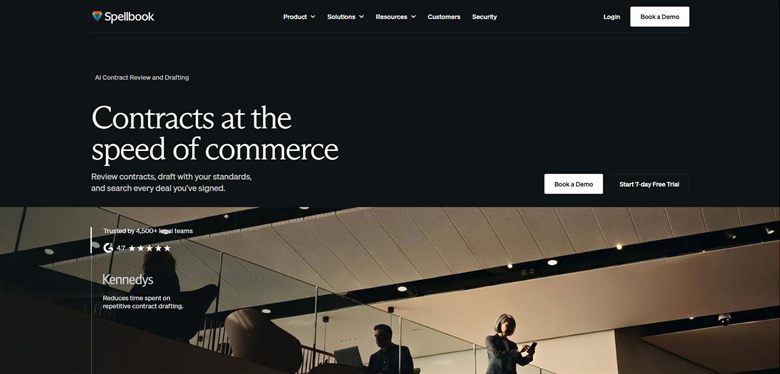
The verdict: The right purchase for a first in-house lawyer who is drowning, because it works on day one with no implementation. It makes that person faster and does not change how the business behaves.
Pricing: No published list price. Reported at approximately $99 to $199 per user a month, rising to around $350 per user on enterprise plans with a ten-seat minimum. A seven-day trial is offered.
Standout features:
- Drafting, review and redlining inside Microsoft Word
- Suggestions benchmarked against market standard
- Same-day setup with no implementation
- Seven-day trial
Limitations: It improves one person's throughput and leaves the queue in front of them the same length, which at a scale-up is usually the actual problem. Nothing the business can use without that lawyer, and the ten-seat minimum on enterprise plans is awkward at this size.
6. Robin AI: Best for several negotiators, one position
5.8 out of 10 how this is calculated

The verdict: Relevant once more than one person negotiates and nobody is comparing what they agreed. That happens earlier at scale-ups than people expect, usually the moment a second salesperson is hired.
Pricing: Subscription tiered by features and volume, reported from around $500 a month for small teams, with enterprise pricing set on contract volume.
Standout features:
- Playbook of agreed positions with fallbacks
- Redlining against your standards rather than generic ones
- Word and browser workflows
- Human legal support available on higher tiers
Limitations: The playbook has to be written first, which is weeks of legal time a scale-up rarely has spare. At around $500 a month it is more than the per-seat tools while doing nothing on storage or renewals.
7. Ironclad: Best for genuine approval complexity
5.4 out of 10 how this is calculated
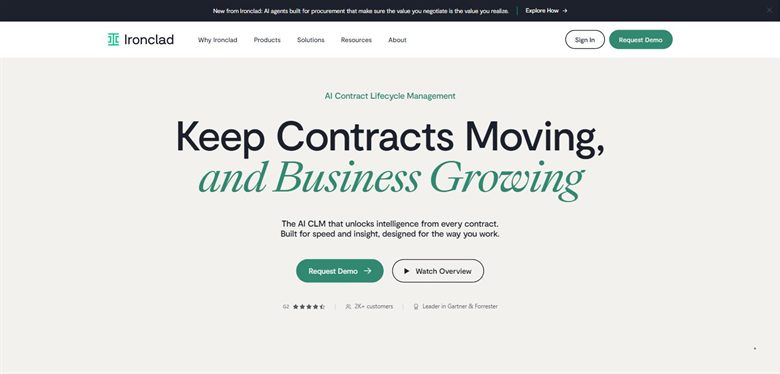
The verdict: Listed last on purpose. It is the right answer eventually and the wrong one early, and scale-ups buy it too soon more often than too late because it is the name they have heard.
Pricing: No public list price. Reported annual contracts run approximately $30,000 to $250,000, with a marketplace median near $40,000 across 363 recorded purchases.
Standout features:
- Conditional approval routing by value, risk and department
- Repository and reporting across executed agreements
- Obligation and renewal tracking
- Deep Salesforce and procurement integration
Limitations: Months to implement with an internal owner, which a scale-up does not have spare, and a reported median near $40,000 a year. Priced partly on contract volume, so it also gets more expensive as you grow. Buy it when approvals across departments are genuinely the bottleneck, not before.
How we chose
- How the price behaves as contract volume grows, which at this stage is the thing that bites.
- Whether it works before you have a legal function and still works after you hire one.
- Time to value, since a scale-up cannot spare an internal owner for a months-long implementation.
- Whether commercial teams can operate it, because for a while they are the only ones available.
- Published price, since a scale-up finance function will ask for one.
- We did not score on fundraising or corporate paperwork. Cap tables, SAFEs and option schemes are a separate category and none of these tools handles them.
Frequently asked questions
What is the best legal AI tool for a scale-up in 2026?
GenieAI if the problem is that nobody agrees what terms are acceptable, at a published free tier rising to $75 a month. Juro if legal has become the queue that sales waits in. PandaDoc at $19 per user if your agreements are standard and nothing gets argued over.
What is the pricing trap at this stage?
Volume-based pricing. Juro and Ironclad both price partly on contract volume, so the bill rises exactly as the business succeeds, and neither publishes a figure you can model against. GenieAI, PandaDoc and Contractbook price per seat or per tier and stay predictable. Buy volume pricing deliberately, not by default.
When should a scale-up buy contract software at all?
When the founder has stopped reading every contract and nobody has replaced them, which is the actual transition. Before that, templates and a shared drive are adequate and cheaper. The signal is usually a spreadsheet appearing to track what was agreed, or a deal delayed because nobody knew who could approve a term.
Should we buy a platform before hiring a lawyer?
Usually a lighter tool first. A platform needs somebody to configure the rules and own the rollout, and without a legal function that person does not exist. A per-seat tool that helps whoever is currently signing things buys time until the hire, and the hire will have opinions about the platform.
How much should a scale-up expect to spend?
PandaDoc publishes $19 per user a month and GenieAI a free tier rising to $75, so a small team can be properly equipped for a few thousand a year. Contractbook is reported from around $39 a month. Platforms start an order of magnitude higher, with Juro reported from $15,000 a year and Ironclad from $30,000.
What about fundraising paperwork?
None of these handle it. Cap tables, SAFEs, option schemes and board documents are a separate category with separate tools, and a contract platform will not help. It is worth saying because scale-ups frequently expect one purchase to cover both and it does not.
How do we avoid buying the wrong thing at this stage?
Name the bottleneck before shortlisting. If contracts are slow because nobody knows what to push back on, that is a review problem. If they are slow because approval is unclear, that is a workflow problem. If signed agreements are lost, that is a repository problem. Scale-ups routinely buy for the second and have the first.