
7 Best CoCounsel Alternatives in 2026
Quick answer: The reported $4,500 per user a year that draws people to CoCounsel is the tier without Westlaw or Practical Law attached, and the price rises sharply once they are. That surprise is the most common reason for looking elsewhere. If the corpus is what you need, Lexis+ AI is the direct competitor at a reported $3,000 to $8,000 per user. If breadth across practice areas is the goal, Harvey is a firm purchase from a reported $50,000. And if what you actually do is contracts rather than research, Spellbook does that job for a reported $99 to $199 per user a month, which is a fraction of any of them.
Comparison
| Tool | Score | Best for | Price | Key strength |
|---|---|---|---|---|
| Lexis+ AI | 9.4 | licensed authority with citation validation | Reported ~$3,000 to $8,000 per user/yr | Shepard's and the corpus behind it |
| Westlaw Precision | 8.6 | firms already on the Westlaw corpus | No published price | KeyCite and headnote depth |
| Harvey | 8.0 | breadth across practice areas | Reported ~$50,000 to $290,000/yr | Firm-wide rather than per seat |
| vLex Vincent | 7.3 | work that crosses jurisdictions | No published price | Breadth of jurisdictions |
| Paxton AI | 6.5 | small firms priced out | No published price | Lowest entry point in the category |
| Spellbook | 5.8 | lawyers whose work is contracts | Reported ~$99 to $199 per user/mo | A twentieth of the price for the right job |
| Luminance | 5.4 | contract analysis across an estate | List ~$41,340/yr for 1,000 documents | Publishes a price, unusually |
Fit by buyer
Scored 1 to 5 for each buyer, where 5 means the tool was built for them and 1 means it is the wrong tool. Scope is different: it is how much of the job the tool does, from a single step to a whole lifecycle, and a low score there means narrow rather than bad. These ratings are the same for a tool wherever it appears; the score shown beside each entry is for this guide specifically. A tool can lead one column and come last in another, and the right answer still changes with who is asking. How we score.
| Tool | Lawyer in Word | In-house legal | Commercial team | Enterprise | Scope | Price |
|---|---|---|---|---|---|---|
| Lexis+ AI | 4 | 4 | 1 | 4 | 4 | Reported |
| Westlaw Precision | 4 | 4 | 1 | 4 | 4 | None |
| Harvey | 4 | 3 | 1 | 4 | 4 | Reported |
| vLex Vincent | 4 | 3 | 1 | 3 | 4 | None |
| Paxton AI | 3 | 3 | 1 | 2 | 3 | None |
| Spellbook | 5 | 4 | 2 | 2 | 2 | Reported |
| Luminance | 3 | 4 | 1 | 4 | 4 | Published |
Which one, for your situation
| If this is your situation | Start with |
|---|---|
| The licensed corpus and citation validation are the point | Lexis+ AI |
| You want the other half of the duopoly | Westlaw Precision |
| A firm buying breadth across practice areas | Harvey |
| The work crosses jurisdictions | vLex Vincent |
| A small firm priced out of the incumbents | Paxton AI |
| What you actually do is contracts, not research | Spellbook |
| The volume is contract analysis across an estate | Luminance |
The 7 best CoCounsel alternatives
1. Lexis+ AI: Best for licensed authority with citation validation
9.4 out of 10 how this is calculated
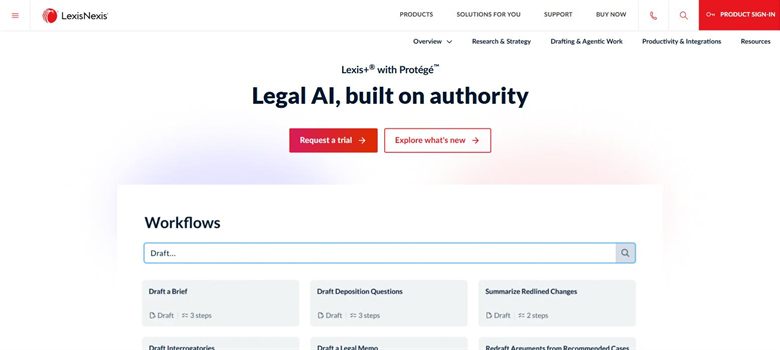
The verdict: The direct competitor and the cleanest swap if authority is what you were buying. Shepard's citation validation is the capability that is genuinely hard to replicate, and unlike CoCounsel's entry tier the corpus is included in the number.
Pricing: No public list price. Reported at approximately $3,000 to $8,000 per user a year for core services, with specialist modules charged separately. The database licence and the AI layer are usually priced as one.
Standout features:
- Licensed case law, statutes and secondary sources
- Shepard's citation validation
- Answers linked to the underlying authority
- Broad US coverage with international modules
Limitations: Priced per user per year on top of a database subscription, which puts it beyond small firms and most in-house teams. It does less on document review and drafting than CoCounsel, so a lawyer whose day mixes both gives something up.
2. Westlaw Precision: Best for firms already on the Westlaw corpus
8.6 out of 10 how this is calculated
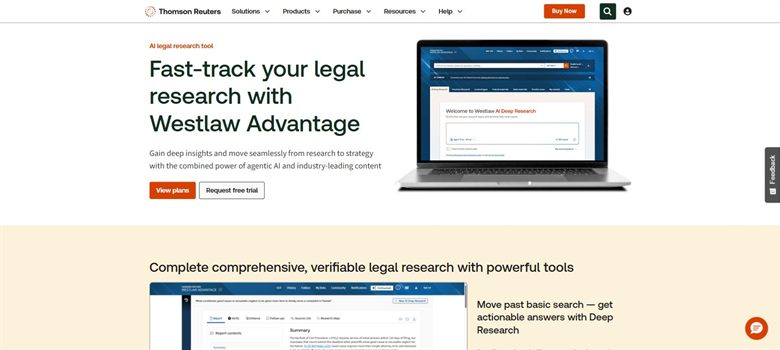
The verdict: Worth naming because it is the same group as CoCounsel, so a firm considering both is often really deciding how much of the Thomson Reuters stack to take. The editorial layer is a century of classification work no model has replicated.
Pricing: No published price and no reliable reported figure we could source. Sold per user per year alongside a Westlaw subscription, and quoted on firm size and practice areas. We would rather say that than print a number we cannot stand behind.
Standout features:
- Licensed case law with editorial headnotes
- KeyCite treatment flags
- AI answers grounded in the licensed corpus
- Practice-area specific research tools
Limitations: Publishes nothing and no reliable figure could be sourced, so it swaps CoCounsel's tier confusion for no visibility at all. It assumes an existing Westlaw subscription, and it does not do the document work CoCounsel bundles.
3. Harvey: Best for breadth across practice areas
8.0 out of 10 how this is calculated
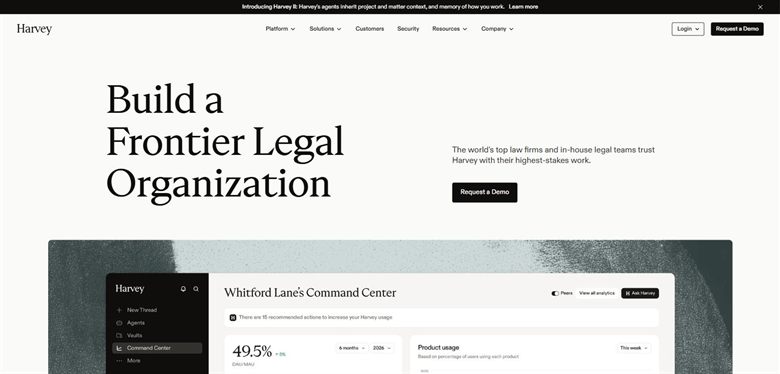
The verdict: The move upward, and a different kind of decision: a partnership sign-off rather than a departmental one. Worth it for breadth and firm knowledge management, not for research quality on its own.
Pricing: No public list price. Reported annual contracts run approximately $50,000 to $290,000 depending on firm size and practice-area coverage.
Standout features:
- Coverage across litigation, corporate and regulatory work
- Research, drafting and analysis in one system
- Firm knowledge management across matters
- Custom workflows per practice group
Limitations: It licenses no primary law, so authority-heavy work still routes to Lexis or Westlaw and the cost is additive. No public trial and a deployment measured in months, against CoCounsel which a single lawyer can start using in days.
4. vLex Vincent: Best for work that crosses jurisdictions
7.3 out of 10 how this is calculated
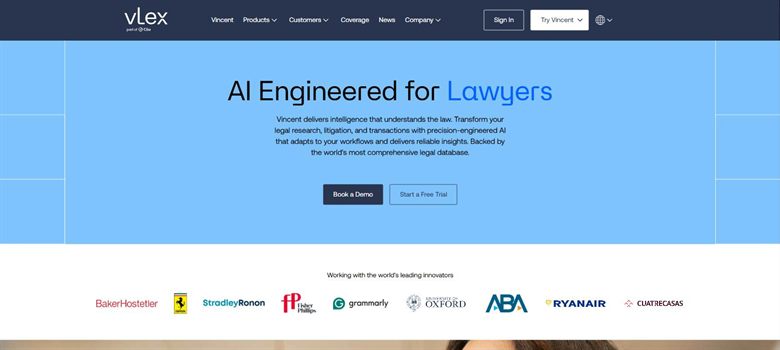
The verdict: The specific answer when CoCounsel's US focus was the limitation. Coverage across many jurisdictions is genuinely broader than the incumbents, and for cross-border questions that beats AI quality.
Pricing: No published price and no reliable reported figure we could source. Sold per user with pricing that varies by jurisdiction coverage.
Standout features:
- Coverage across many jurisdictions
- Cross-border comparison of legal concepts
- Answers linked to source documents
- Now part of Clio following acquisition
Limitations: Depth in any single jurisdiction sits below Lexis or Westlaw in their home markets, so it complements rather than replaces them for US-only work. No published pricing, and the Clio acquisition leaves how it will be sold less settled.
5. Paxton AI: Best for small firms priced out
6.5 out of 10 how this is calculated
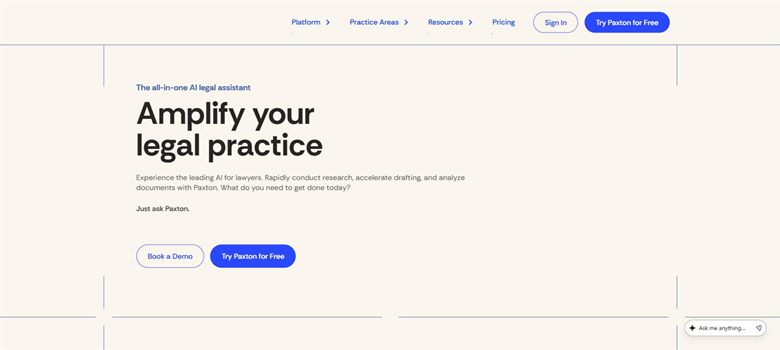
The verdict: Exists precisely because CoCounsel with database access prices small firms out. Whether the corpus is deep enough depends entirely on your practice area, and that is the thing to test rather than assume.
Pricing: No published list price and no reliable reported figure we could source. Positioned well below the incumbents, and sold per user.
Standout features:
- Priced for solo and small firms
- Citation-linked answers
- Document analysis alongside research
- US case law focus
Limitations: It does not license the proprietary editorial layers that make Shepard's and KeyCite valuable, so citation treatment is materially weaker. Coverage is narrower, and it publishes no price of its own despite cost being its main argument.
6. Spellbook: Best for lawyers whose work is contracts
5.8 out of 10 how this is calculated
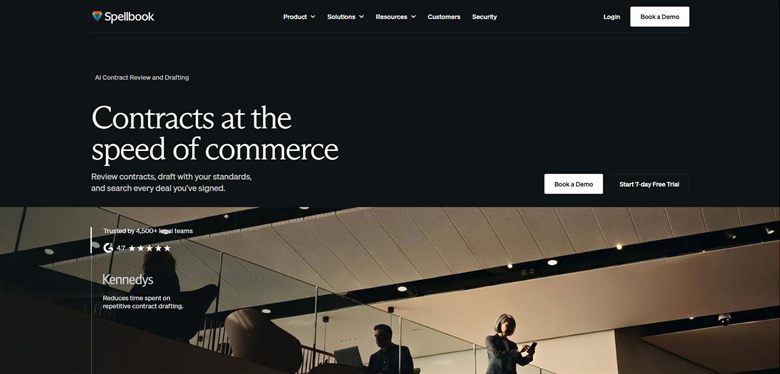
The verdict: Listed because a meaningful share of CoCounsel evaluations end here. If your day is transactional drafting rather than authority research, this does that job in Word for a fraction of the price and starts the same afternoon.
Pricing: No published list price. Reported at approximately $99 to $199 per user a month, rising to around $350 per user on enterprise plans with a ten-seat minimum. A seven-day trial is offered.
Standout features:
- Drafting, review and redlining inside Microsoft Word
- Suggestions benchmarked against market standard
- Same-day setup with no implementation
- Seven-day trial
Limitations: It does no legal research at all and licenses no primary law, so it replaces only the contract half of CoCounsel. For litigation or anything turning on authority it is not a candidate.
7. Luminance: Best for contract analysis across an estate
5.4 out of 10 how this is calculated
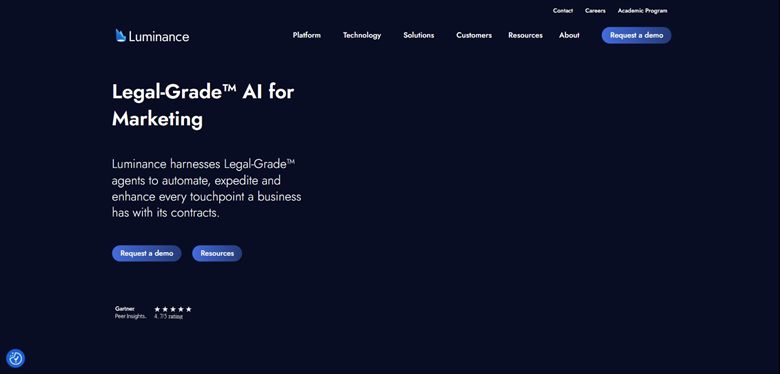
The verdict: Relevant where CoCounsel was being bought for document review at volume rather than for research. Unlimited users on a published tier suits a team that grew past per-seat economics.
Pricing: Published list price of approximately $41,340 a year for 1,000 documents with unlimited users. Enterprise deployments are reported from around $25,000 a year depending on volume and modules.
Standout features:
- Analysis across a whole document set
- Anomaly detection against learned standards
- Unlimited users on the published tier
- Coverage across many languages and jurisdictions
Limitations: No legal research and no licensed primary law, so it addresses one half of what CoCounsel does. Priced by document volume, which suits a wide estate and penalises a firm handling a few large matters.
How we chose
- What the price includes, since database access is what moves it and the entry figure excludes it.
- Whether the tool licenses primary law, or searches openly available material.
- Citation treatment, because a research answer you cannot verify is not a research answer.
- Whether it can be bought per seat or requires a firm-level decision.
- Coverage outside the US, where all the incumbents are thinner than they suggest.
- We did not score on which foundation model sits underneath. What a tool is permitted to read decides research quality far more than what it is built on.
Frequently asked questions
What is the best alternative to CoCounsel in 2026?
Lexis+ AI if licensed authority and citation validation are what you were buying, reported at $3,000 to $8,000 per user a year. Harvey if breadth across practice areas is the goal, at a reported $50,000 upwards. Spellbook if your work is actually contracts, at a fraction of any of them.
Why do people look for CoCounsel alternatives?
Mostly the price surprise. The reported $4,500 per user a year is the tier without Westlaw or Practical Law attached, and the figure rises sharply once database access is added, which is often what the buyer assumed they were getting. Second, firms wanting breadth across practice areas find themselves comparing it with Harvey instead.
Is there a cheaper alternative to CoCounsel?
Spellbook at a reported $99 to $199 per user a month, if contracts rather than research are the job. Paxton AI is positioned below the incumbents though it publishes no figure. Among genuine research tools with a licensed corpus, nothing is meaningfully cheaper, because the corpus is what costs money.
Which alternatives license primary law?
Lexis+ AI, Westlaw Precision and vLex Vincent do. Harvey, Spellbook and Luminance do not, and Paxton does not license the editorial layers that make citation treatment valuable. If the work turns on authority, that split is the whole shortlist.
Is Harvey a realistic upgrade from CoCounsel?
Only for a firm, and only with partnership sign-off. Harvey is bought once at a reported $50,000 to $290,000 a year for the firm, against CoCounsel's per-seat model. At ten lawyers the gap narrows considerably, which is the arithmetic worth doing before assuming Harvey is out of reach.
What about in-house teams?
Most should not be on this page. In-house work is weighted towards contracts, advice and process rather than authority-heavy research, so a per-user research subscription is poor value. Spellbook, or a contract-focused tool, serves an in-house day better than any research product here.
Does anything here publish a price?
Only Luminance, at roughly $41,340 a year for 1,000 documents. Lexis+ AI, Harvey and Spellbook have reported figures we could source. Westlaw Precision, vLex Vincent and Paxton AI publish nothing and no reliable figures exist, so all three appear in our price index only among the omissions.