
8 Best DocuSign CLM Alternatives in 2026
Quick answer: Before comparing anything, check which product you actually need. DocuSign eSignature is $25 per user a month and DocuSign CLM is a different product reported at $10,000 to $50,000 a year and beyond, and a meaningful number of people reading this were upsold from the first to the second without the requirement changing. If you only need signing, the answer is to stay on eSignature. If you genuinely need lifecycle management, Ironclad is the strongest at a reported median near $40,000, Juro deploys in weeks, and SpotDraft prices per seat rather than on volume.
Comparison
| Tool | Score | Best for | Price | Key strength |
|---|---|---|---|---|
| Ironclad | 9.4 | real lifecycle depth, with usable figures | Reported ~$30,000 to $250,000/yr | Approval routing at scale |
| Juro | 8.8 | teams for whom the implementation was the problem | Reported ~$15,000 to $130,000/yr | Weeks rather than months |
| SpotDraft | 8.2 | per-seat rather than volume pricing | Reported from ~$10,000/yr, per seat | Predictable as contract volume grows |
| Icertis | 7.6 | procurement and supplier volume | No published price | Built for the buy side |
| Evisort | 7.0 | reading the estate rather than routing it | Reported ~$30,000 to $150,000/yr | Extraction across unstructured sets |
| GenieAI | 6.4 | anyone upsold into a CLM whose requirement never changed | Free plan, then $75/mo; Enterprise from $600/mo | The option for people who never needed a platform |
| PandaDoc | 5.8 | teams that only ever needed signing | $19 per user/mo | The only published price here |
| Contractbook | 5.2 | small teams that overbought | Reported ~$39 to $599/mo | Only small-team price here |
Fit by buyer
Scored 1 to 5 for each buyer, where 5 means the tool was built for them and 1 means it is the wrong tool. Scope is different: it is how much of the job the tool does, from a single step to a whole lifecycle, and a low score there means narrow rather than bad. These ratings are the same for a tool wherever it appears; the score shown beside each entry is for this guide specifically. A tool can lead one column and come last in another, and the right answer still changes with who is asking. How we score.
| Tool | Lawyer in Word | In-house legal | Commercial team | Enterprise | Scope | Price |
|---|---|---|---|---|---|---|
| Ironclad | 2 | 4 | 2 | 5 | 5 | Reported |
| Juro | 2 | 4 | 4 | 4 | 4 | Reported |
| SpotDraft | 1 | 4 | 4 | 3 | 4 | Reported |
| Icertis | 1 | 3 | 1 | 5 | 5 | None |
| Evisort | 1 | 4 | 2 | 4 | 4 | Reported |
| GenieAI | 3 | 5 | 5 | 3 | 2 | Published |
| PandaDoc | 1 | 2 | 4 | 2 | 2 | Published |
| Contractbook | 1 | 3 | 4 | 2 | 3 | Reported |
Which one, for your situation
| If this is your situation | Start with |
|---|---|
| You only ever needed signing and were upsold | PandaDoc |
| You need genuine lifecycle depth with figures you can plan against | Ironclad |
| The implementation was the problem | Juro |
| You want per-seat pricing rather than contract volume | SpotDraft |
| Procurement and supplier contracts are the volume | Icertis |
| Understanding the existing estate was the real need | Evisort |
| You are small and this was always oversized | Contractbook |
The 8 best DocuSign CLM alternatives
1. Ironclad: Best for real lifecycle depth, with usable figures
9.4 out of 10 how this is calculated
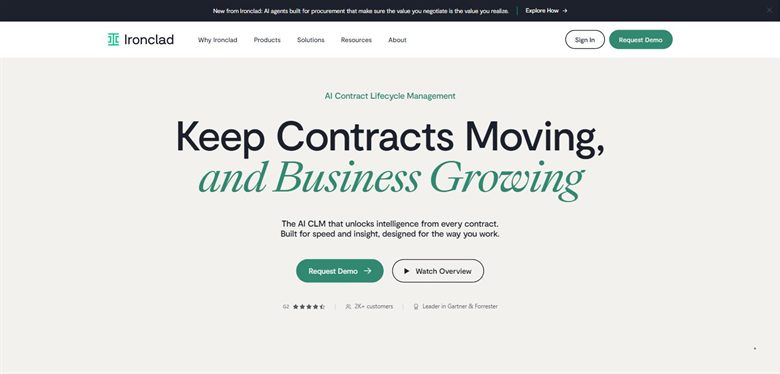
The verdict: The strongest like-for-like and the usual destination. Conditional approval routing is deeper, and the marketplace data behind its pricing means you can size the decision before entering a process, which DocuSign CLM does not allow.
Pricing: No public list price. Reported annual contracts run approximately $30,000 to $250,000, with a marketplace median near $40,000 across 363 recorded purchases.
Standout features:
- Conditional approval routing by value, risk and department
- Repository and reporting across executed agreements
- Obligation and renewal tracking
- Works with your existing e-signature tool
Limitations: Implementation still runs to months with an internal owner, so it fixes the pricing opacity complaint rather than the deployment one. At a reported median near $40,000 a year it is not a saving for most mid-market buyers.
2. Juro: Best for teams for whom the implementation was the problem
8.8 out of 10 how this is calculated
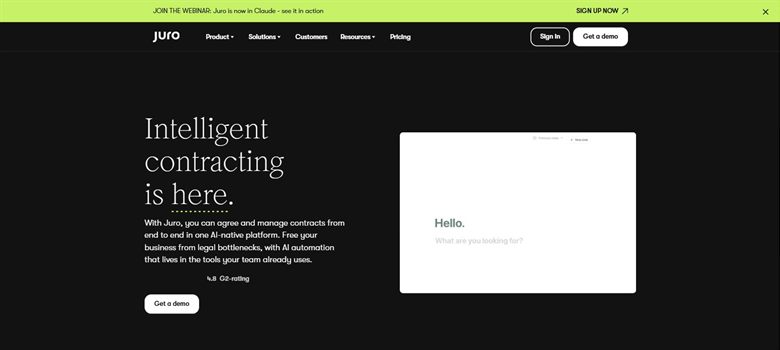
The verdict: The answer if the DocuSign CLM experience was a long deployment with professional services attached. Weeks to live, no hourly consultants, and non-legal staff run it unaided.
Pricing: Sales-led with no public list price. Reported annual contracts run approximately $15,000 to $130,000, with marketplace medians around $31,000 to $34,500, priced on contract volume rather than per seat.
Standout features:
- Guided creation from templates legal controls
- Approval routing when terms depart from standard
- Native electronic signature included
- Searchable repository with renewal dates
Limitations: Priced on contract volume with no published figure, so growth is unmodellable in the same way. Its native signature means giving up DocuSign's counterparty recognition, which conservative counterparties occasionally notice.
3. SpotDraft: Best for per-seat rather than volume pricing
8.2 out of 10 how this is calculated

The verdict: Worth a look specifically on the cost model. Implementation reported at two to four weeks and often included is the sharpest contrast with hourly professional services, and per-seat pricing means closing more deals does not raise the bill.
Pricing: No published list price. Reported from around $10,000 a year with a range of roughly $5,000 to $50,000, priced per seat rather than on contract volume. The VerifAI review add-on is reported to add $5,000 to $15,000 a year. Implementation is reported at two to four weeks and often included.
Standout features:
- Per-seat pricing rather than contract volume
- Template-driven creation with approval workflow
- Repository with renewal tracking
- Implementation typically two to four weeks
Limitations: Per-seat pricing works against you once contracts are touched across many departments, since every user is a licence. The AI review capability is reported as a separate add-on, which is easy to miss when comparing entry figures.
4. Icertis: Best for procurement and supplier volume
7.6 out of 10 how this is calculated

The verdict: Relevant only if most of your contract volume runs inbound. DocuSign CLM is built around agreements you send, and a procurement-heavy business is fighting the product rather than using it.
Pricing: No published price and no reliable reported figure we could source. Enterprise sales-led, quoted on contract volume and module count. Widely understood to sit at the top of the market alongside Ironclad.
Standout features:
- Procurement and sourcing contract management
- Obligation tracking with owner assignment
- Deep ERP integration
- Multi-entity and multi-jurisdiction support
Limitations: Publishes nothing and no reliable reported figure could be sourced, so a buyer leaving over cost opacity gets less visibility rather than more. Implementation is longer than DocuSign CLM, not shorter.
5. Evisort: Best for reading the estate rather than routing it
7.0 out of 10 how this is calculated

The verdict: For the buyer whose actual question was what have we already signed. That is a reading problem, and a lifecycle platform is an expensive way to answer it.
Pricing: No public list price. Reported annual contracts run approximately $30,000 to $150,000. Now part of Workday following acquisition, so renewals may route differently than they did.
Standout features:
- Extraction across large and unstructured document sets
- Obligation and renewal identification without manual entry
- Reporting on terms across the estate
- Workflow and approvals alongside extraction
Limitations: Lighter on workflow than DocuSign CLM, so it is a change of emphasis rather than a replacement. The Workday acquisition leaves pricing and roadmap less settled on a multi-year commitment.
6. GenieAI: Best for anyone upsold into a CLM whose requirement never changed
6.4 out of 10 how this is calculated
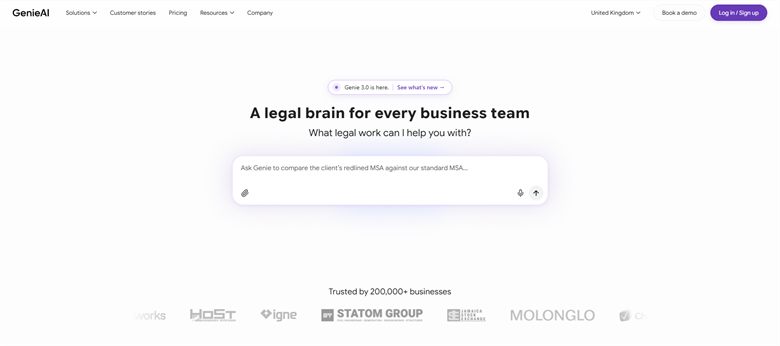
The verdict: Belongs on this page because of the group the page itself identifies: people moved from eSignature to a full CLM without the underlying requirement changing. If what you actually needed was help drafting and checking the agreements rather than governing their lifecycle, this does that at a published price and you can test it free.
Pricing: Permanent free plan with no time limit. Pro $75 a month for one user, Business $320 a month for five, Enterprise from $600 a month with SSO, API access and an SLA.
Standout features:
- Drafting and clause-level review in one workspace
- Risk rated red, amber or green with a plain-language reason
- Your own positions applied consistently by non-lawyers
- Microsoft Word add-in that preserves native track changes
- Published pricing with a permanent free tier
Limitations: No signature and no repository, which for a DocuSign customer is a real gap rather than a footnote. Most teams pairing it here keep an e-signature tool alongside.
7. PandaDoc: Best for teams that only ever needed signing
5.8 out of 10 how this is calculated
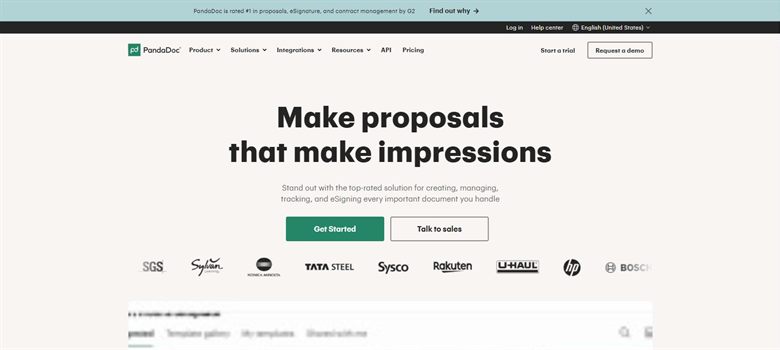
The verdict: On this page because a real share of DocuSign CLM buyers were upsold from e-signature and never needed lifecycle management. If nothing in your agreements is negotiated, this does the whole job at a published price.
Pricing: Published at $19 per user a month, one of the few vendors in this market to state a list price at all.
Standout features:
- Template-driven document and contract generation
- Native electronic signature
- CRM integration with Salesforce and HubSpot
- Published pricing you can read without a sales call
Limitations: No clause-level intelligence, no approval routing beyond the basic, and it stores documents rather than reporting on contract terms. If you genuinely need lifecycle management this is a step down and Ironclad or Juro are the real answers here.
8. Contractbook: Best for small teams that overbought
5.2 out of 10 how this is calculated
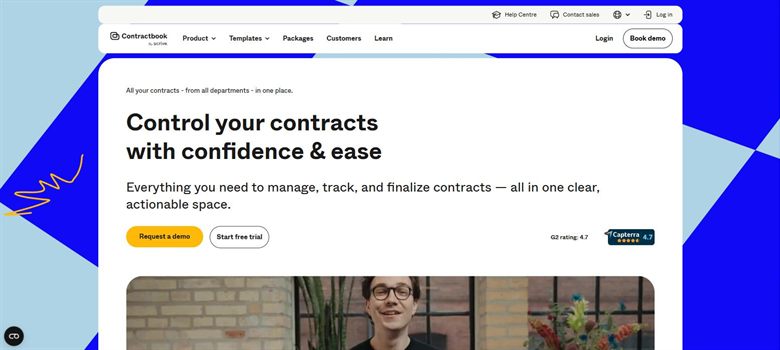
The verdict: The reality check. A business signing a few hundred agreements a year mostly needs them stored, findable and flagged before renewal, and that is two orders of magnitude cheaper than a CLM.
Pricing: No published rate card. Reported between approximately $39 and $599 a month depending on tier, which is the only genuinely small-team price in this category.
Standout features:
- Searchable repository of executed agreements
- Renewal and date reminders
- Template-driven creation with signing
- Monthly pricing rather than annual contracts
Limitations: Approvals, reporting and AI extraction are all well below DocuSign CLM, so this is a deliberate step down in scope. No published rate card, and the tier spread means growth involves a negotiation you cannot plan.
How we chose
- Total first-year cost rather than licence price, since implementation and integration fees are where this category diverges.
- Whether the vendor applies annual escalators, which reportedly run 5 to 8% at DocuSign CLM.
- Implementation length and whether professional services are charged hourly.
- Whether you can keep your existing e-signature tool or are locked into one.
- Published price, which almost nobody here offers.
- We did not score on e-signature quality. Every platform here signs documents adequately, and it is not the reason anyone buys or leaves a CLM.
Frequently asked questions
What is the best alternative to DocuSign CLM in 2026?
Ironclad for genuine lifecycle depth, reported at a median near $40,000 a year. Juro if the implementation was the problem, since it deploys in weeks. SpotDraft if you want per-seat pricing rather than contract volume. And PandaDoc at a published $19 per user if you only ever needed signing.
Is DocuSign CLM the same as DocuSign eSignature?
No, and conflating them is the most expensive mistake in this category. eSignature is $25 per user a month on Standard. CLM is a separate product reported from around $10,000 a year and running to $50,000 and beyond, custom quoted with no self-serve option. A number of people reading this were moved from one to the other without the requirement changing.
What does DocuSign CLM actually cost?
There is no public list price. Reported figures put mid-market deployments at roughly $3,000 to $8,000 a month for 10 to 50 users, and enterprise contracts from $50,000 into six figures. Reported extras include professional services charged hourly, a Salesforce integration fee, and annual escalators of 5 to 8%.
Why do people leave DocuSign CLM?
Three reasons. Total cost, once implementation hours, integration fees and the annual escalator are counted rather than just the licence. Implementation length. And the realisation that lifecycle management was never the requirement, which is common among buyers who arrived from e-signature.
Can we keep DocuSign for signing and use something else for CLM?
Yes, and it is a common arrangement. Ironclad, Evisort and Icertis all work alongside an existing e-signature tool, so you keep the counterparty recognition DocuSign has and buy lifecycle management from whoever does it best. Juro and PandaDoc include their own signature, which means giving that recognition up.
Which alternative has the shortest implementation?
SpotDraft reports two to four weeks and often includes it, and Juro is measured in weeks. Ironclad and Icertis both run to months with an internal owner. If hourly professional services were part of your complaint, only the first two genuinely answer it.
Does DocuSign owning Lexion change anything?
It means DocuSign's agreement management capability now includes what Lexion built, so a buyer comparing them is comparing two parts of the same company. If you are looking for an alternative specifically to reduce dependence on one vendor, that is worth knowing before evaluating either.