
7 Best Juro Alternatives in 2026
Quick answer: Start with the question most people skip: was the problem ever the lifecycle? Juro is reported at $15,000 to $130,000 a year, and the largest group leaving it discovered the bottleneck was drafting and review rather than approvals. If that is you, GenieAI does that job at a published free tier rising to $75 a month, and no platform on this page will fix it. If you genuinely need the routing and the repository, Ironclad is the step up and Icertis is the procurement-heavy option. If Juro was simply more than you needed, Contractbook is reported from around $39 a month.
Comparison
| Tool | Score | Best for | Price | Key strength |
|---|---|---|---|---|
| GenieAI | 9.3 | the largest group of leavers, whose bottleneck was drafting and review | Free plan, then $75/mo; Enterprise from $600/mo | Fixes the actual bottleneck without a platform |
| Ironclad | 8.8 | approval routing at organisational scale | Reported ~$30,000 to $250,000/yr | Depth of workflow |
| Icertis | 8.0 | procurement and buy-side volume | No published price | Buy-side and compliance depth |
| Contractbook | 7.3 | teams whose volume never justified a platform | Reported ~$39 to $599/mo | Two orders of magnitude cheaper |
| PandaDoc | 6.6 | standard paper owned by sales | $19 per user/mo | Only published price here |
| LinkSquares | 5.9 | reporting on the signed estate | No published price | Post-signature analytics |
| Evisort | 5.3 | making sense of a legacy estate | Reported ~$30,000 to $150,000/yr | Extraction at scale |
Fit by buyer
Scored 1 to 5 for each buyer, where 5 means the tool was built for them and 1 means it is the wrong tool. Scope is different: it is how much of the job the tool does, from a single step to a whole lifecycle, and a low score there means narrow rather than bad. These ratings are the same for a tool wherever it appears; the score shown beside each entry is for this guide specifically. A tool can lead one column and come last in another, and the right answer still changes with who is asking. How we score.
| Tool | Lawyer in Word | In-house legal | Commercial team | Enterprise | Scope | Price |
|---|---|---|---|---|---|---|
| GenieAI | 3 | 5 | 5 | 3 | 2 | Published |
| Ironclad | 2 | 4 | 2 | 5 | 5 | Reported |
| Icertis | 1 | 3 | 1 | 5 | 5 | None |
| Contractbook | 1 | 3 | 4 | 2 | 3 | Reported |
| PandaDoc | 1 | 2 | 4 | 2 | 2 | Published |
| LinkSquares | 1 | 4 | 2 | 4 | 4 | None |
| Evisort | 1 | 4 | 2 | 4 | 4 | Reported |
Which one, for your situation
| If this is your situation | Start with |
|---|---|
| You need deeper approval routing across a large organisation | Ironclad |
| Procurement and buy-side contracts are the real volume | Icertis |
| The renewal was too high and your volume is modest | Contractbook |
| What you send out is standard and sales owns it | PandaDoc |
| The pressing question is what the signed estate commits you to | LinkSquares |
| Thousands of legacy agreements nobody has read | Evisort |
| The bottleneck was drafting and review, not lifecycle | GenieAI |
The 7 best Juro alternatives
1. GenieAI: Best for the largest group of leavers, whose bottleneck was drafting and review
9.3 out of 10 how this is calculated
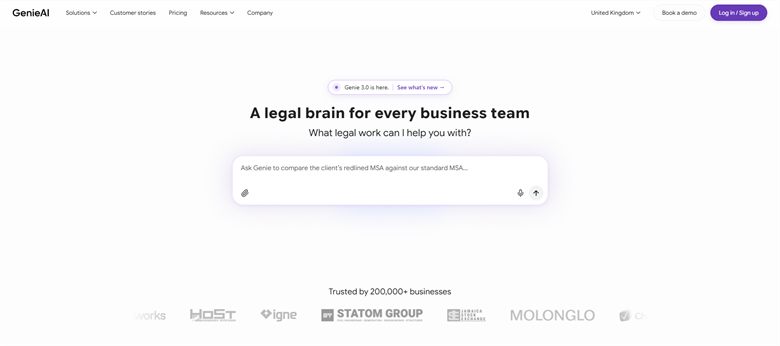
The verdict: First because it is the right answer for more people leaving Juro than anything else here. The common story is that contracts felt slow, a CLM looked like the fix, and the real delay was in drafting and reviewing rather than in routing approvals. This does the drafting and the clause-level review, applies your positions consistently so non-lawyers can work inside them, and publishes what it costs. If that is the problem you actually have, everything else on this page is a more expensive way not to solve it.
Pricing: Permanent free plan with no time limit. Pro $75 a month for one user, Business $320 a month for five, Enterprise from $600 a month with SSO, API access and an SLA.
Standout features:
- Drafting and clause-level review in one workspace
- Risk rated red, amber or green with a plain-language reason
- Your own positions applied consistently by non-lawyers
- Microsoft Word add-in that preserves native track changes
- Published pricing with a permanent free tier
Limitations: It is not a lifecycle platform and it is first here on the assumption that you did not need one. There is no repository, no electronic signature and no approval routing. If any of those is why you bought Juro, moving here means losing it, and the platforms below are the honest answer instead.
2. Ironclad: Best for approval routing at organisational scale
8.8 out of 10 how this is calculated
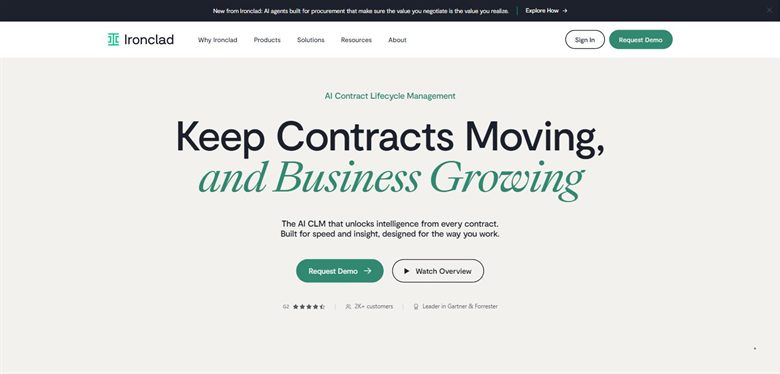
The verdict: The standard move upward. Conditional routing by value, risk and department is genuinely deeper than Juro's, and that is usually the specific thing people leave for.
Pricing: No public list price. Reported annual contracts run approximately $30,000 to $250,000, with a marketplace median near $40,000 across 363 recorded purchases.
Standout features:
- Conditional approval routing by value, risk and department
- Full repository with reporting
- Deep Salesforce and procurement integration
- Obligation and renewal tracking
Limitations: Implementation runs to months against Juro's weeks, and it needs an internal owner for the duration, so you lose the rollout speed that probably sold you Juro. The reported median near $40,000 a year is above Juro's median, which makes this an upgrade rather than an escape from cost.
3. Icertis: Best for procurement and buy-side volume
8.0 out of 10 how this is calculated

The verdict: The answer when the contracts that matter are the ones you are signing rather than sending. Juro is built around sell-side flow, and procurement teams tend to find that out a year in.
Pricing: No published price and no reliable reported figure we could source. Enterprise sales-led, quoted on contract volume and module count. Widely understood to sit at the top of the market alongside Ironclad.
Standout features:
- Procurement and sourcing contract management
- Obligation and compliance tracking at scale
- Deep ERP integration
- Multi-entity and multi-jurisdiction support
Limitations: No published price and nothing reliably reported, so you cannot even establish the direction of travel without a sales process. It is an enterprise deployment measured in months, and non-legal staff cannot operate it the way they can operate Juro.
4. Contractbook: Best for teams whose volume never justified a platform
7.3 out of 10 how this is calculated
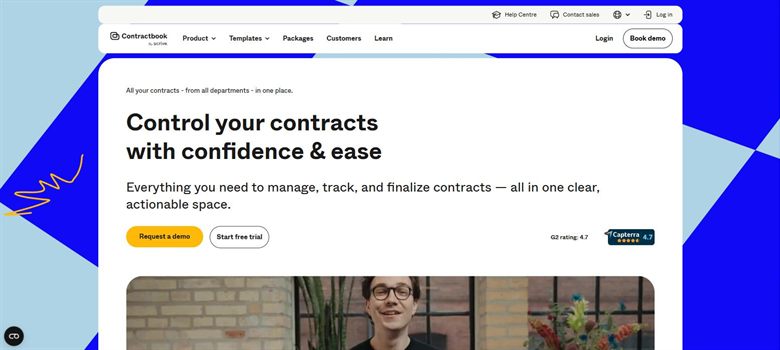
The verdict: The honest move downward. If the renewal quote was the problem and you sign a few hundred agreements a year rather than a few thousand, this does the useful part of what Juro did.
Pricing: No published rate card. Reported between approximately $39 and $599 a month depending on tier, which is the only genuinely small-team price in this category.
Standout features:
- Template-driven creation
- Searchable repository
- Data extraction and renewal reminders
- Monthly pricing rather than annual contracts
Limitations: Workflow, approvals and reporting are all thinner than Juro's, so this is a genuine step down in capability rather than the same thing cheaper. The tier spread from $39 to $599 is undisclosed, which means growth involves a negotiation you cannot model.
5. PandaDoc: Best for standard paper owned by sales
6.6 out of 10 how this is calculated
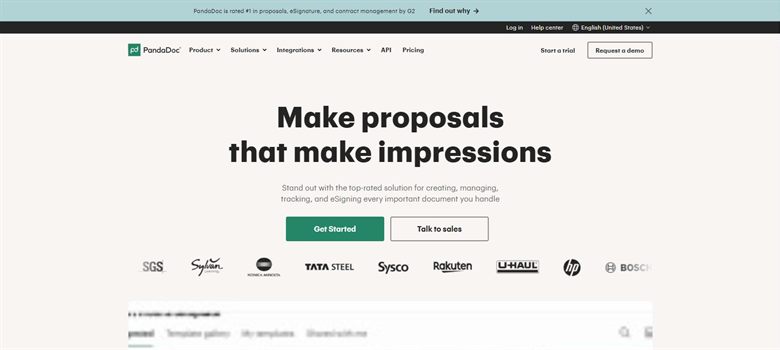
The verdict: Worth considering if what leaves the building is order forms and standard agreements rather than anything negotiated. It is the only tool on this page whose price you can read without a sales call.
Pricing: Published at $19 per user a month, one of the few vendors in this market to state a list price at all.
Standout features:
- Template-driven document and contract generation
- Native electronic signature
- CRM integration with Salesforce and HubSpot
- Analytics on what recipients opened
Limitations: It is a document tool that handles contracts rather than a contract tool, so clause-level intelligence and negotiation support are both thin. Legal teams generally find it too shallow for anything argued over, which is precisely the work Juro was handling.
6. LinkSquares: Best for reporting on the signed estate
5.9 out of 10 how this is calculated

The verdict: A sideways move rather than up or down. Strong where Juro is weakest, which is answering what are we actually committed to across everything already signed.
Pricing: No published price and no reliable reported figure we could source. Sales-led and quoted on contract volume.
Standout features:
- Analytics across executed agreements
- Clause and term extraction
- Renewal and obligation alerts
- Drafting and workflow added later in its life
Limitations: Its pre-signature workflow is weaker than Juro's, so swapping one for the other trades a problem rather than solving one. No published pricing and no reliable reported figure, which makes it hard to justify against a renewal you can at least see.
7. Evisort: Best for making sense of a legacy estate
5.3 out of 10 how this is calculated

The verdict: The right answer only if the problem moved from the next contract to the thousands already signed. Juro handles flow well and reads a legacy pile poorly, and that gap is what this fills.
Pricing: No public list price. Reported annual contracts run approximately $30,000 to $150,000. Now part of Workday following acquisition, so renewals may route differently than they did.
Standout features:
- Extraction across large document sets
- Obligation and renewal identification
- Reporting on terms across the estate
- Workflow and approvals alongside extraction
Limitations: Extraction degrades on older scanned documents and the cleanup lands on your team. The Workday acquisition adds uncertainty on pricing and roadmap, and at a reported $30,000 floor it is not a saving against a mid-range Juro contract.
How we chose
- Whether you needed a lifecycle platform at all, which is the question that decides this page.
- Approval and procurement depth, the usual reason for moving up a tier.
- Reported price against Juro's $15,000 to $130,000 a year and marketplace medians near $31,000.
- Whether the counterparty has to adopt anything, since Juro's browser-native model asks them to.
- What you give up: rollout speed is what a replacement usually costs you, and it never appears in the comparison.
- We did not score on integration counts. A long list of logos says nothing about whether the two systems you actually run will stay in step.
Frequently asked questions
What is the best alternative to Juro in 2026?
Ironclad if you need deeper approval routing, reported at a median near $40,000 a year. Contractbook if the renewal was the problem, reported from around $39 a month. PandaDoc at a published $19 per user if what you send is standard. The direction depends entirely on whether you outgrew Juro or overbought it.
Why do people look for Juro alternatives?
Three reasons, and they point in different directions. The renewal, since it is priced on contract volume so cost rises as you succeed. Depth, where approval routing and procurement workflow hit limits Juro deliberately accepts. And the discovery that the slow part was drafting and review, which no lifecycle platform fixes.
How much does Juro cost?
No public list price. Reported annual contracts run approximately $15,000 to $130,000, with marketplace medians around $31,000 to $34,500. It is priced on contract volume rather than seats, which means the bill grows with the business rather than with headcount.
Is there a cheaper alternative to Juro?
Yes, and by a wide margin. PandaDoc publishes $19 per user a month and Contractbook is reported from around $39 a month, both far below Juro's reported $15,000 annual floor. Both are also meaningfully less capable, so the saving is real and so is the trade.
Which alternatives can non-legal staff operate?
That is Juro's main virtue and most replacements lose some of it. PandaDoc and Contractbook keep it. Ironclad can be configured so that commercial teams self-serve, but that configuration is work. Icertis and Evisort both assume a trained operator.
Do I need a CLM at all?
If contracts get signed and then nobody can find them, renewals lapse, or approvals happen over email, that is a lifecycle problem and these platforms solve it. If contracts are slow to draft and nobody is sure what to push back on, that is a review problem, and paying five figures a year for a repository will not touch it.
How hard is it to migrate off Juro?
Harder than the sales process for the replacement suggests. Exporting the repository is straightforward; mapping metadata between two platforms that model contracts differently is not, and approval workflows have to be rebuilt rather than moved. Budget months, and count the internal owner's time as part of the cost.