
7 Best LegalOn Alternatives in 2026
Quick answer: LegalOn has the best pre-built position libraries in this category and the worst price transparency. It publishes nothing, and we could not source a reported figure we would stand behind, which is unusual even in a market this opaque. So most people arrive here for one of two reasons: they want the same lawyer-authored review depth with a price they can read, or they want positions that are theirs rather than the vendor's. Spellbook answers the first at a reported $99 to $199 per user a month. Robin AI answers the second. GenieAI answers both at a published price, with a free tier that makes the evaluation cost nothing.
Comparison
| Tool | Score | Best for | Price | Key strength |
|---|---|---|---|---|
| Spellbook | 9.2 | the same job with a findable price | Reported ~$99 to $199 per user/mo | Word-native, and priced in public enough to plan around |
| Robin AI | 8.5 | positions that belong to you | From ~$500/mo | Your playbook rather than the vendor's |
| GenieAI | 7.9 | teams that need a price they can know in advance | Free plan, then $75/mo; Enterprise from $600/mo | Publishes its price and has a free tier |
| Luminance | 7.4 | questions about the estate, not the document | List ~$41,340/yr for 1,000 documents | Publishes a list price at enterprise scale |
| Wordsmith | 6.5 | in-house teams fielding repeat requests | Reported ~$450 per user/mo | Answers the question behind the document |
| LegalFly | 5.8 | review with a platform around it | Reported ~$75 per user/mo plus platform fee | Anonymisation before the model sees anything |
| Harvey | 5.3 | large firms buying across practice areas | Reported ~$50,000 to $290,000/yr | Breadth beyond contract review |
Fit by buyer
Scored 1 to 5 for each buyer, where 5 means the tool was built for them and 1 means it is the wrong tool. Scope is different: it is how much of the job the tool does, from a single step to a whole lifecycle, and a low score there means narrow rather than bad. These ratings are the same for a tool wherever it appears; the score shown beside each entry is for this guide specifically. A tool can lead one column and come last in another, and the right answer still changes with who is asking. How we score.
| Tool | Lawyer in Word | In-house legal | Commercial team | Enterprise | Scope | Price |
|---|---|---|---|---|---|---|
| Spellbook | 5 | 4 | 2 | 2 | 2 | Reported |
| Robin AI | 3 | 3 | 4 | 2 | 2 | Reported |
| GenieAI | 3 | 5 | 5 | 3 | 2 | Published |
| Luminance | 3 | 4 | 1 | 4 | 4 | Published |
| Wordsmith | 4 | 4 | 2 | 2 | 2 | Reported |
| LegalFly | 3 | 4 | 3 | 3 | 2 | Reported |
| Harvey | 4 | 3 | 1 | 4 | 4 | Reported |
Which one, for your situation
| If this is your situation | Start with |
|---|---|
| You want the same job with a price you can find | Spellbook |
| You want positions that are yours rather than the vendor's | Robin AI |
| Budget is the binding constraint | GenieAI |
| The question is about the whole estate, not this contract | Luminance |
| Your in-house team is drowning in repeat requests | Wordsmith |
| You need review with a platform around it | LegalFly |
| You are a large firm buying across practice areas | Harvey |
The 7 best LegalOn alternatives
1. Spellbook: Best for the same job with a findable price
9.2 out of 10 how this is calculated
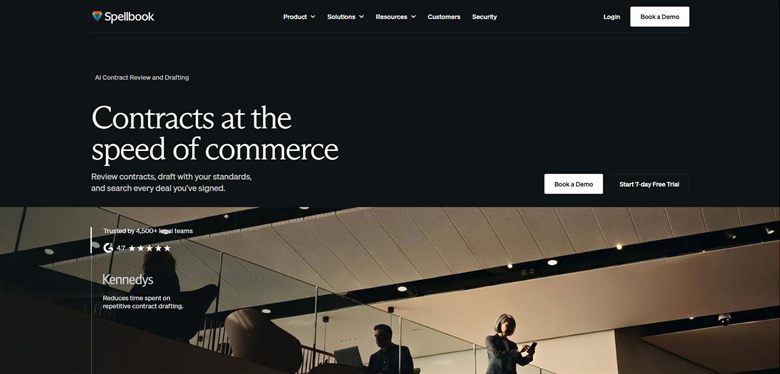
The verdict: The closest like-for-like, and the reason most LegalOn evaluations end somewhere. It benchmarks against market standard rather than a curated library, which is a different philosophy but lands in a similar place for common agreements.
Pricing: No published list price. Reported at approximately $99 to $199 per user a month, rising to around $350 per user on enterprise plans with a ten-seat minimum. A seven-day trial is offered.
Standout features:
- Drafting, review and redlining inside Microsoft Word
- Suggestions benchmarked against market standard
- Clause generation alongside review
- Seven-day trial
Limitations: Benchmarking against what is common is not the same as a library a lawyer curated, and on unusual agreements the difference shows. The ten-seat minimum on enterprise plans is awkward for exactly the small teams its per-seat rate otherwise suits.
2. Robin AI: Best for positions that belong to you
8.5 out of 10 how this is calculated

The verdict: The philosophical opposite of LegalOn. Instead of buying a library someone else wrote, you encode what your organisation has already decided, which ages with your business rather than with the vendor's release cycle.
Pricing: Subscription tiered by features and volume, reported from around $500 a month for small teams, with enterprise pricing set on contract volume.
Standout features:
- Playbook of agreed positions with fallbacks
- Redlining against your standards rather than generic ones
- Word and browser workflows
- Human legal support on higher tiers
Limitations: You have to build the playbook before it does anything, which is real work and is where most deployments stall. LegalOn is useful on day one and this is useful in month three, so it is a poor swap if speed was the appeal.
3. GenieAI: Best for teams that need a price they can know in advance
7.9 out of 10 how this is calculated
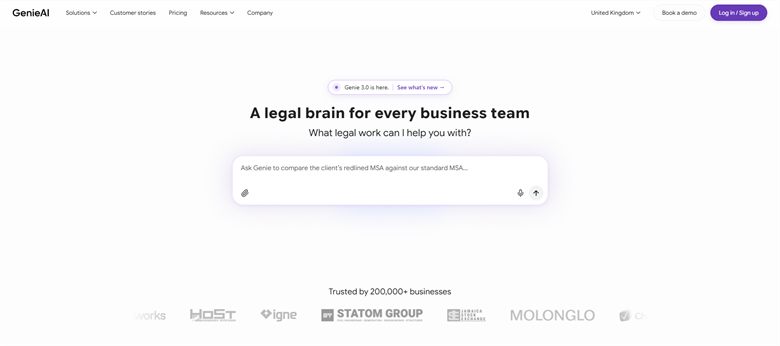
The verdict: If the reason you are reading this is that nobody would give you a number, this is the direct answer: the price is published and the free tier has no time limit, so the evaluation costs nothing.
Pricing: Permanent free plan with no time limit. Pro $75 a month for one user, Business $320 a month for five, Enterprise from $600 a month with SSO, API access and an SLA.
Standout features:
- Drafting, review and negotiation in one workspace
- Risk rated red, amber or green per clause
- Microsoft Word add-in that preserves native track changes
- Plain-language explanation of what a clause does
- Free tier with no time limit
Limitations: It has no curated position library of the depth LegalOn ships, so on a complex negotiated agreement it flags risk well and proposes wording less well. It is also built for business teams executing against standards rather than for the qualified reviewer LegalOn assumes, which makes a law firm the wrong buyer for it.
4. Luminance: Best for questions about the estate, not the document
7.4 out of 10 how this is calculated
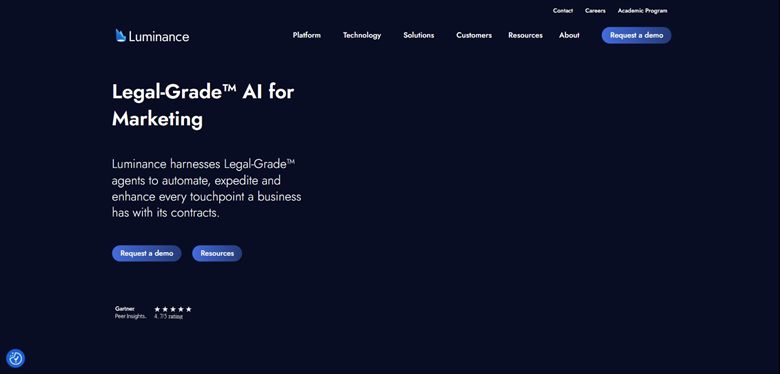
The verdict: A different tier and a different question. Worth looking at only if what you wanted from LegalOn was consistency across everything you have signed rather than help with the contract on screen.
Pricing: Published list price of approximately $41,340 a year for 1,000 documents with unlimited users. Enterprise deployments are reported from around $25,000 a year depending on volume and modules.
Standout features:
- Analysis across the whole contract estate
- Anomaly detection against learned standards
- Unlimited users on the published tier
- Coverage across many languages and jurisdictions
Limitations: At roughly $41,340 a year it is far above a per-seat review tool, and priced by document volume rather than seats, so a team reviewing a few complex agreements pays for capacity it cannot use. It reads the estate well and coaches the individual reviewer less well.
5. Wordsmith: Best for in-house teams fielding repeat requests
6.5 out of 10 how this is calculated
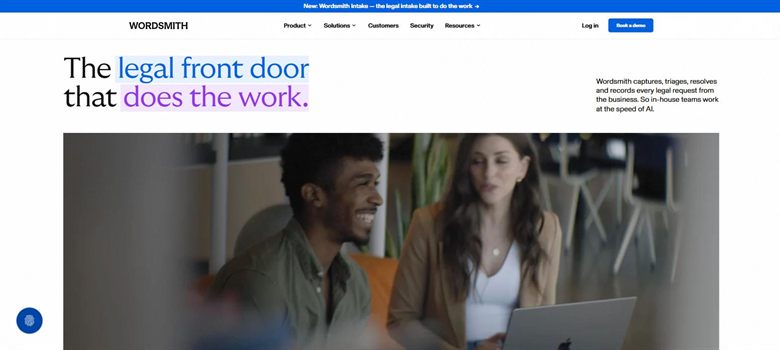
The verdict: Sits closer to a legal assistant than a review tool. Useful where the real load is the business asking the same thing repeatedly rather than any single contract being hard.
Pricing: No published list price. Reported at approximately $450 per user a month, which is the top of the per-seat range in this category.
Standout features:
- Review and generation from your own precedent
- Answers policy questions alongside producing documents
- Integrations with Slack and email
- Built for in-house rather than firm workflows
Limitations: At a reported $450 per user a month it is the most expensive per seat in this set, so it is not an answer to a pricing complaint. It is also younger than everything else here, with a correspondingly shorter track record on complex agreements.
6. LegalFly: Best for review with a platform around it
5.8 out of 10 how this is calculated

The verdict: Worth a look where data handling was part of the evaluation. Anonymising before documents reach the model is a genuine differentiator for teams whose objection to these tools was never the output quality.
Pricing: No published list price. Reported at approximately $75 per user a month plus a platform fee, so the effective cost depends heavily on team size.
Standout features:
- Review and drafting with workflow around it
- Anonymisation before documents reach the model
- Multi-language coverage across European jurisdictions
- Repository alongside review
Limitations: The platform fee is unpublished, so the reported $75 per user is a floor rather than a price and small teams can pay more per head than the figure suggests. Its position libraries are thinner than LegalOn's, which is the specific thing you would be leaving behind.
7. Harvey: Best for large firms buying across practice areas
5.3 out of 10 how this is calculated
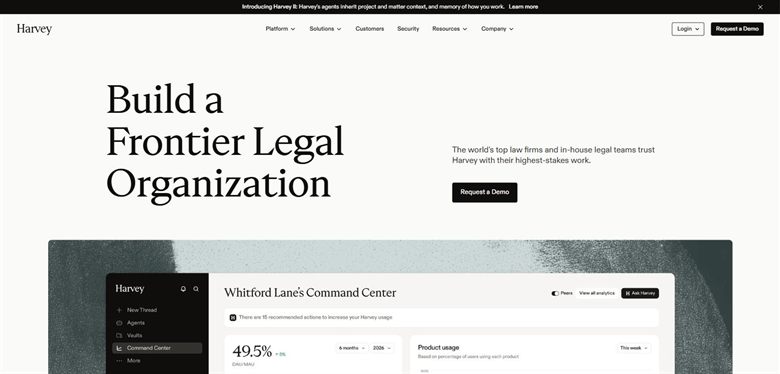
The verdict: Included for completeness rather than as a realistic swap. Almost nobody comparing review tools is buying a firm-wide platform instead, and the two are answering different questions.
Pricing: No public list price. Reported annual contracts run approximately $50,000 to $290,000 depending on firm size and practice-area coverage.
Standout features:
- Coverage across multiple practice areas
- Research, drafting and analysis in one system
- Firm knowledge management
- Custom workflows per practice group
Limitations: The reported floor of around $50,000 a year is a partnership decision rather than a software purchase, and deployment runs to months. If price transparency was your complaint about LegalOn, this is worse on every axis.
How we chose
- Depth of the position library, which is the thing LegalOn is actually good at.
- Whether the positions are the vendor's or yours, since those age very differently.
- Microsoft Word integration, because that is where the counterparty sends the document back.
- Whether a price exists that you can read before a sales call, which LegalOn does not offer.
- Whether a non-lawyer can act on the output, which LegalOn does not really intend.
- We did not score on the number of agreement types covered. Every vendor counts them differently, and depth on the five you actually sign beats breadth across ninety you do not.
Frequently asked questions
What is the best alternative to LegalOn in 2026?
Spellbook for the closest like-for-like with a price you can plan around, reported at $99 to $199 per user a month. Robin AI if you would rather encode your own positions than buy someone else's library. GenieAI if budget is the constraint, since it publishes its price and runs a free tier.
How much does LegalOn cost?
It publishes nothing, and we could not source a reported figure we would stand behind, which is why our price index lists it as absent rather than estimated. Pricing is sales-led and quoted on seat count and playbook scope. That opacity is unusual even in a market where most vendors publish nothing.
Why do people look for LegalOn alternatives?
Most commonly because they cannot get a number without a sales process, which makes it hard to shortlist. Second, because the position library is the vendor's rather than theirs, and organisations with settled positions of their own would rather encode those. Third, because it assumes a lawyer is reading the output.
Which alternatives have a real position library?
Spellbook benchmarks against market standard, which is a different mechanism reaching a similar result on common agreements. Robin AI holds a playbook, but you write it. Nothing else here ships curated positions of comparable depth, and that is genuinely what you give up when you leave.
Which LegalOn alternatives work in Microsoft Word?
Spellbook is the strongest, since it was built around Word rather than integrated with it. Wordsmith, Robin AI and GenieAI all offer Word workflows, and GenieAI preserves native track changes. The difference is who the tool assumes is reading: Spellbook and LegalOn assume a qualified reviewer, GenieAI assumes a business team working to standards somebody else set.
Is there a free alternative to LegalOn?
GenieAI runs a permanent free plan with no time limit. Spellbook offers a seven-day trial rather than a free tier. Nothing else in this set has either, so testing them means a sales conversation first, which is the problem you were trying to escape.
Should a commercial team buy any of these?
LegalOn, Spellbook and Wordsmith all assume a reader who can judge whether a proposed position suits the deal. For a team without legal support, a tool that flags risk in plain language serves better than one that proposes wording, because a confident suggestion nobody can evaluate is worse than a clear warning.