
8 Best Lexion Alternatives in 2026
Quick answer: DocuSign completed its acquisition of Lexion on 31 May 2024 for $165 million, and buyers are still working out what that means for a product they chose partly because it was not one of the incumbents. Lexion's appeal was a light-touch platform that in-house teams could run without a legal ops function, at a reported $15,000 to $150,000 a year. Juro is the closest on that specific quality and deploys in weeks. Ironclad is the answer if you need more depth, at a reported median near $40,000. If the acquisition is your only concern, the product still works and switching costs are real.
Comparison
| Tool | Score | Best for | Price | Key strength |
|---|---|---|---|---|
| Juro | 9.4 | the same light touch, independently owned | Reported ~$15,000 to $130,000/yr | Weeks to deploy, no legal ops needed |
| Ironclad | 8.8 | more depth with usable figures | Reported ~$30,000 to $250,000/yr | Approval routing at real scale |
| Evisort | 8.2 | reading the estate you already have | Reported ~$30,000 to $150,000/yr | Extraction across unstructured sets |
| GenieAI | 7.5 | in-house teams who valued Lexion for being light rather than for being a platform | Free plan, then $75/mo; Enterprise from $600/mo | Light-touch, no legal ops function required |
| SpotDraft | 7.0 | per-seat pricing at mid-market scale | Reported from ~$10,000/yr, per seat | Priced by users, not contract volume |
| Icertis | 6.5 | procurement and supplier volume | No published price | Built for the buy side |
| LinkSquares | 5.8 | reporting on executed agreements | No published price | Post-signature analytics |
| Contractbook | 5.2 | storage and renewals at small scale | Reported ~$39 to $599/mo | Only small-team price here |
Fit by buyer
Scored 1 to 5 for each buyer, where 5 means the tool was built for them and 1 means it is the wrong tool. Scope is different: it is how much of the job the tool does, from a single step to a whole lifecycle, and a low score there means narrow rather than bad. These ratings are the same for a tool wherever it appears; the score shown beside each entry is for this guide specifically. A tool can lead one column and come last in another, and the right answer still changes with who is asking. How we score.
| Tool | Lawyer in Word | In-house legal | Commercial team | Enterprise | Scope | Price |
|---|---|---|---|---|---|---|
| Juro | 2 | 4 | 4 | 4 | 4 | Reported |
| Ironclad | 2 | 4 | 2 | 5 | 5 | Reported |
| Evisort | 1 | 4 | 2 | 4 | 4 | Reported |
| GenieAI | 3 | 5 | 5 | 3 | 2 | Published |
| SpotDraft | 1 | 4 | 4 | 3 | 4 | Reported |
| Icertis | 1 | 3 | 1 | 5 | 5 | None |
| LinkSquares | 1 | 4 | 2 | 4 | 4 | None |
| Contractbook | 1 | 3 | 4 | 2 | 3 | Reported |
Which one, for your situation
| If this is your situation | Start with |
|---|---|
| You want the same light-touch platform from an independent vendor | Juro |
| You need more depth and want figures you can plan against | Ironclad |
| Reading the existing estate was the real value | Evisort |
| You want per-seat pricing at mid-market scale | SpotDraft |
| Procurement and supplier contracts are the volume | Icertis |
| Reporting on executed agreements is the whole job | LinkSquares |
| You are small and mainly need storage and renewals | Contractbook |
The 8 best Lexion alternatives
1. Juro: Best for the same light touch, independently owned
9.4 out of 10 how this is calculated
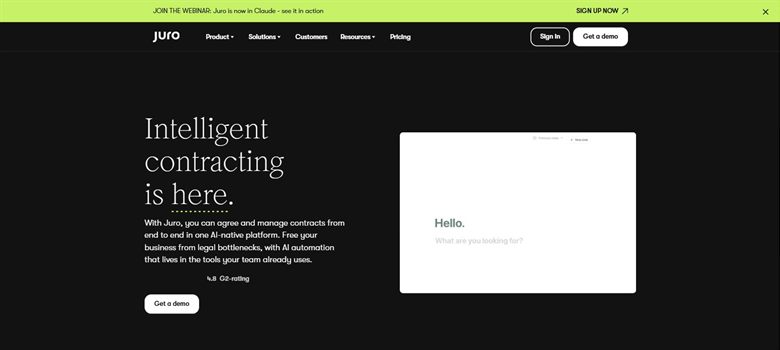
The verdict: The closest match on the quality that made people choose Lexion in the first place: a platform an in-house team of two can actually run, deployed in weeks rather than months, without a legal ops hire to own it.
Pricing: Sales-led with no public list price. Reported annual contracts run approximately $15,000 to $130,000, with marketplace medians around $31,000 to $34,500, priced on contract volume rather than per seat.
Standout features:
- Guided creation from templates legal controls
- Approval routing when terms depart from standard
- Searchable repository with renewal dates
- Non-legal staff can operate it unaided
Limitations: Priced on contract volume rather than per seat, so growth is harder to model than Lexion's user-based pricing was. The browser-native negotiation model breaks when a larger counterparty insists on a Word file, which Lexion handled more conventionally.
2. Ironclad: Best for more depth with usable figures
8.8 out of 10 how this is calculated
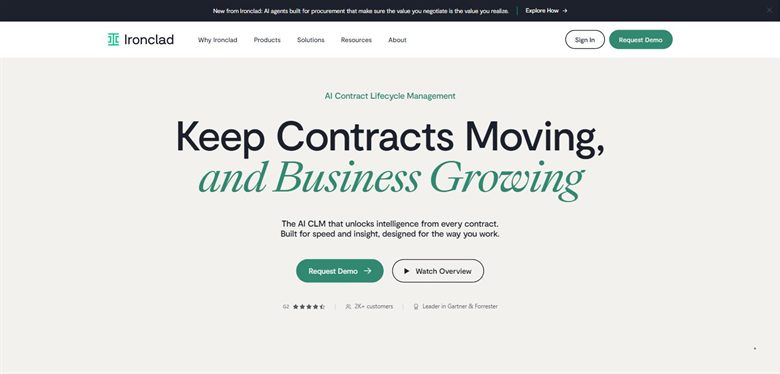
The verdict: The upgrade rather than the sideways move. Conditional routing across departments is genuinely deeper than Lexion's, and the marketplace data behind its pricing means you can size the decision before a sales call.
Pricing: No public list price. Reported annual contracts run approximately $30,000 to $250,000, with a marketplace median near $40,000 across 363 recorded purchases.
Standout features:
- Conditional approval routing by value, risk and department
- Repository and reporting across executed agreements
- Obligation and renewal tracking
- Deep Salesforce and procurement integration
Limitations: Implementation runs to months with an internal owner, which is the opposite of what Lexion buyers chose. If a light touch was the appeal, this trades it away deliberately and you should be sure that is what you want.
3. Evisort: Best for reading the estate you already have
8.2 out of 10 how this is calculated

The verdict: Right if what you valued in Lexion was the AI reading rather than the workflow around it. Extraction across scattered and badly formatted agreements is the thing it does better than any platform here.
Pricing: No public list price. Reported annual contracts run approximately $30,000 to $150,000. Now part of Workday following acquisition, so renewals may route differently than they did.
Standout features:
- Extraction across large and unstructured document sets
- Obligation and renewal identification without manual entry
- Reporting on terms across the estate
- Workflow and approvals alongside extraction
Limitations: Also acquired, by Workday, so a buyer moving away from Lexion over ownership uncertainty is walking into the same question. Its workflow is lighter than Lexion's, so this is a change of emphasis rather than a like-for-like.
4. GenieAI: Best for in-house teams who valued Lexion for being light rather than for being a platform
7.5 out of 10 how this is calculated
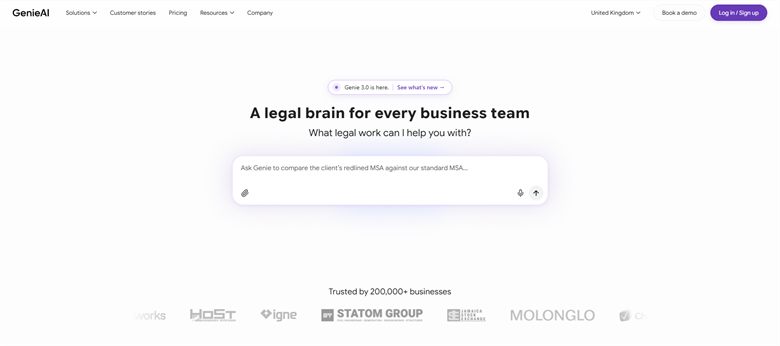
The verdict: Lexion was chosen by teams who wanted something a small in-house function could run without legal ops, and that is the same buyer this serves. It goes further on drafting and clause-level review and stops short of the repository and workflow, so it is the right move if what you valued was the lightness rather than the lifecycle.
Pricing: Permanent free plan with no time limit. Pro $75 a month for one user, Business $320 a month for five, Enterprise from $600 a month with SSO, API access and an SLA.
Standout features:
- Drafting and clause-level review in one workspace
- Risk rated red, amber or green with a plain-language reason
- Your own positions applied consistently by non-lawyers
- Microsoft Word add-in that preserves native track changes
- Published pricing with a permanent free tier
Limitations: It holds nothing once the document leaves it. Lexion gave you a repository and this does not, so a team that relied on that will need somewhere for signed agreements to live.
5. SpotDraft: Best for per-seat pricing at mid-market scale
7.0 out of 10 how this is calculated

The verdict: The closest match on pricing model, which matters more than it sounds. Lexion charged per user; most alternatives at this tier charge on contract volume, so the bill grows as the business does. This does not.
Pricing: No published list price. Reported from around $10,000 a year with a range of roughly $5,000 to $50,000, priced per seat rather than on contract volume. The VerifAI review add-on is reported to add $5,000 to $15,000 a year, so check which tier includes it.
Standout features:
- Per-seat pricing rather than contract volume
- Template-driven creation with approval workflow
- Repository with renewal tracking
- Implementation typically two to four weeks
Limitations: Per-seat pricing cuts the other way once contracts are touched by many departments, since every additional user is a licence. The AI review capability is reported as a separate add-on at $5,000 to $15,000 a year, which is easy to miss when comparing entry figures.
6. Icertis: Best for procurement and supplier volume
6.5 out of 10 how this is calculated

The verdict: Only relevant if most of your contract volume runs inbound. Lexion was built around agreements you handle rather than suppliers you manage, and this is a different product for a different direction of travel.
Pricing: No published price and no reliable reported figure we could source. Enterprise sales-led, quoted on contract volume and module count. Widely understood to sit at the top of the market alongside Ironclad.
Standout features:
- Procurement and sourcing contract management
- Obligation tracking with owner assignment
- Deep ERP integration
- Multi-entity and multi-jurisdiction support
Limitations: Publishes nothing and no reported figure could be sourced, and it is an enterprise deployment measured in months. For a team that chose Lexion for its light touch, this is the furthest thing from it on the page.
7. LinkSquares: Best for reporting on executed agreements
5.8 out of 10 how this is calculated

The verdict: A narrower swap aimed at the reporting half. Suits a team whose Lexion usage was mostly answering questions about what had been signed rather than getting new agreements through.
Pricing: No published price and no reliable reported figure we could source. Sales-led and quoted on contract volume.
Standout features:
- Analytics across executed agreements
- Clause and term extraction with alerting
- Renewal and obligation notifications
- Drafting and workflow added later in its life
Limitations: Deliberately light before signature, so approvals and template control sit outside it. It publishes no price and no reliable figure exists, which is a poor trade for a buyer who could at least find reported figures for Lexion.
8. Contractbook: Best for storage and renewals at small scale
5.2 out of 10 how this is calculated
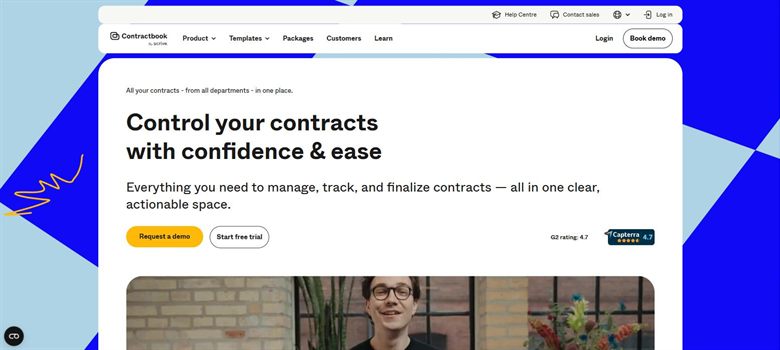
The verdict: For the team that used Lexion mainly as a repository with renewal dates. That is a much cheaper problem than the one a platform solves, and worth checking before replacing like for like.
Pricing: No published rate card. Reported between approximately $39 and $599 a month depending on tier, which is the only genuinely small-team price in this category.
Standout features:
- Searchable repository of executed agreements
- Renewal and date reminders
- Template-driven creation with signing
- Monthly pricing rather than annual contracts
Limitations: Workflow, approvals and AI extraction are all well below Lexion, so this is a genuine step down rather than the same thing cheaper. No published rate card despite being the small-team option.
How we chose
- Whether an in-house team can run it without a legal ops function, which was Lexion's main appeal.
- Implementation length, since a light touch was the point rather than a compromise.
- Ownership and roadmap independence, which is why most people are on this page.
- Whether AI-assisted extraction and workflow come together or as separate modules.
- Published price, and whether the vendor will state a figure at all.
- We did not score on integration counts. Lexion buyers rarely chose it for a logo wall, and a longer list says nothing about whether the two systems you run will stay in step.
Frequently asked questions
What happened to Lexion?
DocuSign announced an agreement to acquire it on 6 May 2024 and completed the acquisition on 31 May 2024, for $165 million. Lexion's capability has been folded into DocuSign's agreement management platform, which is why buyers who chose it specifically because it was not an incumbent are reassessing.
What is the best alternative to Lexion in 2026?
Juro is the closest on what made Lexion appealing: a platform a small in-house team can run without legal ops, deployed in weeks. Ironclad if you want more depth and figures you can plan against. SpotDraft if per-seat pricing rather than contract-volume pricing was part of the attraction.
Do we have to move because of the acquisition?
Not automatically. The product still works and migration costs are real: re-ingesting agreements, rebuilding workflows and retraining users. The questions worth asking are how renewal is now handled, whether the roadmap serves the wider DocuSign platform, and what pricing looks like at your next renewal rather than today.
Is there a cheaper alternative to Lexion?
SpotDraft is reported from around $10,000 a year against Lexion's reported $15,000 floor, and Contractbook from around $39 a month for much less capability. Ironclad and Icertis are both more expensive. None of these publish a rate card, so all the figures are directional.
Which alternatives price per seat rather than per contract?
SpotDraft does, which matches how Lexion charged. Juro, Ironclad and Icertis all price at least partly on contract volume, so the bill rises as the business grows. That difference is worth modelling before it becomes a renewal conversation.
Which alternative needs the least implementation?
Juro in weeks, and SpotDraft reports two to four weeks. Ironclad and Icertis both run to months with an internal owner. If a light touch was why you chose Lexion, only the first two preserve it and the rest trade it away.
Are any of the alternatives also owned by a larger vendor?
Evisort is now part of Workday, so moving there swaps one acquisition question for another. Juro, Ironclad, Icertis, SpotDraft, LinkSquares and Contractbook are independent at the time of writing. If ownership stability is the reason you are looking, that distinction is the one that matters.