
7 Best Robin AI Alternatives in 2026
Quick answer: Almost everyone here arrives for the same reason: the playbook never got written. Robin AI does very little until your agreed positions exist, and finding weeks of legal time to write them is where deployments stall rather than in the software. That leaves three routes. Rent a library instead of writing one, which is LegalOn. Get a position from the market rather than from yourself, which is Spellbook at a reported $99 to $199 per user a month. Or skip positions entirely and flag risk in plain language, which is GenieAI at a published free tier rising to $75. If the playbook does exist and the complaint is price, Robin AI at a reported $500 a month is not obviously beatable.
Comparison
| Tool | Score | Best for | Price | Key strength |
|---|---|---|---|---|
| LegalOn | 9.1 | a library you did not have to write | No published price | Works on day one |
| GenieAI | 8.6 | standards that exist but are not applied | Free plan, then $75/mo; Enterprise from $600/mo | Turns written standards into applied ones |
| Spellbook | 7.9 | a position from the market instead | Reported ~$99 to $199 per user/mo | Useful the same afternoon |
| Juro | 7.3 | approvals rather than positions | Reported ~$15,000 to $130,000/yr | Escalation without a playbook |
| Wordsmith | 6.5 | in-house teams fielding repeat questions | Reported ~$450 per user/mo | Answers from your own precedent |
| Ironclad | 6.1 | positions that must trigger sign-off | Reported ~$30,000 to $250,000/yr | Ties a departure to an approver |
| Luminance | 5.4 | deriving positions from what you signed | List ~$41,340/yr for 1,000 documents | The library builds itself |
Fit by buyer
Scored 1 to 5 for each buyer, where 5 means the tool was built for them and 1 means it is the wrong tool. Scope is different: it is how much of the job the tool does, from a single step to a whole lifecycle, and a low score there means narrow rather than bad. These ratings are the same for a tool wherever it appears; the score shown beside each entry is for this guide specifically. A tool can lead one column and come last in another, and the right answer still changes with who is asking. How we score.
| Tool | Lawyer in Word | In-house legal | Commercial team | Enterprise | Scope | Price |
|---|---|---|---|---|---|---|
| LegalOn | 4 | 5 | 2 | 3 | 2 | None |
| GenieAI | 3 | 5 | 5 | 3 | 2 | Published |
| Spellbook | 5 | 4 | 2 | 2 | 2 | Reported |
| Juro | 2 | 4 | 4 | 4 | 4 | Reported |
| Wordsmith | 4 | 4 | 2 | 2 | 2 | Reported |
| Ironclad | 2 | 4 | 2 | 5 | 5 | Reported |
| Luminance | 3 | 4 | 1 | 4 | 4 | Published |
Which one, for your situation
| If this is your situation | Start with |
|---|---|
| You want a position library without writing one | LegalOn |
| Standards exist but nobody applies them consistently | GenieAI |
| You want to know what counterparties actually accept | Spellbook |
| The real need is approvals rather than positions | Juro |
| Your in-house team is drowning in repeat questions | Wordsmith |
| Positions must trigger sign-off across departments | Ironclad |
| You would rather derive positions from what you already signed | Luminance |
The 7 best Robin AI alternatives
1. LegalOn: Best for a library you did not have to write
9.1 out of 10 how this is calculated
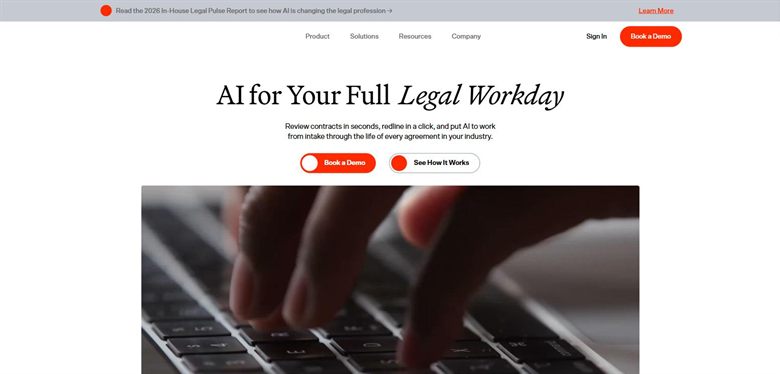
The verdict: The direct answer to the playbook problem: a curated library written by the vendor's lawyers, useful before you have decided anything yourself. You trade positions that are yours for positions that exist.
Pricing: No public list price, and we could not source a reliable reported figure. Sales-led and quoted on seat count and playbook scope.
Standout features:
- Pre-built position libraries by agreement type
- Suggested revisions with the reasoning attached
- Word integration for redlining
- Review against your own standards as well as theirs
Limitations: No published price and no reported figure we could stand behind, so a team leaving Robin AI partly on cost cannot compare. The library is the vendor's, and the clauses your business actually argues about are often the ones a general library did not anticipate.
2. GenieAI: Best for standards that exist but are not applied
8.6 out of 10 how this is calculated
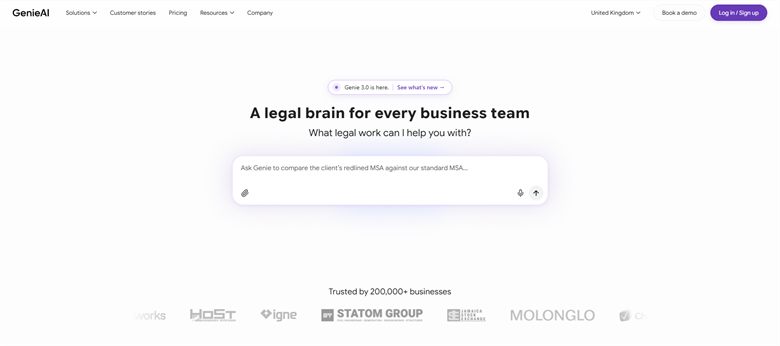
The verdict: Sits between the two other routes. It works against standards you have set and retains them, but it also flags risk in plain language without a full playbook, so it degrades gracefully when the positions are incomplete rather than doing nothing.
Pricing: Permanent free plan with no time limit. Pro $75 a month for one user, Business $320 a month for five, Enterprise from $600 a month with SSO, API access and an SLA.
Standout features:
- Review and redlining against your organisation's own playbook
- Risk rated red, amber or green with plain-language explanations
- Organisational knowledge graph so a position taken once carries forward
- Microsoft Word add-in that preserves native track changes
- Free tier with no time limit
Limitations: It is still better with standards set, so a business that has written nothing down gets generic help until it does. No approval routing and no repository, so it does nothing about who signs off on a departure from position.
3. Spellbook: Best for a position from the market instead
7.9 out of 10 how this is calculated
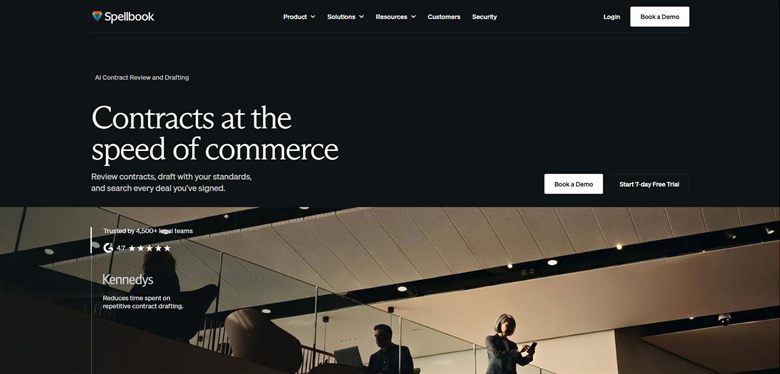
The verdict: The opposite philosophy and the fastest to value. Instead of encoding what you decided, it tells you what comparable counterparties accepted, which requires no preparation at all and answers a different question.
Pricing: No published list price. Reported at approximately $99 to $199 per user a month, rising to around $350 per user on enterprise plans with a ten-seat minimum. A seven-day trial is offered.
Standout features:
- Drafting and redlining inside Microsoft Word
- Suggestions benchmarked against market standard
- Same-day setup with no implementation
- Seven-day trial
Limitations: It has no memory of what your business decided, so five people using it can still take five different positions. That is precisely the problem Robin AI was bought to solve, and swapping to this gives it back.
4. Juro: Best for approvals rather than positions
7.3 out of 10 how this is calculated
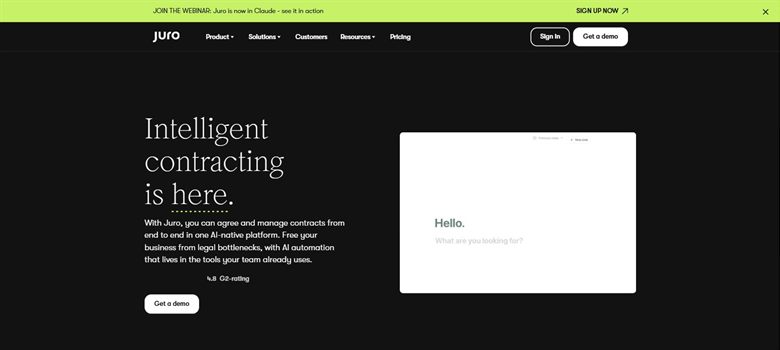
The verdict: Achieves some of the same outcome by a different route. Rather than encoding fallback positions, it enforces a template and escalates anything that departs from it, which needs a template rather than a playbook.
Pricing: Sales-led with no public list price. Reported annual contracts run approximately $15,000 to $130,000, with marketplace medians around $31,000 to $34,500, priced on contract volume rather than per seat.
Standout features:
- Guided creation from templates legal controls
- Approval routing when terms depart from standard
- Native electronic signature
- Searchable repository with reporting
Limitations: It escalates departures without telling anyone what to do about them, so the judgement Robin AI was encoding still has to happen somewhere. A reported floor of around $15,000 a year is a large step from $500 a month.
5. Wordsmith: Best for in-house teams fielding repeat questions
6.5 out of 10 how this is calculated
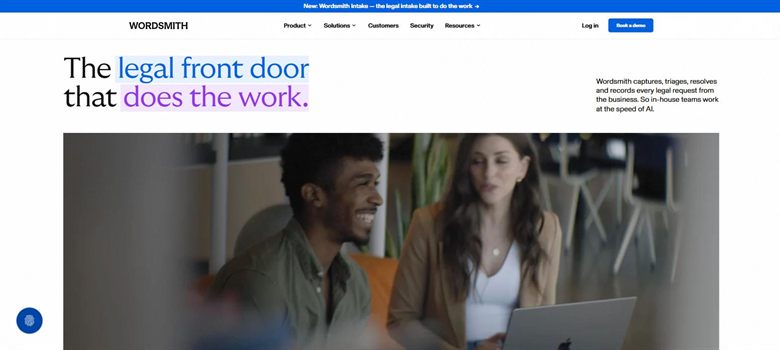
The verdict: Relevant where the underlying problem was the business asking legal the same thing repeatedly, which is often what a playbook is really being bought to fix. It answers from your own precedent rather than from encoded rules.
Pricing: No published list price. Reported at approximately $450 per user a month, which is the top of the per-seat range in this category.
Standout features:
- Answers policy and contract questions from your own precedent
- Integrations with Slack and email where questions arrive
- Review and generation alongside question answering
- Built for in-house rather than firm workflows
Limitations: At a reported $450 per user a month it is the most expensive per seat here, and close to Robin AI's monthly floor for a single user. It is also a young product with a shorter track record on complex negotiated agreements.
6. Ironclad: Best for positions that must trigger sign-off
6.1 out of 10 how this is calculated
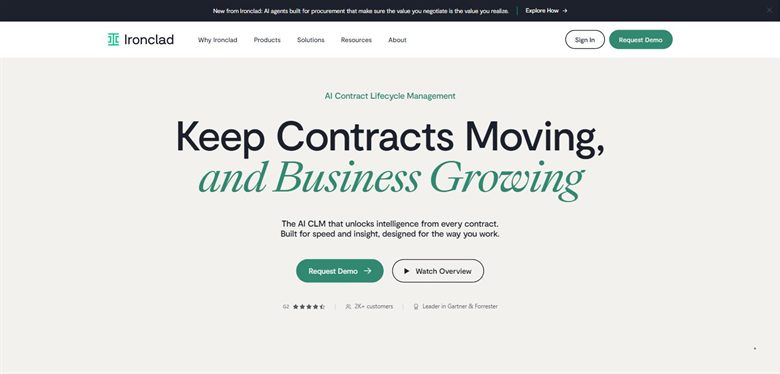
The verdict: The heavyweight route. Positions become approval rules, so departing from one is not a suggestion but a routing event that reaches finance, security or legal automatically.
Pricing: No public list price. Reported annual contracts run approximately $30,000 to $250,000, with a marketplace median near $40,000 across 363 recorded purchases.
Standout features:
- Conditional approval routing by value, risk and department
- Clause library tied to the approvals it triggers
- Repository and reporting across executed agreements
- Obligation and renewal tracking
Limitations: Months to implement with an internal owner, so it replaces a playbook-writing problem with a bigger configuration problem. The reported median near $40,000 a year is far above Robin AI, and its clause-level suggestions are shallower.
7. Luminance: Best for deriving positions from what you signed
5.4 out of 10 how this is calculated
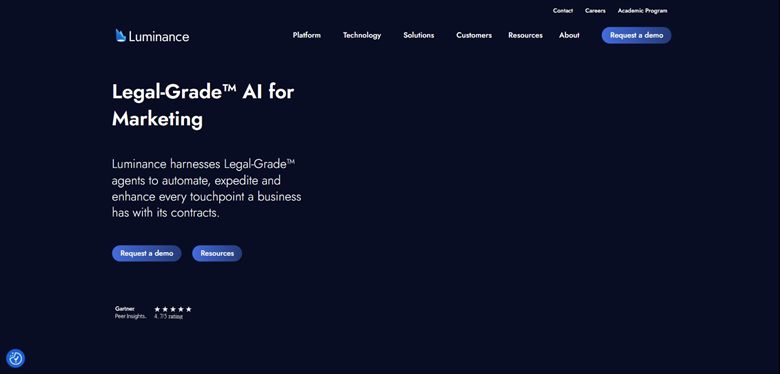
The verdict: The most interesting answer to the playbook problem, because it sidesteps it: positions are learned from agreements you have already signed rather than written from scratch.
Pricing: Published list price of approximately $41,340 a year for 1,000 documents with unlimited users. Enterprise deployments are reported from around $25,000 a year depending on volume and modules.
Standout features:
- Positions learned from the existing contract estate
- Anomaly detection against those learned standards
- Unlimited users on the published tier
- Coverage across many languages and jurisdictions
Limitations: It learns what you actually agreed, including concessions you should not have made, so somebody still has to curate it and that is the playbook exercise wearing a different hat. At roughly $41,340 a year it is far above Robin AI.
How we chose
- Whether the tool works before you have written your positions down, which is the whole issue.
- Where suggested positions come from: your playbook, a vendor library, or the market.
- Time to value, since the answer here is usually measured in weeks against an afternoon.
- Whether a non-lawyer can act on the output.
- Published price.
- We did not score on playbook depth or clause counts. A playbook you have not written has no depth, and that is the situation most readers of this page are actually in.
Frequently asked questions
What is the best alternative to Robin AI in 2026?
LegalOn if you want a position library without writing one, though it publishes no price. GenieAI if standards exist but nobody applies them consistently, at a published free tier rising to $75 a month. Spellbook if you would rather know what the market accepts, at a reported $99 to $199 per user.
Why do people look for Robin AI alternatives?
Overwhelmingly because the playbook never got written. Robin AI does very little until your agreed positions exist, and finding weeks of legal time to write them is where deployments stall. The software is rarely the complaint; the prerequisite is.
Is there a cheaper alternative to Robin AI?
GenieAI publishes a free tier rising to $75 a month, which is well below Robin AI's reported $500 floor. Spellbook at $99 to $199 per user is cheaper for one or two users and more expensive for a team. Everything else here costs considerably more.
Can we avoid writing a playbook altogether?
Partly. LegalOn rents you one, Spellbook substitutes market standard for your positions, and Luminance derives them from what you have already signed. All three are genuine ways round it, and all three give up the thing a real playbook provides, which is positions your business has actually agreed to.
What if the playbook exists and price is the issue?
Then Robin AI at a reported $500 a month is not obviously beatable for what it does, and the honest answer is that switching costs you the playbook build you have already paid for. Check whether the tier you need is the one you are on before assuming a move saves money.
Which alternatives keep consistency across a team?
GenieAI retains positions and reapplies them, and Ironclad turns them into approval rules. Spellbook does not: five people using it can still take five different positions, which is precisely the problem Robin AI solves and the thing you give back by moving to it.
Is a playbook worth writing anyway?
Yes, and independently of the software. If more than one person negotiates on your behalf, the positions need to exist somewhere, and writing them down is the work that produces most of the benefit. The tool then enforces them, which is valuable but secondary.