
8 Best SpotDraft Alternatives in 2026
Quick answer: SpotDraft's per-seat model is its best and worst feature. It means closing more deals does not raise the bill, which is genuinely rare at this tier, and it means every new person who touches a contract is another licence, which bites once contracts spread beyond legal and sales. That is the main reason people look. Juro prices on contract volume instead, so the trade runs the other way. Ironclad is the answer for real depth at a reported median near $40,000. And check whether the VerifAI review add-on, reported at $5,000 to $15,000 a year, was in the number you compared.
Comparison
| Tool | Score | Best for | Price | Key strength |
|---|---|---|---|---|
| Juro | 9.4 | many users, predictable per contract | Reported ~$15,000 to $130,000/yr | Seats do not cost extra |
| Ironclad | 8.8 | real approval depth | Reported ~$30,000 to $250,000/yr | Routing across departments |
| Icertis | 8.2 | procurement-led businesses | No published price | Built for the buy side |
| Evisort | 7.6 | reading the estate you inherited | Reported ~$30,000 to $150,000/yr | Extraction across unstructured sets |
| GenieAI | 7.0 | teams whose SpotDraft bill grew with every new licence | Free plan, then $75/mo; Enterprise from $600/mo | Published per-seat pricing with a free tier |
| LinkSquares | 6.4 | reporting on executed agreements | No published price | Post-signature analytics |
| Agiloft | 5.9 | processes that do not fit a product | No published price | Configurability |
| Contractbook | 5.2 | small teams that overbought | Reported ~$39 to $599/mo | Only small-team price here |
Fit by buyer
Scored 1 to 5 for each buyer, where 5 means the tool was built for them and 1 means it is the wrong tool. Scope is different: it is how much of the job the tool does, from a single step to a whole lifecycle, and a low score there means narrow rather than bad. These ratings are the same for a tool wherever it appears; the score shown beside each entry is for this guide specifically. A tool can lead one column and come last in another, and the right answer still changes with who is asking. How we score.
| Tool | Lawyer in Word | In-house legal | Commercial team | Enterprise | Scope | Price |
|---|---|---|---|---|---|---|
| Juro | 2 | 4 | 4 | 4 | 4 | Reported |
| Ironclad | 2 | 4 | 2 | 5 | 5 | Reported |
| Icertis | 1 | 3 | 1 | 5 | 5 | None |
| Evisort | 1 | 4 | 2 | 4 | 4 | Reported |
| GenieAI | 3 | 5 | 5 | 3 | 2 | Published |
| LinkSquares | 1 | 4 | 2 | 4 | 4 | None |
| Agiloft | 1 | 3 | 1 | 4 | 5 | None |
| Contractbook | 1 | 3 | 4 | 2 | 3 | Reported |
Which one, for your situation
| If this is your situation | Start with |
|---|---|
| Contracts now touch many departments and seats are the problem | Juro |
| You need genuine approval depth across the business | Ironclad |
| Procurement and supplier volume dominate | Icertis |
| Reading the existing estate was the real requirement | Evisort |
| Reporting on executed agreements is the whole job | LinkSquares |
| Your process genuinely does not fit an opinionated product | Agiloft |
| You are small and this was more than needed | Contractbook |
The 8 best SpotDraft alternatives
1. Juro: Best for many users, predictable per contract
9.4 out of 10 how this is calculated
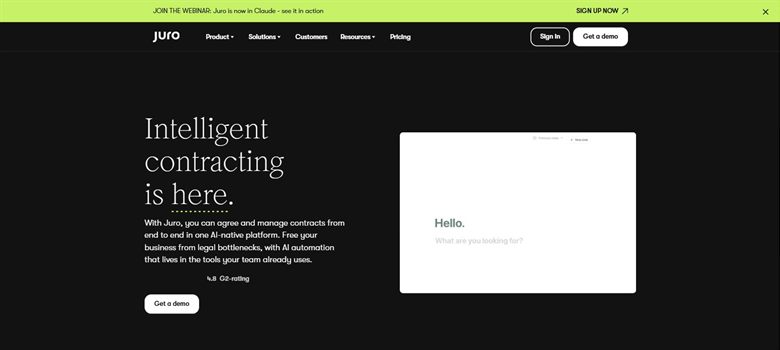
The verdict: The direct answer to the seat problem, and it makes the opposite trade. Adding another department costs nothing; closing more deals costs more. Which is better depends entirely on which of those is growing faster in your business.
Pricing: Sales-led with no public list price. Reported annual contracts run approximately $15,000 to $130,000, with marketplace medians around $31,000 to $34,500, priced on contract volume rather than per seat.
Standout features:
- Priced on contract volume rather than seats
- Guided creation from templates legal controls
- Approval routing when terms depart from standard
- Deploys in weeks with no configuration project
Limitations: You are swapping one unpredictable dimension for another, and Juro's floor of around $15,000 is above SpotDraft's reported $10,000. The browser-native negotiation model breaks when a larger counterparty insists on a Word file.
2. Ironclad: Best for real approval depth
8.8 out of 10 how this is calculated
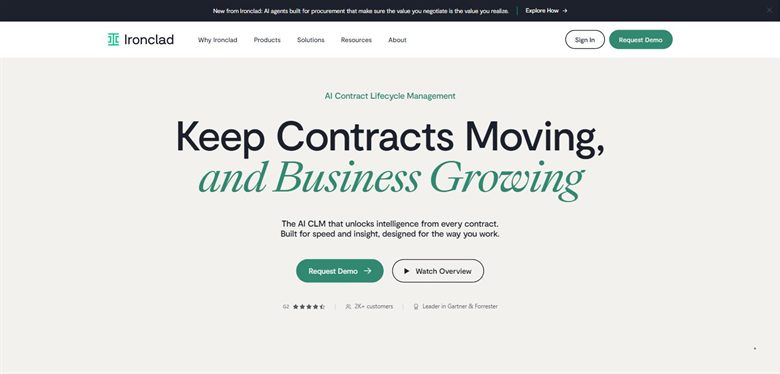
The verdict: The move up rather than across. Conditional routing by value, risk and department is deeper than anything SpotDraft offers, and it is the capability most often missing when a business outgrows a mid-market platform.
Pricing: No public list price. Reported annual contracts run approximately $30,000 to $250,000, with a marketplace median near $40,000 across 363 recorded purchases.
Standout features:
- Conditional approval routing by value, risk and department
- Repository and reporting across executed agreements
- Obligation and renewal tracking
- Deep Salesforce and procurement integration
Limitations: Months to implement with an internal owner, against SpotDraft's reported two to four weeks. At a reported median near $40,000 a year it is a substantial step up in cost as well as capability.
3. Icertis: Best for procurement-led businesses
8.2 out of 10 how this is calculated

The verdict: Relevant only where most contract volume runs inbound. SpotDraft is built around agreements you issue, and a procurement-heavy business hits that limit rather than a pricing one.
Pricing: No published price and no reliable reported figure we could source. Enterprise sales-led, quoted on contract volume and module count. Widely understood to sit at the top of the market alongside Ironclad.
Standout features:
- Procurement and sourcing contract management
- Obligation tracking with owner assignment
- Deep ERP integration
- Multi-entity and multi-jurisdiction support
Limitations: Publishes nothing and no reported figure could be sourced, so cost predictability gets worse rather than better. Implementation runs to months with a dedicated owner.
4. Evisort: Best for reading the estate you inherited
7.6 out of 10 how this is calculated

The verdict: For the buyer whose real question was what have we already signed. SpotDraft manages agreements from creation forward and does much less with a pile that predates it.
Pricing: No public list price. Reported annual contracts run approximately $30,000 to $150,000. Now part of Workday following acquisition, so renewals may route differently than they did.
Standout features:
- Extraction across large and unstructured document sets
- Obligation and renewal identification without manual entry
- Reporting on terms across the estate
- Workflow and approvals alongside extraction
Limitations: Lighter on creation workflow than SpotDraft, so it is a change of emphasis rather than an upgrade. The Workday acquisition leaves pricing and roadmap less settled.
5. GenieAI: Best for teams whose SpotDraft bill grew with every new licence
7.0 out of 10 how this is calculated
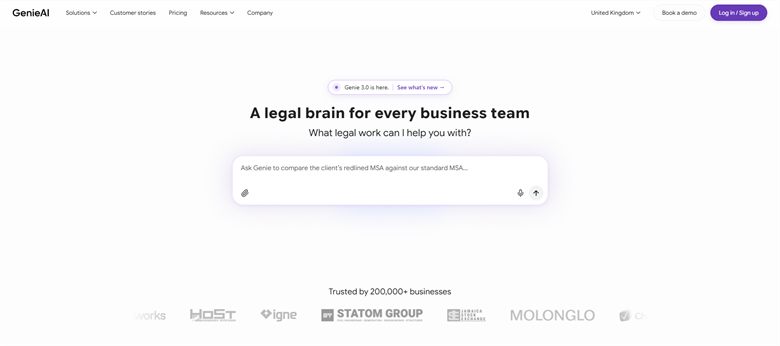
The verdict: Directly addresses the complaint that sends most people to this page. Every additional person who touches a contract is another SpotDraft licence, and here the price is published, starts free and tops out at $320 a month for five users. It covers drafting and review rather than the full lifecycle, which is the trade.
Pricing: Permanent free plan with no time limit. Pro $75 a month for one user, Business $320 a month for five, Enterprise from $600 a month with SSO, API access and an SLA.
Standout features:
- Drafting and clause-level review in one workspace
- Risk rated red, amber or green with a plain-language reason
- Your own positions applied consistently by non-lawyers
- Microsoft Word add-in that preserves native track changes
- Published pricing with a permanent free tier
Limitations: It is not a lifecycle platform, so approvals, repository and signature all sit outside it. If those are the parts of SpotDraft you actually use, this is a downgrade rather than an alternative.
6. LinkSquares: Best for reporting on executed agreements
6.4 out of 10 how this is calculated

The verdict: A narrower option for teams whose SpotDraft usage was mostly answering questions about signed agreements rather than getting new ones through.
Pricing: No published price and no reliable reported figure we could source. Sales-led and quoted on contract volume.
Standout features:
- Analytics across executed agreements
- Clause and term extraction with alerting
- Renewal and obligation notifications
- Drafting and workflow added later in its life
Limitations: Deliberately light before signature, so template control and approvals sit outside it. Publishes nothing and no reliable figure exists, which is a worse position than SpotDraft's reported range.
7. Agiloft: Best for processes that do not fit a product
5.9 out of 10 how this is calculated
The verdict: The alternative when SpotDraft's opinions were the constraint rather than its price. You trade a working product for a configurable one, and pay separately to have it configured.
Pricing: No published price and no reliable reported figure we could source. Quoted on users and modules, with configuration typically a separate cost.
Standout features:
- No-code configuration of the contract data model
- Conditional logic beyond fixed products
- Extensive permissions and audit trail
- Long track record in complex deployments
Limitations: Configuration is charged separately and is usually the larger half of the first year, which turns SpotDraft's short implementation into a months-long project. It also prices on users, so the seat problem does not go away.
8. Contractbook: Best for small teams that overbought
5.2 out of 10 how this is calculated
The verdict: Worth checking before replacing like for like. A business that mainly needs agreements stored, findable and flagged before renewal is paying platform prices for a filing problem.
Pricing: No published rate card. Reported between approximately $39 and $599 a month depending on tier, which is the only genuinely small-team price in this category.
Standout features:
- Searchable repository of executed agreements
- Renewal and date reminders
- Template-driven creation with signing
- Monthly pricing rather than annual contracts
Limitations: Approvals and reporting are both well below SpotDraft, so this is a deliberate reduction in scope. No published rate card, and the $39 to $599 spread makes growth impossible to model.
How we chose
- How the price behaves as more departments touch contracts, which is where per-seat pricing turns.
- Whether AI review is included or a separately priced add-on.
- Implementation length, since SpotDraft's two to four weeks is unusually short for the tier.
- Approval depth, which is the usual reason for moving up rather than sideways.
- Published price, which nobody in this set offers.
- We did not score on template libraries. Every platform here ships some, and the ones that matter are the ones your legal team writes.
Frequently asked questions
What is the best alternative to SpotDraft in 2026?
Juro if per-seat pricing has become the problem, since it charges on contract volume instead. Ironclad if you need genuine approval depth across departments, at a reported median near $40,000 a year. Evisort if the real requirement was reading the estate you already have.
Why do people look for SpotDraft alternatives?
Mostly the seat count. Per-seat pricing is an advantage while contracts stay with legal and sales, and turns into the main cost once procurement, finance and operations all need access. Second, the VerifAI add-on: AI review is reported as a separate line at $5,000 to $15,000 a year, which is easy to miss when comparing entry prices.
Is there a cheaper alternative to SpotDraft?
Contractbook is reported from around $39 a month for far less capability. Among genuine platforms, no: SpotDraft's reported floor near $10,000 a year is at the low end of the tier, and Juro, Ironclad and Icertis all start higher. Leaving SpotDraft over price usually means buying less.
Per seat or per contract volume, which is better?
It depends which is growing faster. Per seat punishes adoption across departments; per volume punishes commercial success. Model both against your next two years rather than against today, because the answer often flips, and neither vendor will do that arithmetic for you.
Which alternative implements fastest?
None faster than SpotDraft, which reports two to four weeks and often includes it. Juro is measured in weeks. Ironclad, Icertis and Agiloft all run to months, with Agiloft usually longest because configuration is the point. If implementation length matters, moving is a step backwards.
Is the AI review add-on worth it?
That depends on whether anything you sign is negotiated. If contracts go out and come back unchanged, review capability of any kind is money spent on a problem you do not have. If terms get argued over, compare the add-on against a dedicated review tool, which may be cheaper and better at that specific job.
Should we stay with SpotDraft?
If contracts remain with a defined group of users, probably yes, because the short implementation and reported low floor are genuinely competitive. The clearest case for moving is a business where contract access is spreading across departments faster than contract volume is growing.