
7 Best Agiloft Alternatives in 2026
Quick answer: Agiloft's argument is that you can model your contract process exactly as it is. The bill for that arrives as configuration, usually charged separately and usually the larger half of the first year, and that is why most people are here. The honest question is whether your process is genuinely unusual or merely undocumented, because those look identical during an evaluation and lead to opposite decisions. If it is undocumented, an opinionated platform is cheaper and faster: Juro in weeks, Ironclad at a reported median near $40,000. If it is genuinely unusual, Icertis is the closest on configurability at enterprise scale.
Comparison
| Tool | Score | Best for | Price | Key strength |
|---|---|---|---|---|
| Juro | 9.4 | processes that were undocumented, not unusual | Reported ~$15,000 to $130,000/yr | Opinions that mean no configuration project |
| Ironclad | 8.8 | depth without building the model | Reported ~$30,000 to $250,000/yr | Configurable routing without a blank canvas |
| Icertis | 8.0 | genuinely unusual at enterprise scale | No published price | Depth plus multi-entity handling |
| Evisort | 7.3 | reading the estate rather than modelling it | Reported ~$30,000 to $150,000/yr | Extraction without configuration |
| LinkSquares | 6.6 | reporting on what is already signed | No published price | Post-signature analytics |
| SpotDraft | 6.0 | short implementation, per-seat pricing | Reported from ~$10,000/yr, per seat | Two to four weeks, often included |
| Contractbook | 5.2 | small teams that overbought | Reported ~$39 to $599/mo | Only small-team price here |
Fit by buyer
Scored 1 to 5 for each buyer, where 5 means the tool was built for them and 1 means it is the wrong tool. Scope is different: it is how much of the job the tool does, from a single step to a whole lifecycle, and a low score there means narrow rather than bad. These ratings are the same for a tool wherever it appears; the score shown beside each entry is for this guide specifically. A tool can lead one column and come last in another, and the right answer still changes with who is asking. How we score.
| Tool | Lawyer in Word | In-house legal | Commercial team | Enterprise | Scope | Price |
|---|---|---|---|---|---|---|
| Juro | 2 | 4 | 4 | 4 | 4 | Reported |
| Ironclad | 2 | 4 | 2 | 5 | 5 | Reported |
| Icertis | 1 | 3 | 1 | 5 | 5 | None |
| Evisort | 1 | 4 | 2 | 4 | 4 | Reported |
| LinkSquares | 1 | 4 | 2 | 4 | 4 | None |
| SpotDraft | 1 | 4 | 4 | 3 | 4 | Reported |
| Contractbook | 1 | 3 | 4 | 2 | 3 | Reported |
Which one, for your situation
| If this is your situation | Start with |
|---|---|
| Your process was undocumented rather than unusual | Juro |
| You want depth without building the data model yourself | Ironclad |
| Genuinely unusual requirements at enterprise scale | Icertis |
| The value was reading the estate, not modelling it | Evisort |
| You need reporting on executed agreements only | LinkSquares |
| You want per-seat pricing and a short implementation | SpotDraft |
| You are small and this was always oversized | Contractbook |
The 7 best Agiloft alternatives
1. Juro: Best for processes that were undocumented, not unusual
9.4 out of 10 how this is calculated
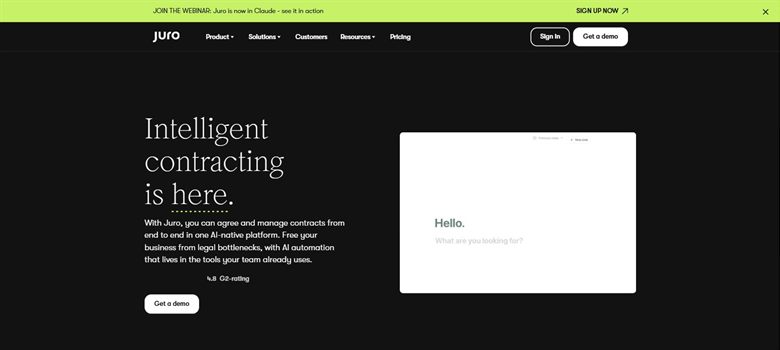
The verdict: The direct answer to the most common Agiloft regret. Its opinions about how contracting works are strong, and for most businesses that is a feature: you adopt a sensible process in weeks instead of encoding an unexamined one over months.
Pricing: Sales-led with no public list price. Reported annual contracts run approximately $15,000 to $130,000, with marketplace medians around $31,000 to $34,500, priced on contract volume rather than per seat.
Standout features:
- Guided creation from templates legal controls
- Approval routing when terms depart from standard
- Native electronic signature
- Weeks to deploy with no configuration project
Limitations: If your process genuinely is unusual, its opinions become constraints and you will be working around them. Priced on contract volume with no published figure, so growth cannot be modelled in advance.
2. Ironclad: Best for depth without building the model
8.8 out of 10 how this is calculated
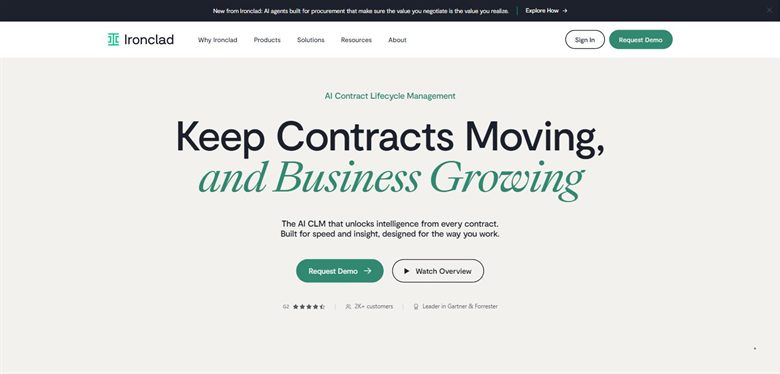
The verdict: Sits between the two poles. Conditional routing by value, risk and department covers most of what teams reach for Agiloft to build, without starting from an empty data model.
Pricing: No public list price. Reported annual contracts run approximately $30,000 to $250,000, with a marketplace median near $40,000 across 363 recorded purchases.
Standout features:
- Conditional approval routing by value, risk and department
- Repository and reporting across executed agreements
- Obligation and renewal tracking
- Deep Salesforce and procurement integration
Limitations: Still an implementation measured in months with an internal owner, so it shortens the configuration problem rather than removing it. Less flexible than Agiloft where requirements genuinely fall outside its model.
3. Icertis: Best for genuinely unusual at enterprise scale
8.0 out of 10 how this is calculated

The verdict: The alternative if the requirement is real rather than imagined. Multi-entity structures, procurement depth and compliance tracking come built rather than configured, which is a different way of solving the same problem.
Pricing: No published price and no reliable reported figure we could source. Enterprise sales-led, quoted on contract volume and module count. Widely understood to sit at the top of the market alongside Ironclad.
Standout features:
- Procurement and sourcing contract management
- Obligation tracking with owner assignment and status
- Deep ERP integration
- Multi-entity and multi-jurisdiction support
Limitations: Publishes nothing and no reported figure could be sourced, and implementation is longer than Agiloft's rather than shorter. If configuration time was your complaint, this does not solve it.
4. Evisort: Best for reading the estate rather than modelling it
7.3 out of 10 how this is calculated

The verdict: Worth considering if what you wanted from a configurable data model was visibility over what you have signed. Extraction reaches that without anyone defining fields first.
Pricing: No public list price. Reported annual contracts run approximately $30,000 to $150,000. Now part of Workday following acquisition, so renewals may route differently than they did.
Standout features:
- Extraction across large and unstructured document sets
- Obligation and renewal identification without manual entry
- Reporting on terms across the estate
- Workflow and approvals alongside extraction
Limitations: Workflow is lighter than Agiloft's and there is no comparable ability to model an unusual process. The Workday acquisition leaves pricing and roadmap less settled on a multi-year commitment.
5. LinkSquares: Best for reporting on what is already signed
6.6 out of 10 how this is calculated

The verdict: A narrower swap for teams whose Agiloft build was mostly about reporting fields. Analytics across executed agreements arrives without a data modelling exercise first.
Pricing: No published price and no reliable reported figure we could source. Sales-led and quoted on contract volume.
Standout features:
- Analytics across executed agreements
- Clause and term extraction with alerting
- Renewal and obligation notifications
- Drafting and workflow added later in its life
Limitations: Deliberately light before signature, so approvals and template control sit outside it. Publishes nothing and no reliable figure exists, so it repeats Agiloft's pricing opacity.
6. SpotDraft: Best for short implementation, per-seat pricing
6.0 out of 10 how this is calculated

The verdict: The sharpest contrast with Agiloft on the exact axis that sends people looking. Implementation reported at two to four weeks and often included, against configuration charged separately and measured in months.
Pricing: No published list price. Reported from around $10,000 a year with a range of roughly $5,000 to $50,000, priced per seat rather than on contract volume. The VerifAI review add-on is reported to add $5,000 to $15,000 a year. Implementation is reported at two to four weeks and often included.
Standout features:
- Per-seat pricing rather than contract volume
- Template-driven creation with approval workflow
- Repository with renewal tracking
- Implementation typically two to four weeks
Limitations: Considerably less configurable, so a genuinely unusual process will not fit and you are back where you started. Per-seat pricing works against you once many departments touch contracts, and the AI review capability is a separate add-on.
7. Contractbook: Best for small teams that overbought
5.2 out of 10 how this is calculated
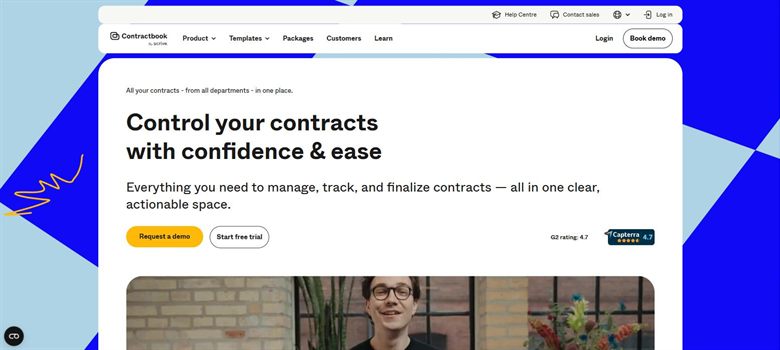
The verdict: The reality check. Some Agiloft evaluations begin with a business that mainly needs agreements stored, findable and flagged before renewal, and configurability is answering a question it does not have.
Pricing: No published rate card. Reported between approximately $39 and $599 a month depending on tier, which is the only genuinely small-team price in this category.
Standout features:
- Searchable repository of executed agreements
- Renewal and date reminders
- Template-driven creation with signing
- Monthly pricing rather than annual contracts
Limitations: No configurability worth the name, so if your requirements genuinely are specific this is not a candidate. Workflow and reporting are both well below Agiloft, and it publishes no rate card despite being the small-team option.
How we chose
- How much of the first-year cost is configuration rather than licence, which is the whole issue.
- Whether the product's built-in opinions fit your process closely enough to skip configuring.
- Time to a working system, since configurable platforms are slower before they are better.
- Who maintains the configuration after go-live, which is rarely budgeted.
- Published price, which almost nobody in this set offers.
- We did not score on the number of configurable fields or objects. Every configurable platform can model anything given enough time, and the differences appear in how long that takes rather than in what is possible.
Frequently asked questions
What is the best alternative to Agiloft in 2026?
Juro if your process turned out to be undocumented rather than unusual, since it deploys in weeks with no configuration project. Ironclad for depth without building a data model, at a reported median near $40,000 a year. Icertis if the requirement is genuinely unusual at enterprise scale.
Why do people look for Agiloft alternatives?
Almost always the configuration cost. It is charged separately from the licence and is usually the larger half of the first year, which the licence quote does not show. Second, the time: a configurable platform is slower before it is better, and businesses that needed something working this quarter find that out late.
Is my process unusual or just undocumented?
The most useful question on this page, and the two look identical during an evaluation. A practical test: can somebody write down the current process in a page without saying it depends. If not, it is undocumented, and configuring a platform to match an unexamined process encodes the confusion rather than fixing it.
Is there a cheaper alternative to Agiloft?
Hard to establish, because Agiloft publishes no price and no reliable reported figure exists. SpotDraft is reported from around $10,000 a year and Contractbook from $39 a month. The more useful comparison is total first-year cost including configuration, where almost anything with a short implementation comes out ahead.
Which alternative implements fastest?
SpotDraft reports two to four weeks and often includes it, and Juro is measured in weeks. Ironclad and Icertis both run to months, and Icertis is usually longer than Agiloft rather than shorter. If implementation length was your complaint, only the first two answer it.
Who maintains the configuration afterwards?
You do, and it is rarely budgeted. A configured platform needs somebody who understands the model when the process changes, when a field needs adding or when the person who built it leaves. That ongoing dependency is a real part of the cost and it does not appear in any comparison table, including ours.
Should we stay with Agiloft?
If your requirements genuinely fall outside what opinionated products model, yes, because the alternatives all give something up and you have already paid the configuration cost. The strongest case for moving is a business that configured a process it had never examined, where a platform with good defaults would have been faster and cheaper.