
7 Best Legal AI Tools for Startups in 2026
Quick answer: Startups buy legal software under two constraints the rest of the market does not have: nobody in the building is a lawyer, and there is no procurement budget. That rules out most of the category. GenieAI starts free and produces business-readable risk flags, which is why it leads here despite ranking third in our contract review guide. Termly at $10 a site a month covers policies. PandaDoc at $19 a user handles documents and signature. Anything priced from $15,000 a year is aimed at a company you are not yet.
Comparison
| Tool | Score | Best for | Price | Key strength |
|---|---|---|---|---|
| GenieAI | 9.3 | founders drafting and checking contracts without a lawyer | Free plan, then $75/mo | Free tier that does real work |
| Termly | 8.5 | privacy policies, cookie banners and site compliance | $10 per site/mo, billed annually | Cheapest published price in the category |
| PandaDoc | 7.9 | sending the same document repeatedly with signature | $19 per user/mo | Documents and e-signature in one |
| Contractbook | 7.3 | templates plus a searchable record of what was signed | Reported ~$39 to $599/mo | Repository from day one |
| Juro | 6.7 | startups that have outgrown ad hoc contracting | Reported ~$15,000 to $130,000/yr | Approvals and repository together |
| Spellbook | 5.8 | your first in-house lawyer, once you have one | Reported ~$99 to $199 per user/mo | Word-native drafting and review |
| Robin AI | 5.2 | startups facing something more serious than paperwork | From ~$500/mo | Software with human legal backup |
Fit by buyer
Scored 1 to 5 for each buyer, where 5 means the tool was built for them and 1 means it is the wrong tool. Scope is different: it is how much of the job the tool does, from a single step to a whole lifecycle, and a low score there means narrow rather than bad. These ratings are the same for a tool wherever it appears; the score shown beside each entry is for this guide specifically. A tool can lead one column and come last in another, and the right answer still changes with who is asking. How we score.
| Tool | Lawyer in Word | In-house legal | Commercial team | Enterprise | Scope | Price |
|---|---|---|---|---|---|---|
| GenieAI | 3 | 5 | 5 | 3 | 2 | Published |
| Termly | 1 | 2 | 3 | 2 | 1 | Published |
| PandaDoc | 1 | 2 | 4 | 2 | 2 | Published |
| Contractbook | 1 | 3 | 4 | 2 | 3 | Reported |
| Juro | 2 | 4 | 4 | 4 | 4 | Reported |
| Spellbook | 5 | 4 | 2 | 2 | 2 | Reported |
| Robin AI | 3 | 3 | 4 | 2 | 2 | Reported |
Which one, for your situation
| If this is your situation | Start with |
|---|---|
| You need contracts drafted and checked and have no legal budget | GenieAI |
| You need a privacy policy and cookie banner that stay compliant | Termly |
| You send the same document repeatedly and need signature | PandaDoc |
| You have grown past ad hoc and want approvals and a repository | Juro |
| You have hired your first lawyer and they work in Word | Spellbook |
| You want templates plus somewhere to store what was signed | Contractbook |
| You are facing a real dispute rather than routine paperwork | Robin AI |
The 7 best legal AI tools for startups
1. GenieAI: Best for founders drafting and checking contracts without a lawyer
9.3 out of 10 how this is calculated
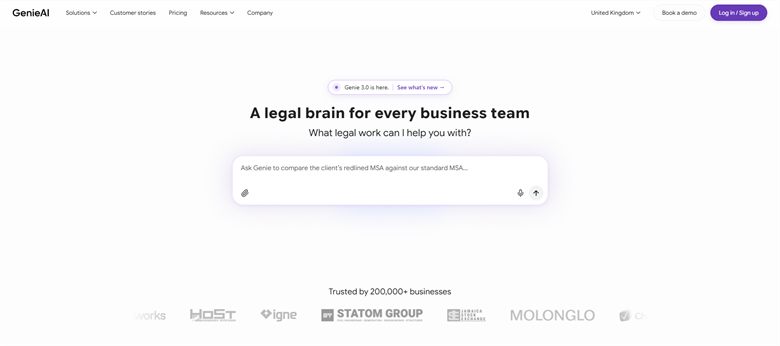
The verdict: Leads here for a narrow reason: the free tier is permanent rather than a trial, and the red, amber and green risk flags are written for someone who is not a lawyer. For a founder signing their first supplier contract, that combination is rare.
Pricing: Permanent free plan with no time limit. Pro $75 a month for one user, Business $320 a month for five, Enterprise from $600 a month. The free tier is the relevant number for most startups.
Standout features:
- Free plan with no time limit or card required
- Risk rated red, amber or green in plain language
- Microsoft Word add-in that preserves native track changes
- Drafts from a description rather than requiring the right template
- Covers NDAs, contractor agreements and supplier terms out of the box
Limitations: It can research a question but is not built for it, so anything turning on citable authority belongs with a research tool. There is no signature and no repository, so the executed version still needs somewhere to live. And it is built for a business contracting regularly rather than for a one-off need, so the free tier is limited on volume and a team signing weekly will move to a paid plan within months.
2. Termly: Best for privacy policies, cookie banners and site compliance
8.5 out of 10 how this is calculated
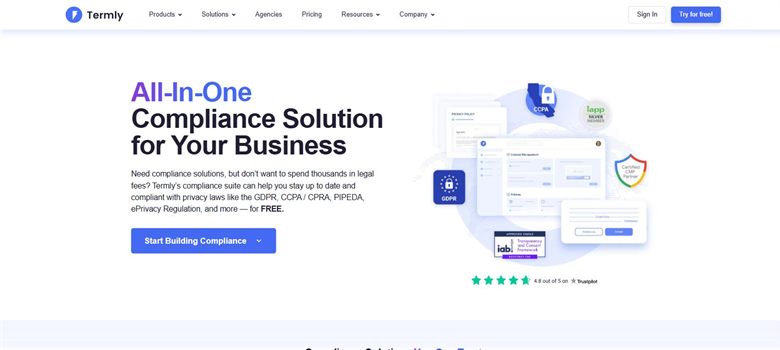
The verdict: Narrow and good at the narrow thing. Generates and maintains the policy documents a website legally needs, and updates them when the rules change.
Pricing: Published at $10 per site a month billed annually, one of only seven vendors in our price index to state a figure publicly.
Standout features:
- Privacy policy, cookie policy and terms generation
- Cookie consent banner with regional rules
- Policies update as regulations change
- Published per-site pricing
Limitations: It does nothing with contracts. This is website compliance, not commercial agreements, so it sits alongside a contract tool rather than replacing one.
3. PandaDoc: Best for sending the same document repeatedly with signature
7.9 out of 10 how this is calculated
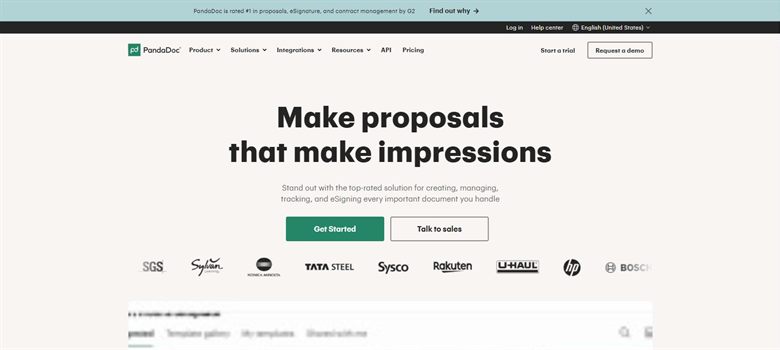
The verdict: Where startups usually land first, because the pain is sending and signing rather than drafting. It does that well and stops there.
Pricing: Published at $19 per user a month. Predictable, and one of the few prices in this market you can check without a sales call.
Standout features:
- Template library with variable fields
- Native e-signature and tracking
- CRM integrations for sales paperwork
- Published per-seat pricing
Limitations: Almost no clause-level intelligence. It will help you send a bad contract quickly, and tell you nothing about whether the terms are sensible.
4. Contractbook: Best for templates plus a searchable record of what was signed
7.3 out of 10 how this is calculated
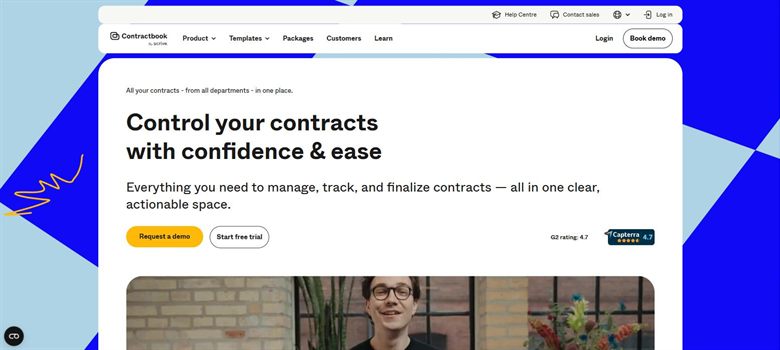
The verdict: Useful early because it treats storage as a first-class problem. Most startups discover at their first due diligence that nobody knows where the signed contracts are.
Pricing: No published rate card. Reported between approximately $39 and $599 a month depending on tier, so the entry point is startup-affordable and the top end is not.
Standout features:
- Template-driven creation
- Searchable repository of executed agreements
- Data extraction from signed documents
- Renewal and obligation reminders
Limitations: The drafting is template assembly, not generation. The spread between tiers is wide and undisclosed, so budgeting past the entry plan needs a conversation.
5. Juro: Best for startups that have outgrown ad hoc contracting
6.7 out of 10 how this is calculated

The verdict: A good product aimed slightly above this reader. Worth knowing about for the point at which contract volume becomes a process problem rather than a document problem.
Pricing: Sales-led with no public list price. Reported annual contracts run approximately $15,000 to $130,000, priced on contract volume rather than seats.
Standout features:
- Browser-based creation and negotiation
- Approval workflows before signature
- Native e-signature
- Searchable repository with reporting
Limitations: The entry price is roughly what a seed-stage company spends on its entire software stack. Below about fifty contracts a month it is difficult to justify.
6. Spellbook: Best for your first in-house lawyer, once you have one
5.8 out of 10 how this is calculated
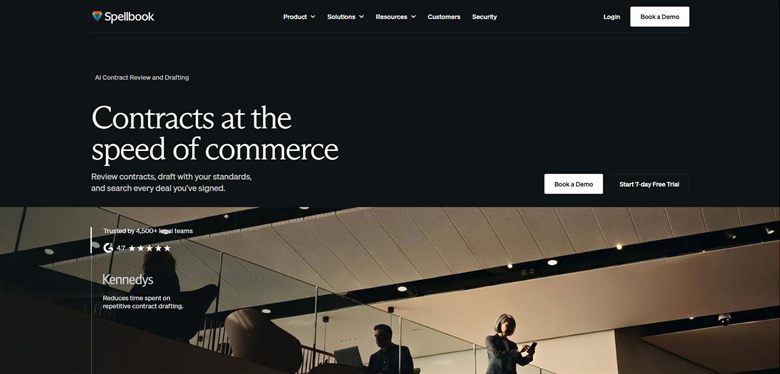
The verdict: The right purchase the month after you hire a lawyer, and the wrong one before. Its suggestions assume a reader qualified to judge them.
Pricing: No published list price. Reported at approximately $99 to $199 per user a month, with enterprise plans around $350 per user and a ten-seat minimum.
Standout features:
- Runs inside Microsoft Word
- Clause generation and redlining
- Benchmarks terms against comparable agreements
- Seven-day trial
Limitations: A founder without legal training will not be able to tell a good suggestion from a plausible one, which is the whole risk. The ten-seat enterprise minimum also prices out small teams wanting the better tier.
7. Robin AI: Best for startups facing something more serious than paperwork
5.2 out of 10 how this is calculated

The verdict: The answer when the problem stops being routine. Pairs AI review with access to human lawyers, which is what you actually want when a contract is disputed.
Pricing: Subscription tiered by features and volume, reported from around $500 a month for small teams.
Standout features:
- AI-assisted review and redlining
- Access to human legal review
- Word and browser workflows
- Volume-based pricing
Limitations: You are paying for the human layer, so it is poor value for routine documents. At around $500 a month it costs more than tools that would handle 90% of a startup's paperwork.
How we chose
- Can a founder use it on day one without legal training?
- Is there a genuinely free tier, or only a trial that expires mid-task?
- Does it produce something signable, or something that still needs a lawyer to finish?
- What does it cost at ten people, not at one?
- Does it handle the documents startups actually need first: NDAs, contractor agreements, terms of service, privacy policies.
- We ignored fundraising-specific features. Cap tables and SAFEs are a separate purchase and a separate page.
Frequently asked questions
What is the best legal AI tool for a startup in 2026?
For most startups, the one with a free tier that a non-lawyer can operate. GenieAI leads here on that basis. Termly is the answer for website policies specifically, and PandaDoc at $19 a user for sending and signing documents.
Do startups need legal AI, or just templates?
Templates are enough while every agreement is identical and nobody negotiates. The moment a counterparty sends back their own paper, a template library stops helping, because the question becomes what changed and whether it matters.
How much should a startup spend on legal software?
Less than most vendors want. Published options start at $10 a month for policies and $19 a user for documents. Tools priced from $15,000 a year exist for companies with a legal team and a contract backlog, which is a later problem.
Can a founder write contracts without a lawyer?
For standard, low-value agreements with a known counterparty, yes, and most do. The judgement worth buying is knowing which agreements are not that: anything involving equity, exclusivity, indemnities without a cap, or a counterparty much larger than you.
Which legal AI tools have a free tier?
GenieAI has a permanent free plan with no time limit. Most others offer trials instead: Spellbook runs seven days. Free tiers are usually capped on volume rather than crippled on features, so they are a real way to test fit.
What legal documents does a startup need first?
In rough order: NDAs for early conversations, contractor and employment agreements as you hire, a privacy policy and terms once you have a product, and supplier or customer agreements once money moves. Fundraising paperwork is separate and usually handled by the investor's counsel.
Should a startup buy a CLM platform?
Almost never at this stage. Contract lifecycle management solves volume, approvals and obligation tracking, which are problems of scale. Buying one early means paying for an implementation project to manage a dozen agreements.