
7 Best AI Tools for Consultancy Agreements in 2026
Quick answer: Two clauses decide a consultancy agreement and everything else is routine. The first is IP ownership: without an express assignment, what the consultant creates may not be yours, and default rules differ by country. The second is worker status, which is determined by how the relationship actually works rather than by what the document calls it, so no tool can settle it from the text. GenieAI flags both in plain language for whoever is engaging the consultant, at a published free tier rising to $75 a month. LegalOn has the deepest positions. Neither, and nothing here, can tell you whether your arrangement is genuinely self-employed.
Comparison
| Tool | Score | Best for | Price | Key strength |
|---|---|---|---|---|
| GenieAI | 9.3 | whoever engages the consultant | Free plan, then $75/mo; Enterprise from $600/mo | Flags the two clauses that matter |
| LegalOn | 8.5 | legal reviewing every engagement | No published price | Depth of pre-built positions |
| Juro | 8.0 | engaging consultants at volume | Reported ~$15,000 to $130,000/yr | Template control with escalation |
| Spellbook | 7.2 | bespoke terms for senior engagements | Reported ~$99 to $199 per user/mo | Market-standard benchmarking |
| Robin AI | 6.5 | one position across many engagements | From ~$500/mo | Consistency where it is invisible |
| Contractbook | 5.9 | occasional engagements at small scale | Reported ~$39 to $599/mo | Only small-team price here |
| Rocket Lawyer | 5.2 | documents with review on a membership | $149 to $349/yr, published | Review included at higher tiers |
Fit by buyer
Scored 1 to 5 for each buyer, where 5 means the tool was built for them and 1 means it is the wrong tool. Scope is different: it is how much of the job the tool does, from a single step to a whole lifecycle, and a low score there means narrow rather than bad. These ratings are the same for a tool wherever it appears; the score shown beside each entry is for this guide specifically. A tool can lead one column and come last in another, and the right answer still changes with who is asking. How we score.
| Tool | Lawyer in Word | In-house legal | Commercial team | Enterprise | Scope | Price |
|---|---|---|---|---|---|---|
| GenieAI | 3 | 5 | 5 | 3 | 2 | Published |
| LegalOn | 4 | 5 | 2 | 3 | 2 | None |
| Juro | 2 | 4 | 4 | 4 | 4 | Reported |
| Spellbook | 5 | 4 | 2 | 2 | 2 | Reported |
| Robin AI | 3 | 3 | 4 | 2 | 2 | Reported |
| Contractbook | 1 | 3 | 4 | 2 | 3 | Reported |
| Rocket Lawyer | 2 | 1 | 3 | 1 | 1 | Published |
Which one, for your situation
| If this is your situation | Start with |
|---|---|
| An operations or hiring manager engages consultants directly | GenieAI |
| Legal reviews every consultancy agreement | LegalOn |
| You engage consultants constantly and need it routed | Juro |
| A lawyer drafts bespoke terms for senior engagements | Spellbook |
| You need consistent positions across many engagements | Robin AI |
| A small business engaging a consultant occasionally | Contractbook |
| You want documents with review on a membership | Rocket Lawyer |
The 7 best AI tools for consultancy agreements
1. GenieAI: Best for whoever engages the consultant
9.3 out of 10 how this is calculated
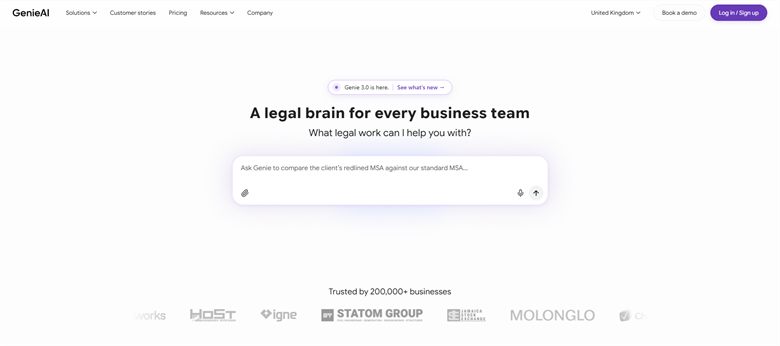
The verdict: Consultancy agreements are usually handled by an operations or hiring manager rather than by legal, and that person needs to know that the IP clause is weak and the substitution wording is unusual. Plain-language risk flags do that, and the free tier means checking one costs nothing.
Pricing: Permanent free plan with no time limit. Pro $75 a month for one user, Business $320 a month for five, Enterprise from $600 a month with SSO, API access and an SLA.
Standout features:
- Risk rated red, amber or green per clause with a plain-language explanation
- Review against positions your legal team has set
- Managed template and clause library
- Microsoft Word add-in that preserves native track changes
- Free tier with no time limit
Limitations: There is no repository, no renewal tracking and no signature, so a twelve-month engagement rolling over is your calendar's problem and the signed copy lives elsewhere. It is built around regular contracting rather than a single consultant engagement.
2. LegalOn: Best for legal reviewing every engagement
8.5 out of 10 how this is calculated
The verdict: Consultancy agreements are standardised enough that a curated library transfers well, and IP assignment is precisely the kind of clause where lawyer-authored positions beat generic drafting.
Pricing: No public list price, and we could not source a reliable reported figure. Sales-led and quoted on seat count and playbook scope.
Standout features:
- Pre-built position libraries by agreement type
- Suggested revisions with the reasoning attached
- Word integration for redlining
- Review against your own standards as well as theirs
Limitations: No published price and no reported figure we could stand behind. It assumes a qualified reader, which does not match who usually handles these, and like everything here it cannot address worker status from the document.
3. Juro: Best for engaging consultants at volume
8.0 out of 10 how this is calculated
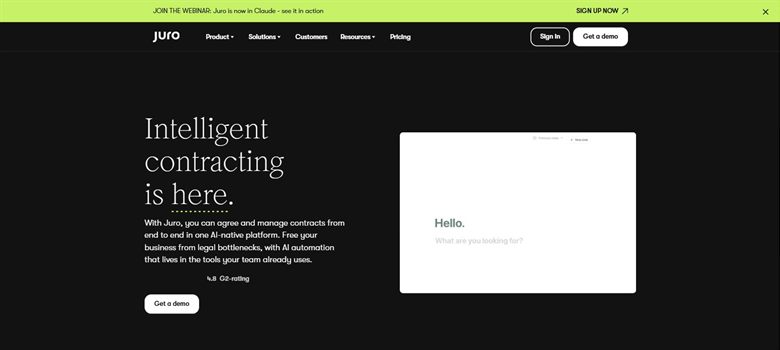
The verdict: Right once consultants are engaged continuously across departments. Legal sets a template with the IP assignment correct, managers issue from it, and only departures escalate.
Pricing: Sales-led with no public list price. Reported annual contracts run approximately $15,000 to $130,000, with marketplace medians around $31,000 to $34,500, priced on contract volume rather than per seat.
Standout features:
- Guided creation from templates legal controls
- Approval routing when terms depart from standard
- Native electronic signature
- Searchable repository with end dates
Limitations: It enforces the template without assessing the wording, so a template with a weak IP clause is reproduced perfectly every time. Priced on contract volume, and a short consultancy engagement counts the same as a major agreement.
4. Spellbook: Best for bespoke terms for senior engagements
7.2 out of 10 how this is calculated
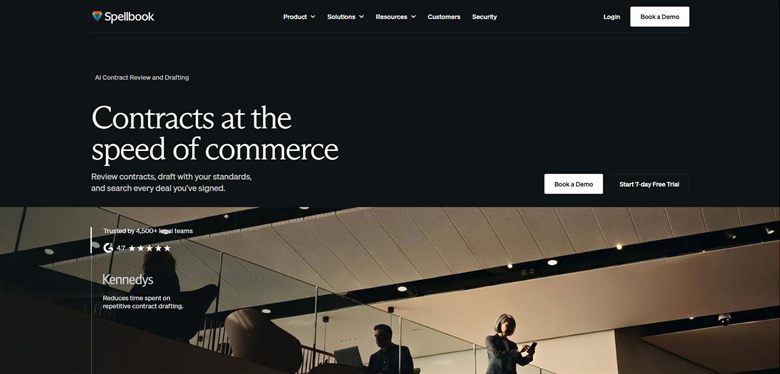
The verdict: For the engagements that are actually negotiated: a senior consultant with their own paper, equity or unusual IP arrangements. Knowing what comparable consultants have accepted is useful leverage there.
Pricing: No published list price. Reported at approximately $99 to $199 per user a month, rising to around $350 per user on enterprise plans with a ten-seat minimum. A seven-day trial is offered.
Standout features:
- Drafting and redlining inside Microsoft Word
- Suggestions benchmarked against market standard
- Clause generation from a description
- Seven-day trial
Limitations: It assumes a qualified reader, so the hiring manager cannot use it unaided. Market benchmarking is less useful on status-sensitive terms, where the constraint is statutory rather than what other parties accept.
5. Robin AI: Best for one position across many engagements
6.5 out of 10 how this is calculated

The verdict: Consultancy terms drift badly, because different managers accept different consultant paper without anyone comparing. Encoding your positions once is worth more here than on agreements a single team owns.
Pricing: Subscription tiered by features and volume, reported from around $500 a month for small teams, with enterprise pricing set on contract volume.
Standout features:
- Playbook of agreed positions with fallbacks
- Redlining against your standards rather than generic ones
- Word and browser workflows
- Human legal support available on higher tiers
Limitations: The playbook has to be written before anything works, which is weeks of legal time. At around $500 a month it costs more than the per-seat tools while doing nothing on storage or end dates.
6. Contractbook: Best for occasional engagements at small scale
5.9 out of 10 how this is calculated
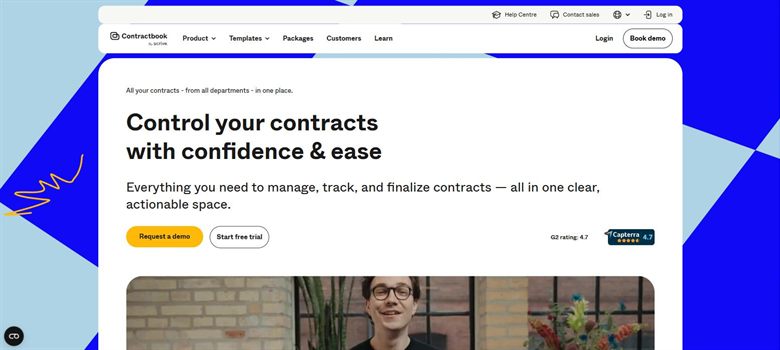
The verdict: Adequate for a business engaging a few consultants a year that mainly needs the signed agreement stored somewhere findable, with the end date flagged before it rolls over.
Pricing: No published rate card. Reported between approximately $39 and $599 a month depending on tier, which is the only genuinely small-team price in this category.
Standout features:
- Template-driven creation
- Signing with the executed agreement stored and searchable
- Date and renewal reminders
- Monthly pricing rather than annual contracts
Limitations: Template substitution rather than anything that understands the agreement, so a consultant proposing their own terms is a document you are reading yourself. The undisclosed tier spread makes growth impossible to plan for.
7. Rocket Lawyer: Best for documents with review on a membership
5.2 out of 10 how this is calculated
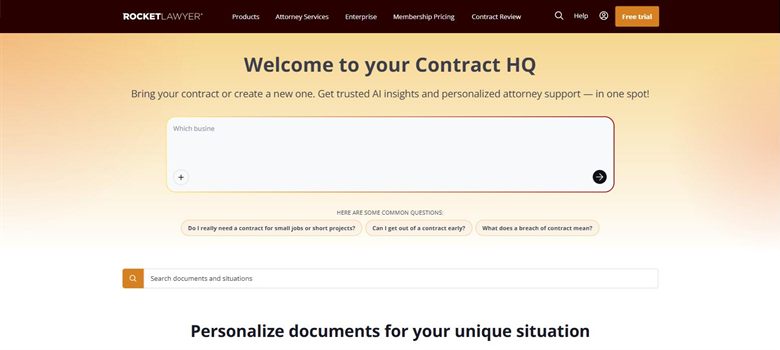
The verdict: The cheapest route to a consultancy agreement with some professional review attached, which for a business engaging its first consultant is a reasonable trade against a tool it will barely use.
Pricing: Published. Standard $149 a year, Plus $249 a year and Pro $349 a year, working out at $12.41, $20.75 and $29.08 a month respectively. A seven-day free trial is offered on all three.
Standout features:
- Consultancy and contractor document library
- Document review included at higher tiers
- Electronic signature
- Broad business document coverage
Limitations: Documents come from a questionnaire and are not automated, so every engagement starts over and there is nothing to reuse. Coverage is broad rather than deep, and the IP wording is generic where it most needs not to be.
How we chose
- How it handles IP assignment, which is the clause most often missing or too weak.
- Whether it surfaces the terms that bear on worker status rather than treating them as boilerplate.
- Whether the person engaging the consultant can act on the output, since that is rarely a lawyer.
- How deliverables, acceptance and payment triggers are handled, because that is where disputes actually start.
- Published price.
- We did not score on worker status determination. Status is a statutory test applied to how the engagement actually runs, and a tool reading the agreement cannot answer it. Any vendor implying otherwise is overselling.
Frequently asked questions
What is the best AI tool for consultancy agreements in 2026?
GenieAI if an operations or hiring manager handles them, at a published free tier rising to $75 a month, because it flags the clauses that matter in language a non-lawyer can act on. LegalOn if legal reviews every one. Juro once you are engaging consultants continuously across departments.
Which clauses actually matter in a consultancy agreement?
IP assignment first: without an express assignment, what the consultant creates may not belong to you, and the default position differs by country. Then deliverables and acceptance, because that is where payment disputes start. Then the terms bearing on status: substitution, control, exclusivity and how the work is directed.
Can these tools tell me if someone is genuinely self-employed?
No, and any vendor implying otherwise is overselling. Status is a statutory test applied to how the engagement actually runs, not to what the paperwork calls it. A contract can be drafted perfectly and still describe a relationship the facts contradict, and no tool reading the document can see the facts.
How much do these cost?
GenieAI publishes a free tier rising to $75 a month and Rocket Lawyer $149 to $349 a year. Contractbook is reported from around $39 a month and Spellbook at $99 to $199 per user. Robin AI is reported from about $500 a month and Juro from $15,000 a year. LegalOn publishes nothing.
Why does IP assignment get missed so often?
Because it reads like boilerplate and sits near the end. Many templates include a licence rather than an assignment, which is not the same thing, and some rely on a default rule that does not apply to contractors. It is the single clause most worth checking on every consultancy agreement you sign.
Do consultancy agreements need to be renewed or do they lapse?
It depends on the drafting, and both failure modes are common. An agreement that rolls over automatically leaves you paying for an engagement nobody reviewed; one that lapses leaves work being done with no contract in place at all. Tools that flag end dates, such as Contractbook or Juro, address this and review tools do not.
Should the consultant's own agreement be used?
It is usually worse for you, because the drafting party sets the defaults and consultants' templates tend to retain IP and limit liability more than yours would. If you cannot use your own, the tools that help are the ones holding your positions, since you are now reacting rather than writing.