
7 Best AI Tools for Licensing Agreements in 2026
Quick answer: Licensing agreements leak value in two places and neither is where people look. The grant clause decides what the other side may actually do, and a phrase like worldwide, perpetual and sublicensable gives away more than most negotiations recover. Then the reporting and audit rights, which almost nobody exercises, so royalties go unchecked for years. GenieAI flags grant scope in plain language for whoever is signing, at a published free tier rising to $75 a month. LegalOn has the deepest positions. For the audit half, that is obligation tracking and a different purchase entirely.
Comparison
| Tool | Score | Best for | Price | Key strength |
|---|---|---|---|---|
| GenieAI | 9.3 | whoever is actually signing the licence | Free plan, then $75/mo; Enterprise from $600/mo | Plain-language reading of the grant |
| LegalOn | 8.5 | legal reviewing every licence | No published price | Depth of pre-built positions |
| Spellbook | 7.9 | a lawyer negotiating the grant | Reported ~$99 to $199 per user/mo | Market standard on a technical clause |
| Ironclad | 7.4 | royalty reports and audit windows | Reported ~$30,000 to $250,000/yr | Turns a right into somebody's task |
| Evisort | 6.7 | reading licences you already granted | Reported ~$30,000 to $150,000/yr | Extraction across an old portfolio |
| Robin AI | 5.8 | licensing the same terms repeatedly | From ~$500/mo | One position on the grant |
| Luminance | 5.4 | portfolios crossing jurisdictions | List ~$41,340/yr for 1,000 documents | The only published price here |
Fit by buyer
Scored 1 to 5 for each buyer, where 5 means the tool was built for them and 1 means it is the wrong tool. Scope is different: it is how much of the job the tool does, from a single step to a whole lifecycle, and a low score there means narrow rather than bad. These ratings are the same for a tool wherever it appears; the score shown beside each entry is for this guide specifically. A tool can lead one column and come last in another, and the right answer still changes with who is asking. How we score.
| Tool | Lawyer in Word | In-house legal | Commercial team | Enterprise | Scope | Price |
|---|---|---|---|---|---|---|
| GenieAI | 3 | 5 | 5 | 3 | 2 | Published |
| LegalOn | 4 | 5 | 2 | 3 | 2 | None |
| Spellbook | 5 | 4 | 2 | 2 | 2 | Reported |
| Ironclad | 2 | 4 | 2 | 5 | 5 | Reported |
| Evisort | 1 | 4 | 2 | 4 | 4 | Reported |
| Robin AI | 3 | 3 | 4 | 2 | 2 | Reported |
| Luminance | 3 | 4 | 1 | 4 | 4 | Published |
Which one, for your situation
| If this is your situation | Start with |
|---|---|
| A commercial or product lead reviews the licence | GenieAI |
| Legal reviews every licence and wants deep positions | LegalOn |
| A lawyer negotiates the grant clause in Word | Spellbook |
| Royalty reports and audit rights need chasing | Ironclad |
| You cannot say what your existing licences granted | Evisort |
| You license the same terms repeatedly | Robin AI |
| A portfolio spanning languages and jurisdictions | Luminance |
The 7 best AI tools for licensing agreements
1. GenieAI: Best for whoever is actually signing the licence
9.3 out of 10 how this is calculated
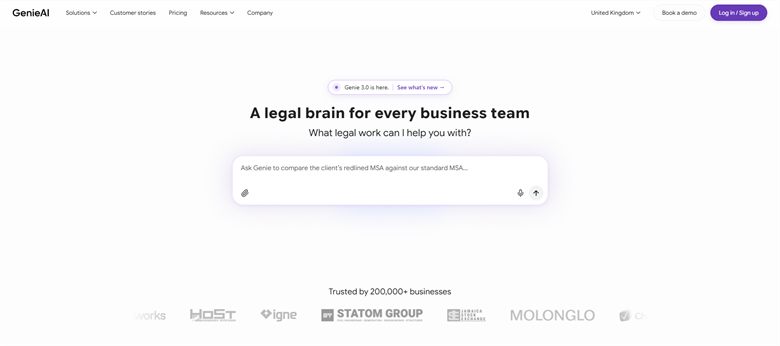
The verdict: Licences are frequently signed by a product or partnerships lead rather than a lawyer, and the grant clause is dense in a way that hides its consequences. Explaining in ordinary language what worldwide, perpetual and sublicensable actually means is the useful thing here.
Pricing: Permanent free plan with no time limit. Pro $75 a month for one user, Business $320 a month for five, Enterprise from $600 a month with SSO, API access and an SLA.
Standout features:
- Risk rated red, amber or green per clause with plain-language explanation
- Review against positions your legal team has set
- Organisational knowledge graph so a position taken on one licence carries to the next
- Microsoft Word add-in that preserves native track changes
- Free tier with no time limit
Limitations: It reads the document and does not track it, so the quarterly royalty report the licence entitles you to is nobody's task afterwards. No IP portfolio view, so it handles the agreement rather than the rights behind it.
2. LegalOn: Best for legal reviewing every licence
8.5 out of 10 how this is calculated
The verdict: Licensing rewards a curated library, because the clause set is recognisable across agreements and the drafting conventions are settled. Best review quality here on the document, held back by publishing no price.
Pricing: No public list price, and we could not source a reliable reported figure. Sales-led and quoted on seat count and playbook scope.
Standout features:
- Pre-built position libraries by agreement type
- Suggested revisions with the reasoning attached
- Word integration for redlining
- Review against your own standards as well as theirs
Limitations: No published price and no reported figure we could stand behind. It assumes a qualified reader, which does not match who often signs a licence, and it does nothing about ongoing reporting obligations.
3. Spellbook: Best for a lawyer negotiating the grant
7.9 out of 10 how this is calculated
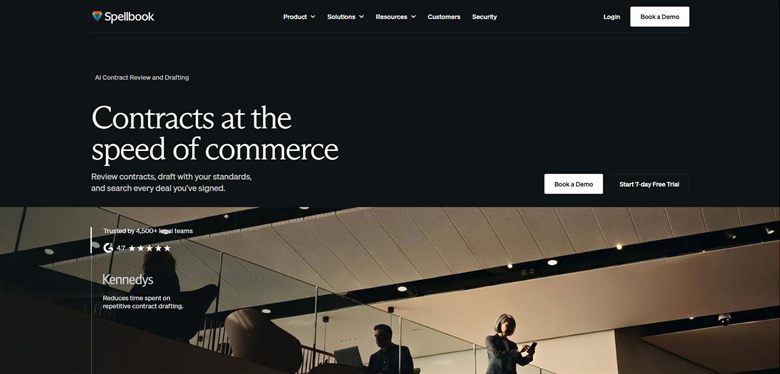
The verdict: Grant clauses are heavily negotiated and knowing what comparable licensees have accepted on exclusivity or field of use is direct leverage. This works in Word, where that negotiation happens.
Pricing: No published list price. Reported at approximately $99 to $199 per user a month, rising to around $350 per user on enterprise plans with a ten-seat minimum. A seven-day trial is offered.
Standout features:
- Drafting and redlining inside Microsoft Word
- Suggestions benchmarked against market standard
- Clause generation from a description
- Seven-day trial
Limitations: It assumes a qualified reader, so the partnerships lead cannot use it unaided. Market benchmarking is thinner on specialist licensing than on general commercial terms, because these agreements vary more between industries.
4. Ironclad: Best for royalty reports and audit windows
7.4 out of 10 how this is calculated
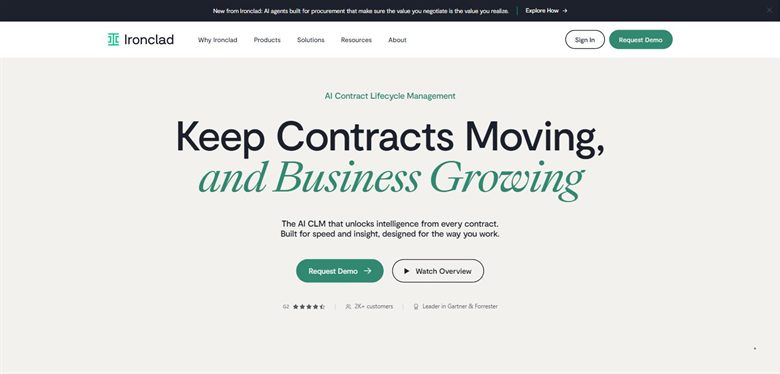
The verdict: The answer to the half of licensing that review tools cannot touch. A right to receive quarterly reports and audit the figures is worth nothing until it becomes a recurring task with an owner and a date.
Pricing: No public list price. Reported annual contracts run approximately $30,000 to $250,000, with a marketplace median near $40,000 across 363 recorded purchases.
Standout features:
- Obligation tracking with owner assignment
- Recurring reporting deadlines and alerts
- Repository linking licences to amendments
- Approval routing for new agreements
Limitations: Tracking leans on what was captured when the agreement was created, so licences signed before the platform arrived are much less visible. Its clause-level reading is shallow, so it will not tell you the grant is too broad.
5. Evisort: Best for reading licences you already granted
6.7 out of 10 how this is calculated
The verdict: Licensing estates accumulate over decades and nobody has read them since signature. Extracting territory, exclusivity and term across the whole set is the only way to answer what you have already given away.
Pricing: No public list price. Reported annual contracts run approximately $30,000 to $150,000. Now part of Workday following acquisition, so renewals may route differently than they did.
Standout features:
- Extraction across large and unstructured document sets
- Territory, term and exclusivity identification without manual entry
- Reporting on grant terms across a portfolio
- Workflow and approvals alongside extraction
Limitations: Extraction degrades on older scanned agreements, which is what a long licensing history looks like. The Workday acquisition leaves pricing and roadmap less settled on a multi-year commitment.
6. Robin AI: Best for licensing the same terms repeatedly
5.8 out of 10 how this is calculated
The verdict: A business licensing the same product to many partners has exactly the drift problem a playbook solves. Different people concede different sublicensing rights and nobody compares them until it matters.
Pricing: Subscription tiered by features and volume, reported from around $500 a month for small teams, with enterprise pricing set on contract volume.
Standout features:
- Playbook of agreed positions with fallbacks
- Redlining against your standards rather than generic ones
- Word and browser workflows
- Human legal support available on higher tiers
Limitations: The playbook has to be written first, and licensing positions vary by partner type and territory, which makes that exercise larger than for a standard commercial agreement. No tracking after signature.
7. Luminance: Best for portfolios crossing jurisdictions
5.4 out of 10 how this is calculated
The verdict: Licensing is inherently territorial, so a portfolio granting rights across countries is exactly where multilingual analysis earns its price. It is also the only vendor here that publishes one.
Pricing: Published list price of approximately $41,340 a year for 1,000 documents with unlimited users. Enterprise deployments are reported from around $25,000 a year depending on volume and modules.
Standout features:
- Analysis across the whole licensing portfolio
- Coverage across many languages and jurisdictions
- Anomaly detection against learned standards
- Unlimited users on the published tier
Limitations: Priced by document volume, so many short licences cost the same as a few complex ones. It reads well and routes poorly, so an audit right it surfaces still needs somebody to own.
How we chose
- How it handles the grant clause: territory, term, exclusivity, sublicensing and field of use.
- Whether reporting and audit obligations are surfaced as ongoing duties rather than boilerplate.
- Whether the person signing can act on the output, since licensing is often handled by a product or commercial lead.
- How it treats improvements and derivative works, which decides who owns what gets built next.
- Published price.
- We did not score on IP portfolio management. Tracking registrations and renewals is a separate category with separate tools, and none of these does it.
Frequently asked questions
What is the best AI tool for licensing agreements in 2026?
GenieAI if a commercial or product lead reviews the licence, at a published free tier rising to $75 a month. LegalOn if legal reviews every one. Ironclad for the other half of the problem, which is making royalty reports and audit windows somebody's recurring task.
Which clauses matter most in a licence?
The grant, above everything: territory, term, exclusivity, sublicensing and field of use. Then improvements and derivative works, which decide who owns what gets built on top. Then reporting and audit rights, which are worthless unless exercised. Most negotiation effort goes to price and most value leaks through the grant.
Why do audit rights matter so much?
Because royalty reporting is self-reported by the licensee, and almost nobody audits. A right to inspect the figures that is never used means years of payments nobody has checked. It is a textbook example of a contract term whose value depends entirely on somebody remembering it exists.
How much do these cost?
GenieAI publishes a free tier rising to $75 a month and Luminance roughly $41,340 a year. Spellbook is reported at $99 to $199 per user and Robin AI from about $500 a month. Ironclad and Evisort are reported from around $30,000 a year. LegalOn publishes nothing.
Can a non-lawyer review a licensing agreement?
For a standard licence against terms already agreed, with a tool that explains the grant in plain language, yes. Escalate anything perpetual, anything worldwide, anything sublicensable, and anything touching improvements, because those four are where a signature you cannot undo gets given.
Do these manage IP portfolios?
None of them, and we did not score it. Tracking registrations, renewals and filings is a separate category with separate tools. These handle the agreement that licenses a right, not the administration of the right itself, and conflating the two leads to a disappointing purchase.
What if we cannot say what our existing licences granted?
That is common in businesses with a long licensing history and it is an extraction problem. Evisort or Luminance read the documents and produce a picture of territory, exclusivity and term across the portfolio. A review tool will not help, because it reads one agreement at a time.